Check the surface before treating the smell
Does the smell remain after washing, or have you also noticed a split, an opening between glued pieces or grooves that retain food? These lead to different decisions. Inspect both faces and the edges before applying another treatment.
USDA’s cutting-board guidance says boards should be discarded when excessive wear or hard-to-clean grooves develop. For a split or open joint whose condition you cannot assess, our recommendation is to stop food preparation on that board and ask the maker about replacement or assessment. This guide does not prescribe sanding or gluing repairs.
Keep odor removal separate from food hygiene. USDA describes washing and sanitizing separately and suggests keeping a board for raw meat, poultry and seafood separate from one for produce and bread. A less noticeable smell is not a reason to skip those precautions.
Wash, rinse and give the board room to dry
Use the board’s care instructions to choose the washing method. For example, JK Adams specifies warm, soapy handwashing and towel drying; it prohibits soaking, dishwasher cleaning and microwave use for its wooden products. Do not choose one of those methods simply because an ordinary wash left an odor.
Dishwashing liquid supports this washing step, not a separate deodorizing promise. Use a suitable product you already own; you do not need a specialist care kit to begin.
- Wash and rinse. Remove food residue, wash as directed and rinse away the soap. Include the edges and any juice groove when inspecting your work.
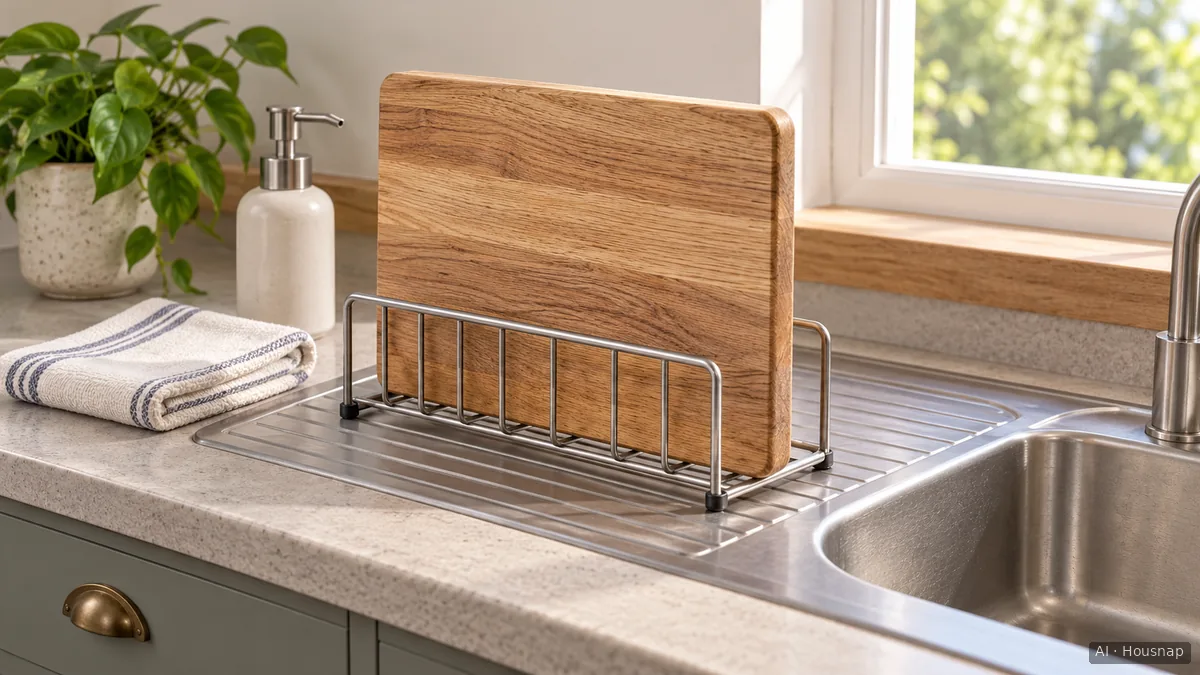
- Dry as directed. Tramontina Singapore advises washing both sides, drying immediately with a clean cloth and standing the board upright in an airy spot. Follow your own board’s specified position and drying instructions.
- Reassess once dry. Check whether the odor remains before adding another treatment. Keep both faces exposed while the board air-dries rather than immediately stacking it away.
Those washing and drying steps appear in Tramontina Singapore’s wooden-board care article. JK Adams explains that wood expands and contracts with moisture and humidity, which is why the drying and washing instructions deserve attention alongside the smell.
Use an odor treatment only when it is permitted
Tramontina Singapore describes sprinkling coarse salt on the board and scrubbing it with half a lemon as an odor-care option. Its lemon-and-salt instructions do not specify a waiting time or how to remove the mixture afterward. Treat this as an option to check with your board’s maker, not a complete procedure or permission for every wooden surface.
If your board’s instructions permit that method, follow their application and removal directions. If the maker specifies something else, use that method instead. When the instructions are missing or unclear, ask before experimenting with additional treatments.
Judge the outcome as an odor result only. The cited lemon-and-salt directions do not establish that this treatment sanitizes the board, repairs damage or makes a difficult-to-clean surface suitable for continued use.
Decide whether to maintain, ask or replace
Once the board is clean and dry, separate maintenance from the unresolved smell. Tramontina Singapore specifies food-grade mineral oil or beeswax cream and describes oiling a clean, dry surface, while JK Adams directs owners to its wood conditioners, including when the surface feels dry. Follow the treatment specified for your board rather than borrowing another maker’s schedule.
A food-grade cutting-board mineral oil is a supporting purchase only if your board permits it and you lack a suitable supply. Do not use oil as your next attempt to remove lingering food residue or as a repair for an open joint.
- Sound surface and odor resolved: return to the board’s normal cleaning, drying and maintenance instructions.
- Odor persists after permitted care: pause food use and send the maker the board model, photos and the methods already tried. Our recommendation is to resolve the uncertainty before escalating treatment.
- Excessive wear or grooves that cannot be cleaned effectively: replace the board, following the USDA replacement criterion.
If replacement is necessary, compare wood and plastic cutting boards by the cleaning routine you can maintain. That is a separate buying decision; an odor alone does not establish which material you should buy.
Cómo se elaboró esta guía
AI wrote this guide for Housnap using USDA household cutting-board guidance and wooden-board care information published by Tramontina Singapore and JK Adams. The sequence for inspecting, reassessing and contacting the maker is an editorial recommendation; treatment compatibility still depends on the particular board’s instructions. No hands-on odor-removal or hygiene testing was performed.