Productos actuales para comparar
Estos productos vienen de los resultados de Housnap para este tema.


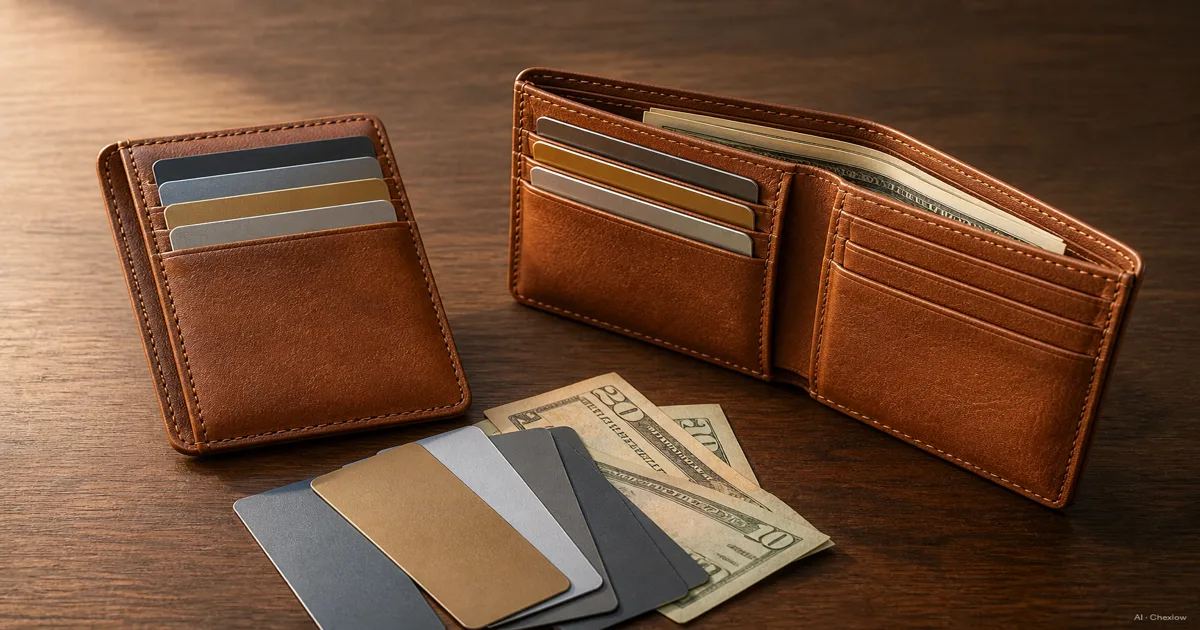
Start with what must come with you
Empty your wallet before browsing replacements. Separate everyday essentials, things needed for particular outings, and things you can leave at home. Keep necessary identification and backup payment in the first group even if you rarely use them.
Write down your required card count, the notes you carry and whether you need somewhere for change. Then choose a starting point:
- Card holder. Start here if your essentials fit within the maker’s stated capacity and you are happy with the proposed cash arrangement. Check whether frequently used cards have individual slots or share a pocket.
- Bifold. Start here if you want a dedicated bill compartment. A bifold folds once, but its internal layout still needs checking; the name alone does not tell you where every item will go.
- Coins as well as cards. Require a suitable coin compartment. Do not assume that choosing a bifold solves this automatically.
Leatherology’s format guide describes bifolds with bill compartments, card holders that accept folded notes, and coin-pocket options. There is no reason to rule out every card holder just because you carry emergency cash.
Before choosing a cash pocket, ask how your actual currency fits. For example, Bellroy’s Slim Sleeve description specifies one fold for US and Australian notes, but two for larger currencies. That is a model-specific detail worth checking, not a rule for all small wallets.
If you want an enclosing zip as well as coin storage, compare card holders and zip wallets. Check the internal coin pocket too; an outer zip does not settle how you will handle change while the wallet is open.
Compare them with the same contents
An empty-wallet photograph cannot answer your pocket-fit question. Where the retailer permits it, try both candidates with the cards and cash you intend to carry. Use the same contents for each.
- Close it. Check that the fold or fastening closes without forcing it and that notes stay clear of the closure.
- Carry it. Try the pocket or bag compartment you actually use. Sit down and reach for the wallet rather than judging it only in your hand.
- Pay with it. Take out your usual payment card, then a less-used card, and put both back. Check how much rearranging each operation needs.
Card access depends on the layout. Bellroy’s Slim Sleeve pull-tab, for example, retrieves less-used cards from a shared pocket. Decide whether you prefer that arrangement or separate visible slots.
For online purchases, ask whether the listed dimensions describe an empty or loaded wallet, and request an interior photograph if the pocket layout is unclear. Do not calculate finished thickness from card count alone: compare the complete loaded item whenever possible.
If the card holder only works after you leave out something essential, choose more usable capacity. If you still want to reduce what you carry, the minimalist card-case guide explores that next decision.
Choose leather for the finish you want to live with
Read the material description separately from the wallet’s capacity. Full grain means the original grain surface has not been mechanically removed to correct it, according to Leather Working Group’s terminology. It does not answer whether this particular wallet fits your needs.
“Genuine leather” identifies real leather rather than a synthetic alternative in Leather Naturally’s glossary. Do not treat those words alone as either a quality guarantee or a lowest-grade label. Ask about the surface finish as well: the same glossary describes aniline leather as less protected from soiling than semi-aniline or pigmented leather.
Decide whether visible change appeals to you. Il Bisonte describes patina developing on its vegetable-tanned leather through use over time. Ask for aged examples of the finish you are considering rather than expecting every leather wallet to change in the same way.
For two wallets that both pass the carry check, compare stitching, pocket edges, lining and the maker’s repair information. Ask about loose threads or separating edges before paying. A material name should not persuade you to overlook a construction concern.
Check the last details before paying
Keep one candidate from each format until you can answer these questions:
- Does everything essential have a place? Confirm the card allowance, your currency fit and any coin compartment. Avoid relying on an unspecified extra pocket to take the overflow.
- Can you use it without forcing it? If card removal is unusually difficult, ask the maker about that model before accepting it as normal break-in. Leatherology warns that overstuffing can distort card pockets; adding extra cards to stretch a tight slot is not a good fitting method.
- Are the care instructions suitable for you? Get advice for the exact finish. Il Bisonte’s care guidance ties treatment to dryness and leather compatibility, rather than giving every wallet the same routine.
- What happens if the fit is wrong? Read the retailer’s return conditions before loading, carrying or personalizing the wallet.
Choose the candidate that accommodates your essentials and passes your pocket and retrieval checks. If neither does, change the layout or size you are looking for before compromising on something you need every day.
Sources
Cómo se elaboró esta guía
Written by AI for Housnap, using manufacturer descriptions from Bellroy, Leatherology and Il Bisonte, plus terminology from Leather Working Group and Leather Naturally. This guide turns those references into a first-purchase comparison based on your contents, access needs and preferred finish. Product examples explain specific features; they are not hands-on test results.