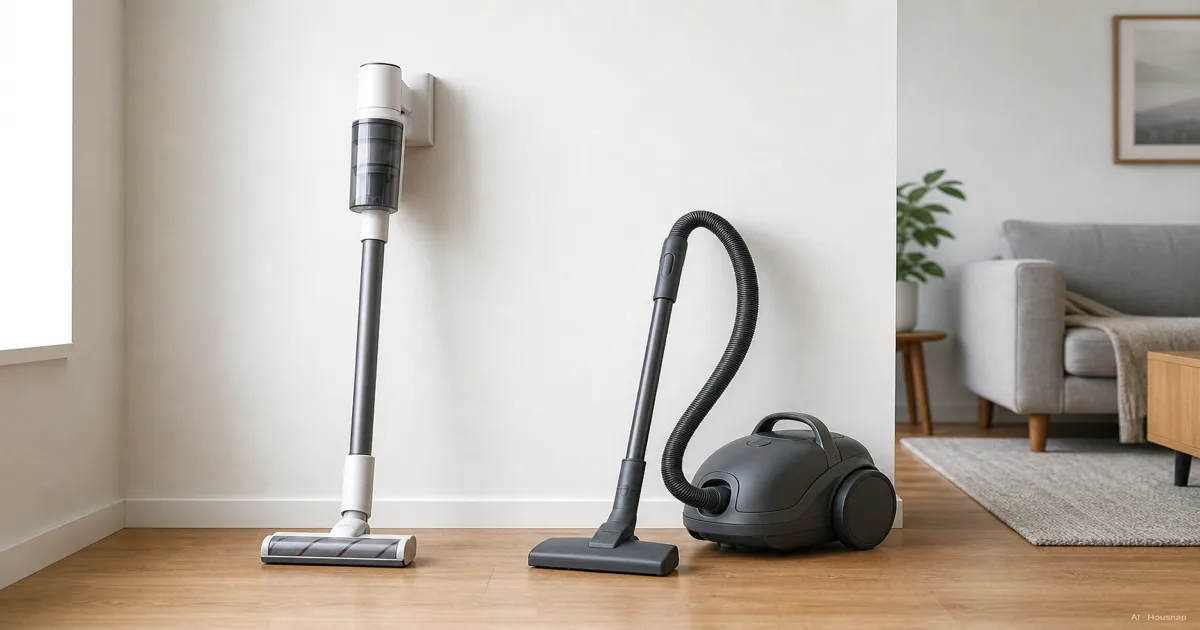
Disponibles ahora en una sola tienda
Por ahora, cada uno de estos productos está disponible en una sola tienda. La comparación de precios se abrirá con más tiendas.
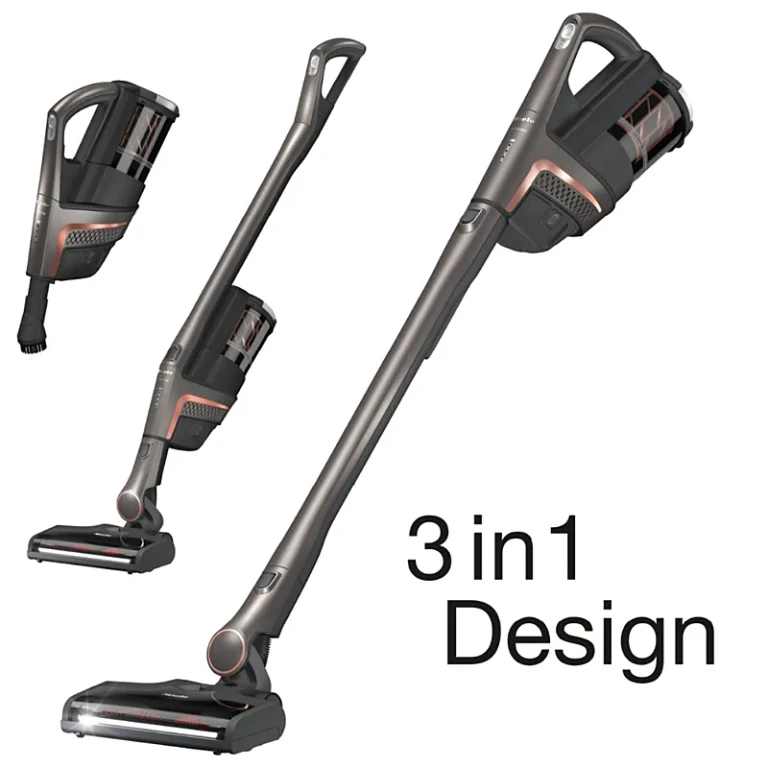
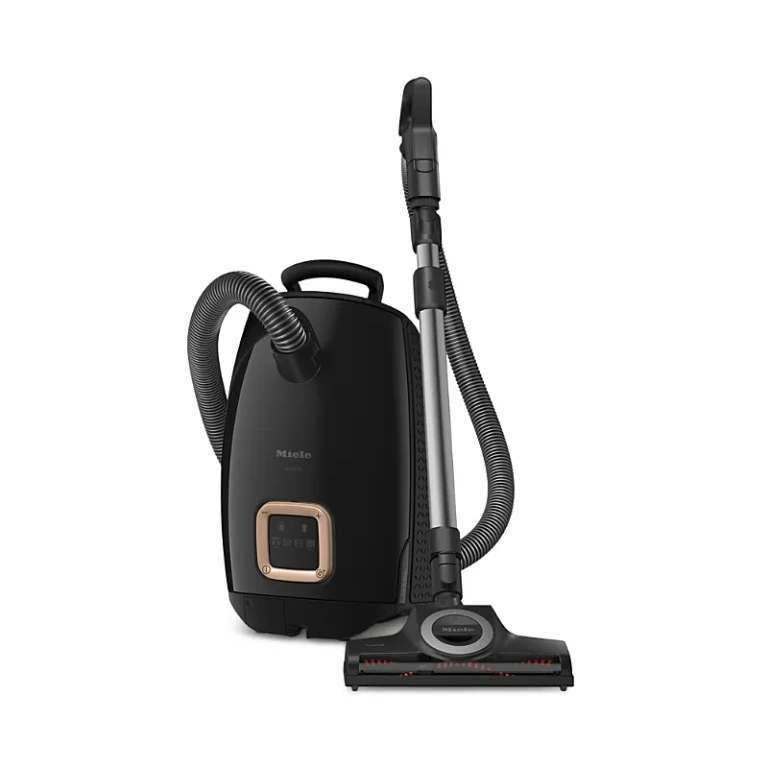
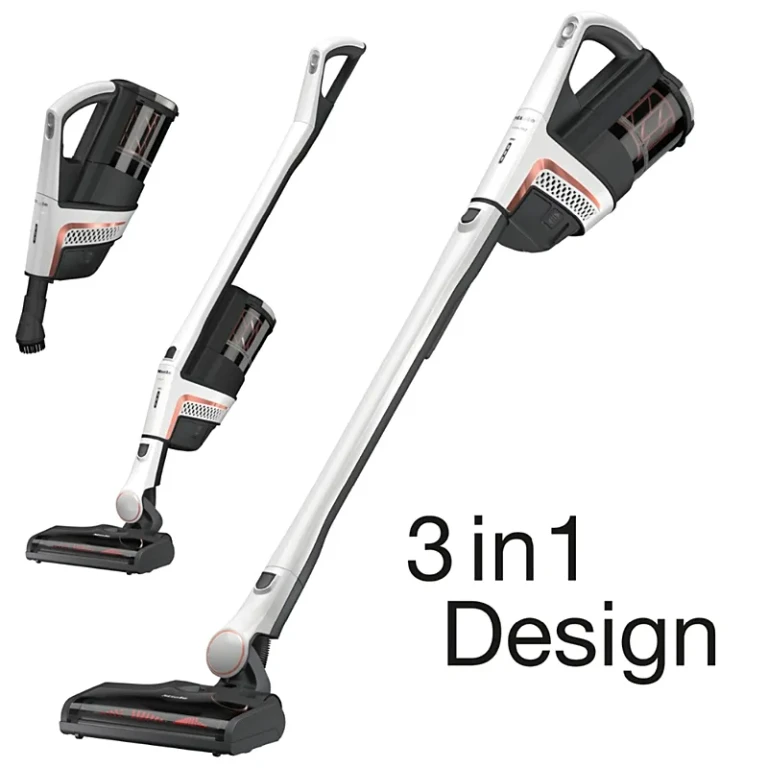
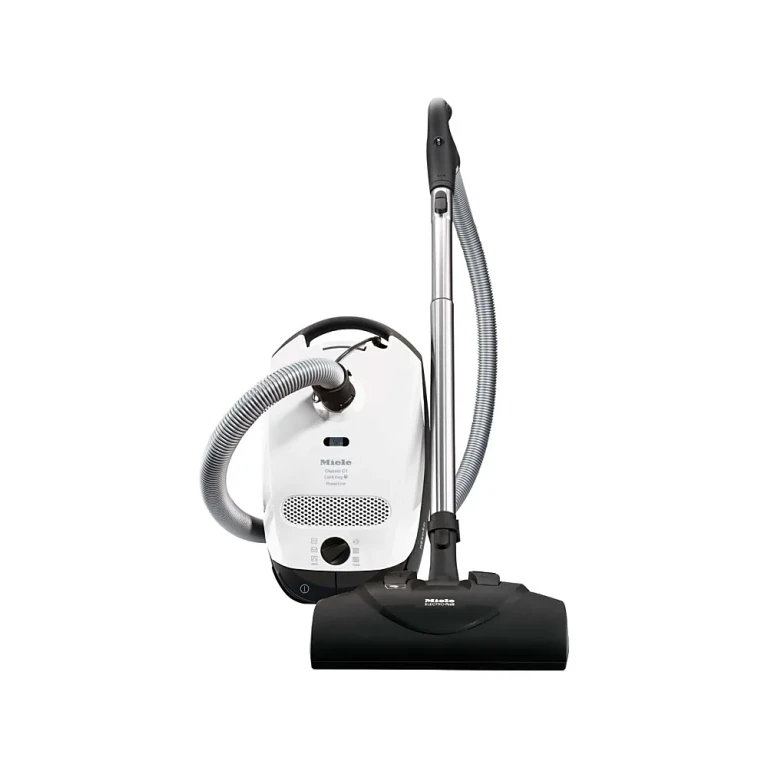
Choose around the cleaning you actually do
This comparison is between a cordless stick and a corded canister, the type with a separate body connected to a hose. Start by writing down everything your only vacuum must cover: floors, rugs, stairs and upholstery.
- Choose a stick provisionally if you want to pick it up for short cleans and can recharge between sessions. Keep it on the shortlist only if the supplied head suits your floors and its usable runtime covers the work.
- Choose a canister provisionally if stopping to recharge would interrupt your usual clean. Check that you can manage its body, hose and cord along your actual route through the house.
Treat these as starting points, not rules based on apartment size. A small home with an awkward rug can demand more checking than a larger home you clean a room at a time.
If the real problem is finding time to push either machine around, compare a cordless stick with a robot vacuum before settling on a manual vacuum.
Check the supplied floor head before the motor specification
Make two columns in your own notes: the surfaces you need to clean and the head supplied for each. A model name alone does not tell you whether the package covers both.
For hard floors, look for a head intended for that surface. For carpet, check the brush action and available adjustments. Miele's brush guide distinguishes soft-bristled parquet brushes, air-driven turbobrushes and electric carpet brushes. They perform different jobs; they are not interchangeable names for one accessory.
Check upgrade compatibility before buying. For example, SEBO's U.S. E2 has an air-driven head, while the E3 has an electric head; the E1 and E2 cannot accept electric power heads. Buying a cheaper canister and adding one later is therefore not always possible. See the SEBO E-series specifications.
Ask for a demonstration on a rug similar to yours, including whether the head pushes comfortably. For delicate flooring, bring its care instructions when checking suitability. If the required head is missing, compare the complete compatible package before deciding which vacuum costs less.
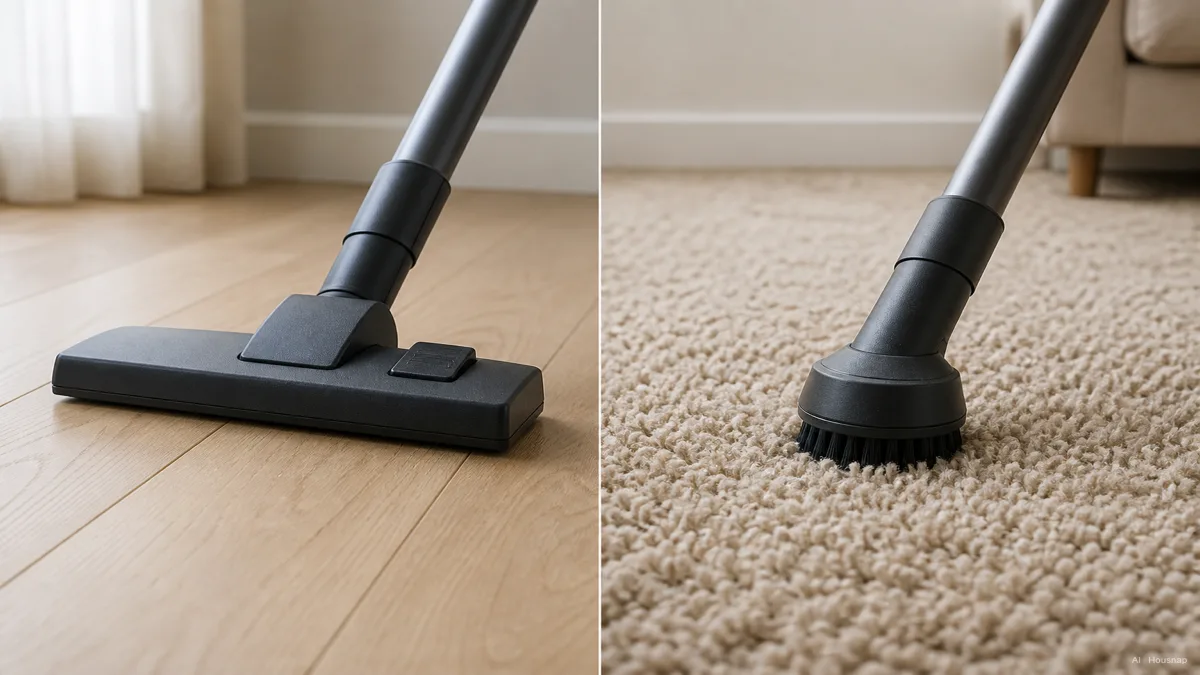
The illustration shows different head-and-surface combinations, not a cleaning-performance test or proof that one shape always wins.
Compare usable runtime with your longest clean
For a cordless candidate, ask which mode and attachment produced the advertised runtime. Dyson says the V8's runtime varies with mode, floor, dust and attachment; a full charge takes up to five hours. A maximum-runtime headline is not enough to plan a whole-home clean.
Also check whether the mode you expect to use is intended for sustained cleaning. Dyson describes Max and Boost as modes for short bursts of spot cleaning, rather than the default for every carpet.
- Stick check. Compare your longest intended session with runtime using the relevant floor head and mode. If that information is missing, ask for it before relying on one battery to finish the job.
- Canister check. Walk the route from available sockets. Compare operating radius, not just cord length: Miele lists them separately.
A cord removes the recharge constraint, not the need for maintenance. SEBO's E-series documentation includes warnings for restricted airflow caused by full bags, blockages or dirty filters. Corded does not mean unconditionally constant suction.
Try carrying, steering and storing the whole setup
Do not decide from the weight label alone. With a stick, handle the assembled machine with its battery and floor head. With a canister, try both steering the wand and lifting the body with the accessories you would carry.
- At floor level. Push, pull and turn the head, then check whether the assembled machine reaches under your lowest furniture.
- Above the floor. Try changing to the attachment you would use on stairs or upholstery. Check the grip, reach and effort involved rather than assuming either shape is automatically easier.
- At the storage spot. Measure space for the machine and accessories, including the canister hose or the stick's charging arrangement. Check installation requirements before choosing a wall mount.
Wall mounting is not universal: the Dyson V8 charger works with or without its dock. Verify the arrangement for the exact machine you are considering.
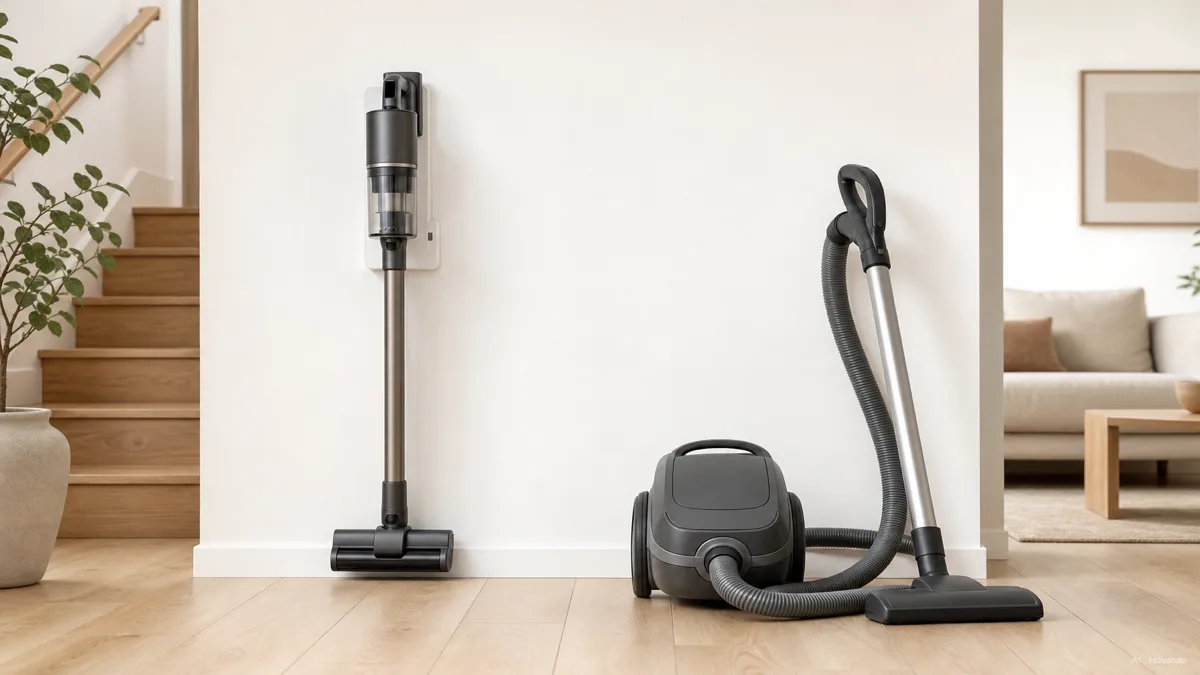
If lifting is the difficult part, prioritize the carrying trial. If pushing is harder, prioritize the floor-head trial. Those are different reasons to reject a candidate.
Compare emptying and replacement parts, then choose
Ask to see how the dust container opens or the bag comes out. Bagged versus bagless is a separate check from stick versus canister. Do not infer disposal convenience or filtration from the shape of the machine.
As a concrete example, SEBO says its bags can be sealed for disposal, but its bags are not reusable and its filters are not washable. Read the chosen model's instructions instead of assuming all filters can be rinsed.
For each finalist, price the complete floor-ready package, compatible bags or filters, any replacement battery and local servicing. Check part numbers and replacement procedures before buying. Dyson explicitly says battery life is not a fixed number of years, so avoid a cost comparison built on a promised replacement date.
- Buy the stick if the head and runtime cover your full task list, the handling trial feels manageable and charging fits your storage setup.
- Buy the canister if avoiding recharge stops matters more to you, and its supplied heads, socket reach and carrying requirements all work.
- Keep looking within the preferred type if a candidate fails one essential check. A larger accessory bundle does not compensate for the wrong floor head or a machine you struggle to use.
Cómo se elaboró esta guía
This AI-written guide for Housnap uses Dyson, Miele and SEBO product documentation and support guidance to explain the checks behind a first-vacuum purchase. The choice criteria are editorial judgments; named models illustrate specific features rather than a tested product ranking.