
Choose one everyday salt first
You do not need three boxes to start. Choose the job you do most often:
- Measuring and baking. Fine table salt is a useful first choice: its small, uniform grains dissolve readily. Jacobsen explains the grain difference.
- Seasoning by hand. Choose kosher salt if you want larger crystals to pinch and scatter. Try one brand before deciding whether you need another.
- One fine salt for cooking and baking. Fine sea salt is another option; Morton specifies both uses for its fine sea salt.
These are alternative starting points, not a compulsory shopping list. If your usual recipes name a particular salt, let that guide the first purchase.

Read the grain description, not just “sea salt”
“Sea” does not tell you whether the salt is fine, coarse, or flaky. King Arthur's guide describes that range. Look for the grain description before adding a bag to your basket.
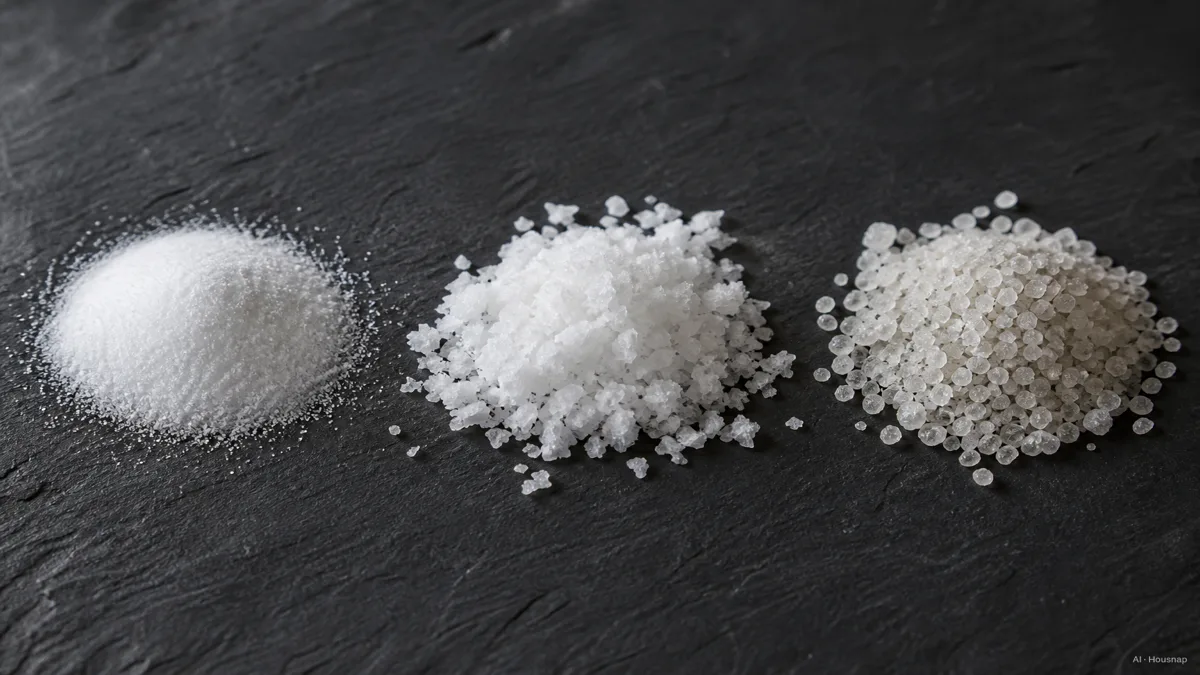
Kosher salt's name comes from its use in koshering meat; it is not a promise that every product has identical crystals or ingredients. Jacobsen explains the name. Check iodine and additives separately: Diamond Crystal directs buyers to the package. Do not infer either from the word “sea” or the salt's colour.
Keep the label if you transfer the salt to a jar. The brand and grain size are useful when a recipe needs a substitution.
Changing salts? Resolve the measurement first
Morton kosher and Diamond Crystal do not give the same result spoon for spoon. For ordinary salt substitutions, keep the recipe's gram quantity when one is supplied. King Arthur explains both points.
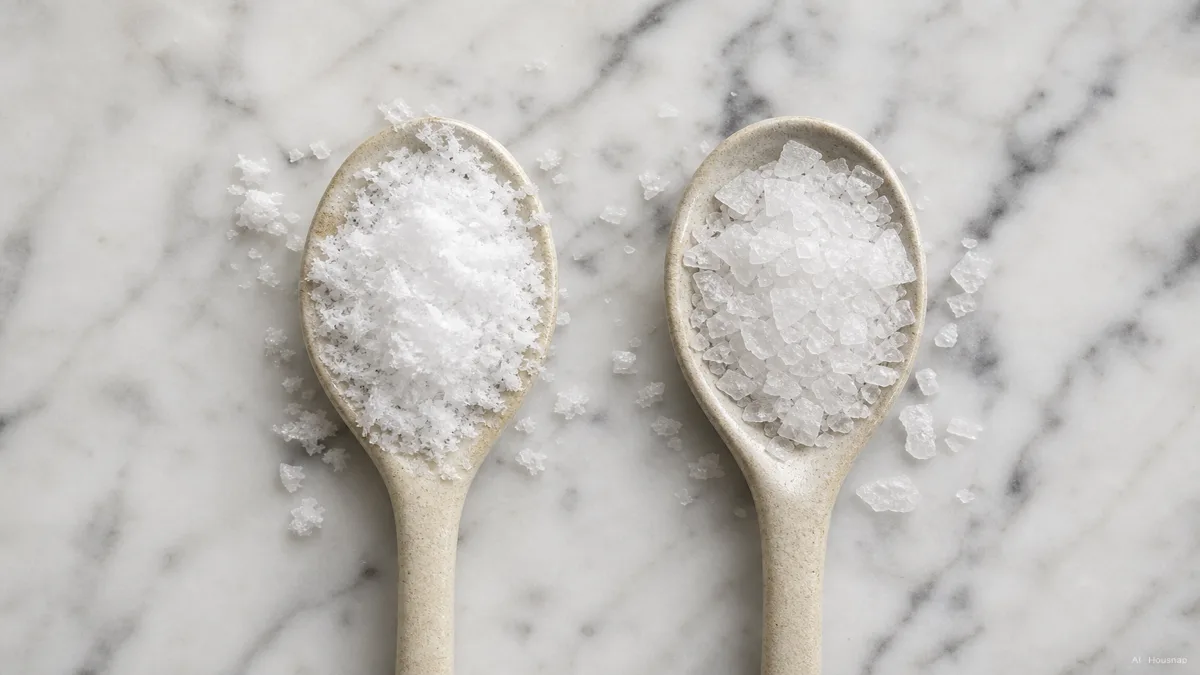
- Grams supplied. Weigh that amount of your replacement salt. Check that the scale can measure the small quantity involved.
- Only teaspoons supplied. Match the named salt, or use guidance for the exact products. Morton's chart gives 1 teaspoon of its table salt as 1¼ teaspoons of its kosher salt; it explicitly limits conversions to Morton products.
- Brand unspecified. Check the recipe notes or ask its author before treating a generic “kosher salt” quantity as an exact conversion.
A scale helps here, but its smallest displayed increment and minimum measurable amount are different specifications. For example, OXO's Precision Scale lists 0.1 g increments starting at 0.5 g. Compare those details before buying; the kitchen scale guide explains how to choose for small quantities and larger bowls.
Add finishing flakes only for a job you want
A finishing salt is an optional second purchase when you want noticeable crystals on the served food. Maldon describes its flakes as crunchy and suitable for both finishing and cooking. Using them in a pan is allowed; reserving them for the final sprinkle is a buying choice, not a rule.
Before adding a box, name a dish where you want that texture. If you mainly need salt to mix into everyday food, start with your chosen fine or kosher salt and leave the extra box for later.
Cómo se elaboró esta guía
AI wrote this guide for Housnap using salt-maker guidance, King Arthur Baking's substitution advice, and OXO's scale specifications. The scope is choosing a first cooking salt and handling substitutions; the one-salt starting point is an editorial recommendation, not a product test.