Choose which part you want to change
Before replacing your sleepwear, name the problem: trouser legs winding around your calves, a waistband you keep adjusting, or a nightdress hem gathering higher than you want. That tells you which alternative is worth trying.
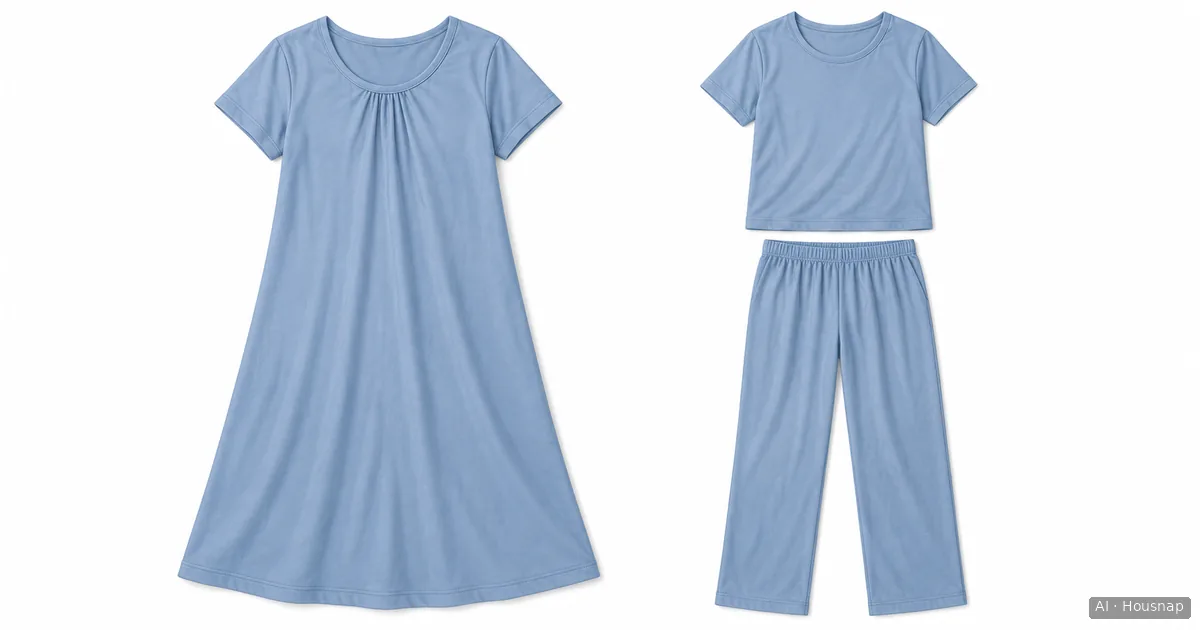
Aruelle’s nightwear guide distinguishes an open-bottomed, one-piece nightdress from pajamas with a separate top and trousers or shorts. Use that construction difference to make your shortlist:
- Try a nightdress when you want to remove separate trouser legs from the equation. If avoiding waist pressure is the point, look for a style without a fitted waist or waist elastic.
- Try pajamas when covering each leg separately matters more than having an open hem. Check the actual trouser length; a shorts set answers a different coverage preference.
- Keep comparing cuts if your current garment pulls across the chest or hips. Changing the garment category alone is not a fit assessment.
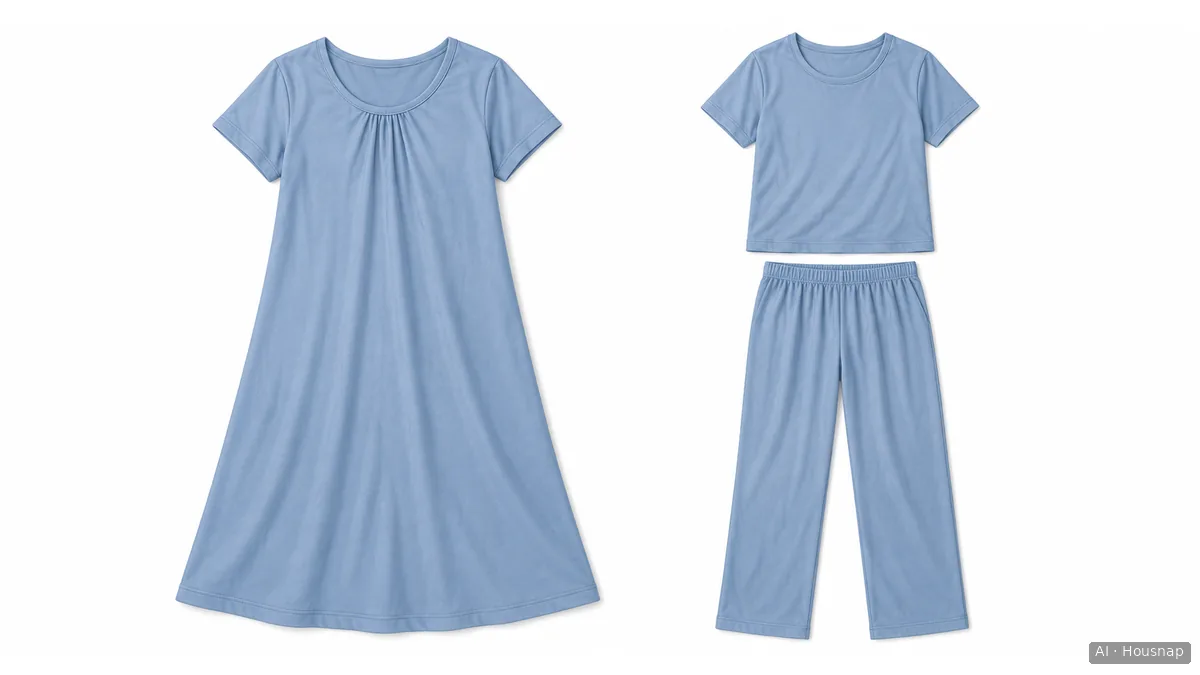
The illustration compares garment shapes. It does not show how either garment moves on your body or establish its fabric, opacity or resistance to twisting.
Check the position you actually sleep in
Where the seller’s fitting conditions allow, try the garment on a clean surface in your usual sleeping position. Bend your knees and turn onto your other side without first arranging every fold. This is a practical fitting check, not an overnight performance test.
With a nightdress, notice where the hem ends up and whether you want to pull it back down. With pajamas, notice whether the legs turn around your calves, the crotch feels restrictive or the waist needs repeated adjustment. Also check the overlap between the top and bottoms when you reach forward.
Aruelle advises a loose fit without excessive size, with no tightness across a nightdress’s chest or underarms, or at a pajama waistband. Use those checks to reject an uncomfortable candidate. Do not keep adding size simply because the first garment twists; compare another cut if the extra fabric does not solve your complaint.
Separate length, fit and see-through coverage
A long garment is not necessarily an opaque one. Sakkas describes its Helena nightgown as sheer rayon and lists an approximate shoulder-to-hem length of 50 inches, or 127 cm. Those are separate pieces of information: the length helps you assess the hem position, while “sheer” matters if you want coverage outside bed too.
For each candidate, check the stated length, any side openings and the fabric’s opacity. Ask about details the listing does not show rather than assuming that “nightgown” means full coverage.
Then identify what the size chart measures. Cyberjammies explicitly says its women’s chart gives body measurements, not garment dimensions. Its main guidance suggests sizing up for a more relaxed fit, but its Fable & Eve guidance recommends true to size. That exception is a good reason to follow the exact range’s instructions instead of applying a universal size-up rule.
If a shirt-style pajama top has confusing chest-width or sleeve figures, the guide to body versus shirt measurements explains how to compare like with like. Use the sleepwear seller’s own measuring points for the actual purchase.
Buy the shape that passes your checks
Keep the candidate only if it resolves the annoyance you identified and gives you the coverage you want when you move. Choose the nightdress if removing trouser legs helps and its hem position suits you; choose pajamas if separate leg coverage works better and their waist and crotch feel comfortable.
Before ordering, read the seller’s conditions for fitting and returns, then check whether the care routine suits you. For example, Sakkas specifies separate cold hand washing and line drying for Helena. Do not assume that every nightdress or pajama set belongs in your usual machine-wash load.
If neither candidate works, record the remaining problem rather than buying the less uncomfortable one. Once the shape is settled, a question about woven versus knitted fabric is a separate comparison. This choice is about clothing fit and coverage, not a treatment for sleep problems.
Cómo se elaboró esta guía
Written by AI for Housnap using Aruelle’s construction and fit guidance, Sakkas’s Helena specifications and Cyberjammies’ sizing instructions. The fitting sequence is an editorial suggestion, not an original wear test, and the product examples do not establish how all sleepwear performs.