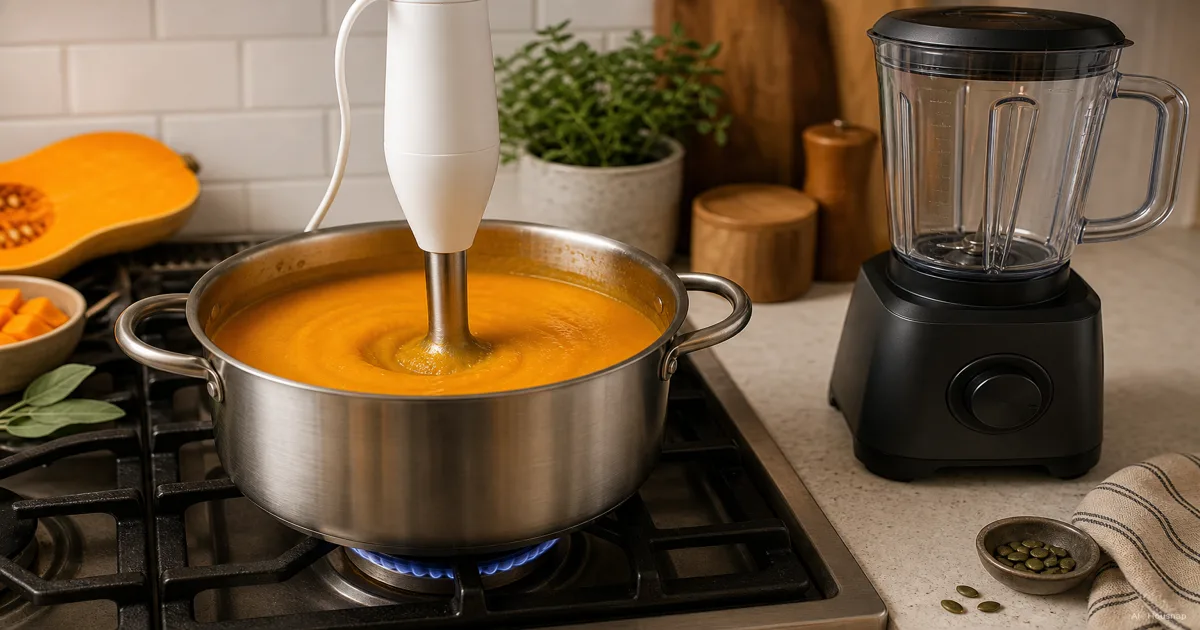
Immersion Blender vs Countertop Blender: Which One to Buy First
Most people buying their first blender already have a specific problem in mind. Maybe it's the butternut squash soup that keeps getting transferred to a blender in three sloshing batches. Maybe it's smoothies every morning that take five minutes to clean up. The blender question looks simple from the outside, but the immersion blender and the countertop blender are built for genuinely different jobs, and buying the wrong one means the appliance sits in a cabinet. The core difference is not about quality or price. It's about where the food is when you blend it. An immersion blender goes into the food. A countertop blender has the food come to it. That one distinction drives almost every practical tradeoff — soup safety, cleanup time, how well it handles frozen fruit, how much counter space it occupies. Understanding which job you're actually trying to solve makes the choice obvious.

Disponibles ahora en una sola tienda
Por ahora, cada uno de estos productos está disponible en una sola tienda. La comparación de precios se abrirá con más tiendas.
The soup problem: why use case comes first
If you have ever tried to blend hot soup in a countertop blender, you have either read the warnings or learned the hard way. Hot liquid in a sealed blender generates steam rapidly. That steam builds pressure inside the container, and the lid can blow off — sending scalding liquid across the kitchen. Even with the vent cap removed and a towel held over the opening, the technique requires care and a half-full container at most (Striped Spatula).
An immersion blender eliminates this entirely. The blade goes directly into the pot. There is no sealed container, no pressure buildup, no transfer of several litres of 90°C liquid into a narrow-mouthed jar. You blend in place, and you are done.
This is the use case that most commonly tips first-time buyers toward an immersion blender: not because immersion blenders are superior, but because for hot soups, sauces, and purees, they are simply the right tool. If you cook soups and blended sauces more than twice a month, an immersion blender will earn its place immediately.
What immersion blenders are actually good at
Immersion blenders — also called stick blenders or hand blenders — run motors between roughly 200 and 800 watts for consumer models. That range is enough for:
- Blending cooked vegetables and legumes into smooth soups and purees directly in the pot
- Making small smoothies in a tall cup or beaker (the cup that often comes included)
- Emulsifying sauces and vinaigrettes
- Making whipped cream or mayonnaise, especially with a whisk attachment
- Blending baby food directly in a bowl
The key phrase is "cooked" or "soft." Once vegetables have been simmered until tender, even a 250W immersion blender will produce a silky result. The motor does not need to fight raw fibre or frozen ice crystals.
Many mid-range immersion blenders come with attachments: a mini chopper bowl for garlic and small quantities of herbs, a whisk for egg whites, and a beaker for blending single portions. This set can cover a surprising range of tasks that would otherwise require a full food processor.
Cleanup is one of the most concrete advantages. Rinse the blade head under running water for thirty seconds and it is done. No disassembling a multi-piece pitcher, no scrubbing the bottom ring seal, no worrying about whether the motor base got wet.
Storage is the other. An immersion blender fits in a kitchen drawer.
What countertop blenders do that immersion blenders cannot
The honest limitation of immersion blenders is power and the vortex effect. A countertop blender creates a downward vortex that pulls ingredients toward the blade continuously. Ice gets crushed because it is forced into the blade at speed, repeatedly, from all sides. Frozen fruit breaks down because the same force applies.
Immersion blenders work by moving the blade through the food manually. You are creating the motion. This works well in liquid-forward mixtures, but frozen ingredients, raw fibrous vegetables, ice, and nut butters resist in a way that a 300W hand motor cannot overcome (America's Test Kitchen).
Where countertop blenders are clearly better:
- Large-batch smoothies with frozen fruit: the vortex does the work, and a 500–1000W motor handles ice and frozen berries cleanly
- Nut butters: require sustained high-torque blending that hand blenders cannot deliver
- Crushing ice: immersion blenders should not be used on ice
- Large volume soups (once cooled or using hot-liquid techniques): a 2-litre batch blends faster in a countertop jar than in a pot with a hand tool
- High-performance blending: green smoothies with raw kale, fibrous root vegetables, thick frozen smoothie bowls
High-end countertop blenders like Vitamix and Blendtec operate at 1,200–2,400 watts and can genuinely replace a food processor for many tasks. Basic countertop models at 300–600W are more limited but still outperform immersion blenders for cold, high-volume jobs.
Power, motor, and when wattage matters
Wattage is most relevant when you are fighting resistance. Cooked vegetables offer almost none. Frozen fruit and ice offer a great deal.
For immersion blenders: 200–300W handles soups, sauces, and soft fruits well. 400–600W adds some capacity for raw ingredients and thicker mixtures. Above 600W in a hand blender is uncommon in consumer models, though commercial units go higher.
For countertop blenders: 300–500W covers basic pureeing and soft-ingredient smoothies. 600–900W handles most smoothie tasks including some frozen ingredients. 1,000W and above is where frozen fruit, leafy greens, and ice become reliable rather than effortful.
The practical implication: a $35 immersion blender is enough for someone who primarily makes soups and sauces. A $40 countertop blender may struggle with frozen smoothies, while a $150–200 model handles them easily. The Vitamix and Blendtec range ($400–600+) is for serious use where texture and capacity matter consistently.
Price ranges in practice: immersion blenders run $25–60 for basic single-speed models, $60–120 for variable-speed models with attachments. Countertop blenders run $40–100 for entry-level, $150–300 for reliable mid-range, $400–600+ for high-performance.
Cleanup and space: the practical daily difference
This is where habits matter as much as capability.
An immersion blender head rinses in seconds. There are no removable gaskets, no blade assembly to dismantle, no jar to dry. The motor body stays dry. For someone making soup three times a week, this adds up to a meaningful time saving.
A countertop blender involves: removing the jar, emptying it, disassembling the blade and gasket if needed for thorough cleaning, or running it through the dishwasher if the jar is dishwasher-safe. Most are, but the blade assembly and gasket seal require attention. Protein smoothies left to sit require more cleaning effort.
For space: immersion blenders fit in a drawer or hang on a hook. Countertop blenders require a dedicated spot on the counter or a lower cabinet shelf — and they are heavy enough that storing them up high is impractical.
If your kitchen has limited counter space, the physical footprint of a countertop blender is a real constraint, not a minor inconvenience.
Which one to buy first
The clearest signal is what you cook most.
Lean toward an immersion blender if:
- You make soups, bisques, purees, or blended sauces more than smoothies
- You want to blend directly in the pot without transferring hot liquid
- Counter space is limited
- You want fast daily cleanup
- You are buying a first blender with a $30–80 budget and soup is the primary use
Lean toward a countertop blender if:
- Smoothies with frozen fruit are your primary reason for buying
- You want to crush ice for cocktails or frozen drinks
- You are making large batches — a full blender jar is faster than moving an immersion wand through four litres
- You want to make nut butters, hummus from scratch, or process raw fibrous vegetables
If you are genuinely undecided: a mid-range countertop blender ($100–200) is more versatile across the widest range of tasks. It handles soups when cooled and smoothies without compromise. The main thing you give up is the convenience of blending hot liquid in the pot.
Some cooks eventually own both — an immersion blender lives in the drawer for quick soups and sauces, and a countertop blender handles frozen smoothies and batch work. The immersion blender typically comes first because it solves the soup problem immediately and costs less.
Sources
- Immersion Blender vs. Blender: How to Choose the Right One — Taste of Home; immersion vs countertop use cases, power comparison, cleanup
- Blending Hot Liquids Safely — Striped Spatula; steam pressure, lid ejection risk, safe countertop technique
- Hand Blender vs. Traditional Blender — Vitamix; texture quality, batch size, use case comparison
- Can You Use an Immersion Blender in Place of a Jar Blender? — America's Test Kitchen; substitution limits, fibrous ingredients, smoothie quality testing

