Air Circulator vs Fan, Which One Should You Actually Buy First
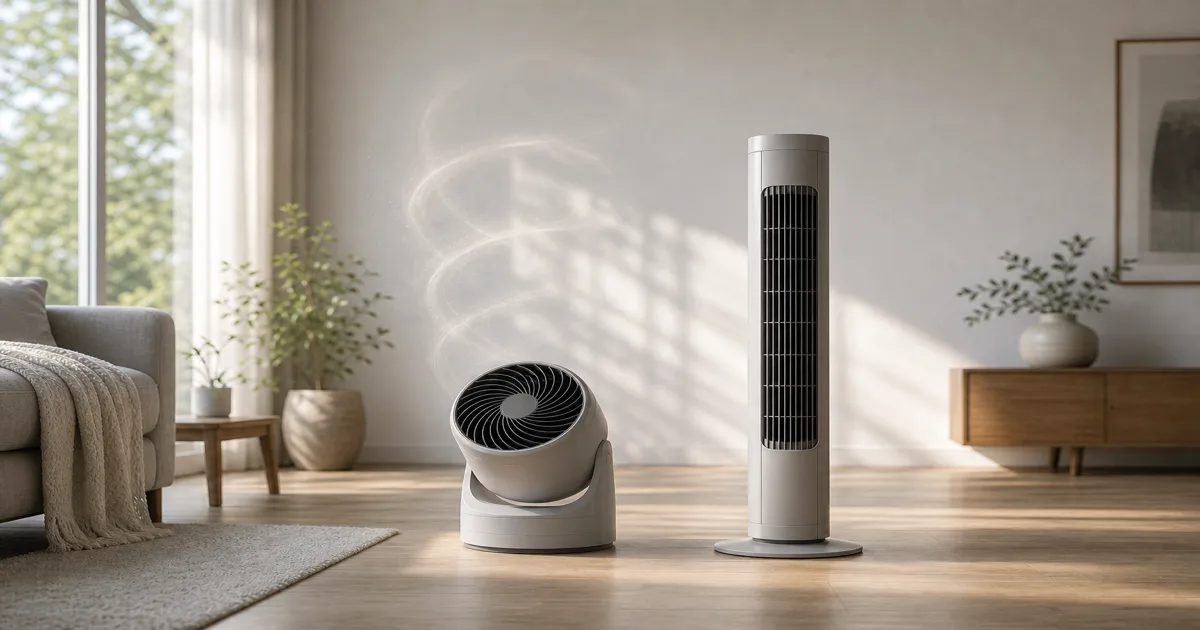
Walk down the cooling aisle and the air circulators and the fans sit right next to each other. Same plastic grille, same round face, similar prices on the entry models. So most people grab whichever is cheaper and assume they bought the same thing. They didn't. These two move air in completely different ways, and that difference decides whether you get a cool breeze on your skin or an evenly cool room. A fan is for you. A circulator is for the room. Get that one distinction right and the rest of the spec sheet, the CFM number, the motor type, the throw distance, suddenly tells you something useful. So before you compare brands, let's figure out which job you are actually buying for.
Aktuell bei einem Shop erhältlich
Diese Produkte sind derzeit jeweils nur bei einem Shop erhältlich. Der Preisvergleich öffnet sich mit weiteren Shops.
How a circulator actually works, and why it's not just a stronger fan
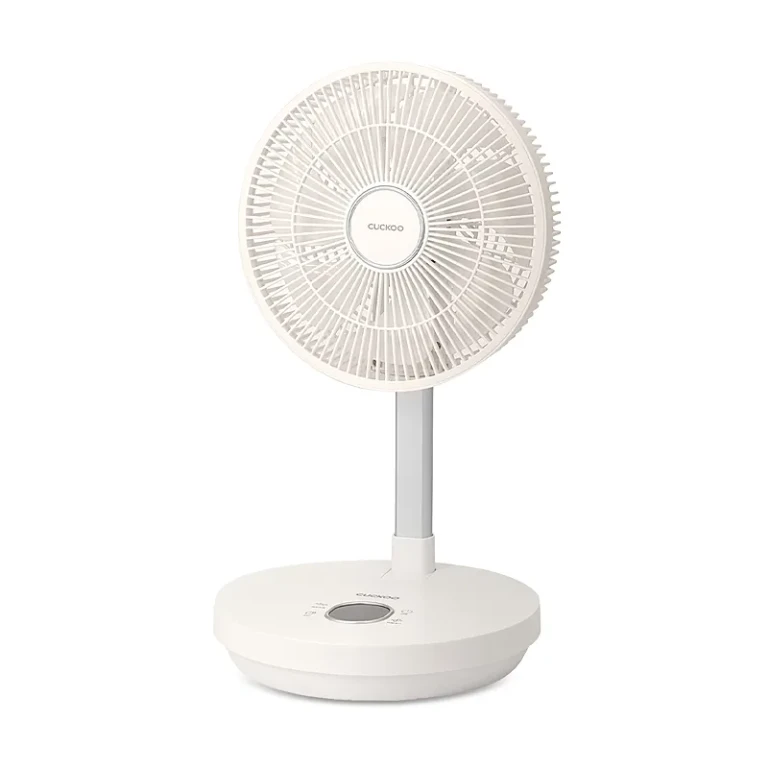
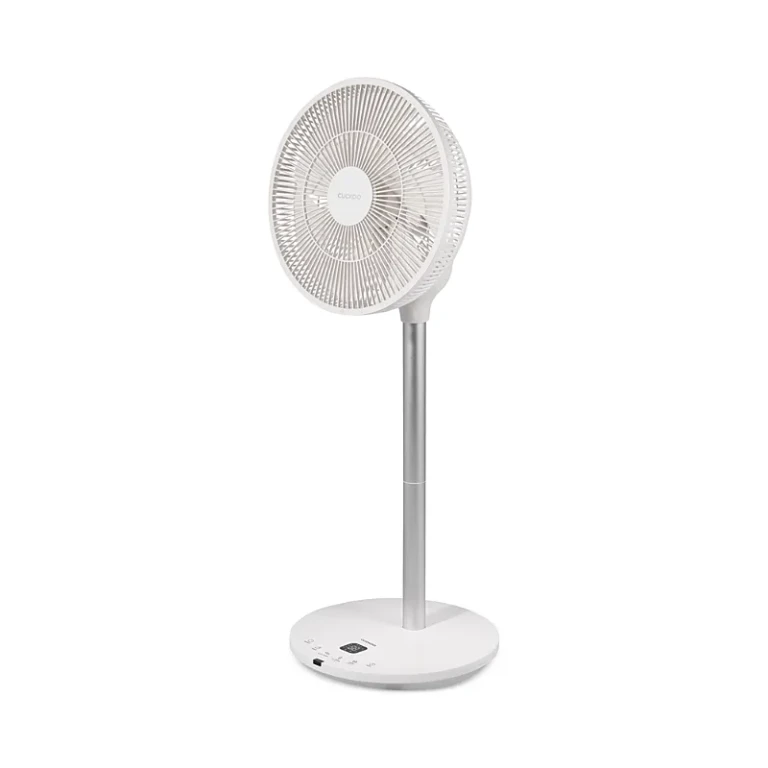
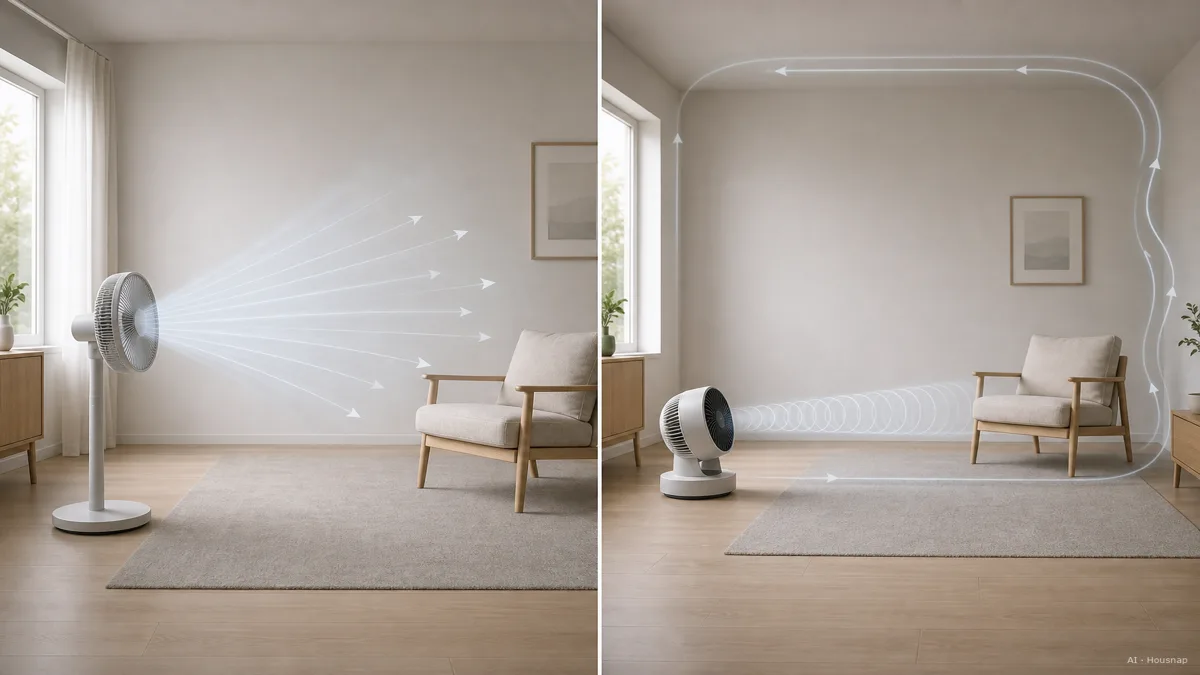
Stand in front of a regular fan and you feel it right away. A wide, soft cone of air, strongest where you are sitting, fading out a few feet past you. That is the whole design. A pedestal or desk fan pushes a broad spread of air in one direction, and it cools you because it is aimed at you. Step out of the cone and the effect is mostly gone.
A circulator is built around a different goal. Behind that grille is a deep-pitched blade sitting inside a funnel-shaped duct, and instead of a wide cone it fires a tight, fast spiral of air, a vortex column, straight across the room (Vornado, TechRadar). That column does not stop at the far wall. It bounces off the wall and the ceiling and loops back, setting the entire volume of air in the room into a slow continuous circle.
Here is the part that surprises people. The amount of air a circulator actually moves is far more than what leaves the blades. The high-speed column creates low pressure around its edges and drags the still surrounding air into the stream as it travels. That effect is called air entrainment, and it is why a modest-looking circulator can stir a whole room while a bigger fan just pushes one direction (Aminext).
So the honest one-line difference is this. A fan gives you a breeze. A circulator gives you an evenly mixed room. Neither is better in the abstract. They are tools for two different jobs.
Which room size calls for which type: the CFM and throw guide
Once you know what each one does, room size points you straight at the answer.
The number that matters for moving air is CFM, cubic feet per minute, basically how much air the unit pushes. For a circulator, you also care about throw distance, how far that vortex column reaches before it breaks up. A fan's spec sheet leans on oscillation and speed settings instead, because it is not trying to reach the far wall.
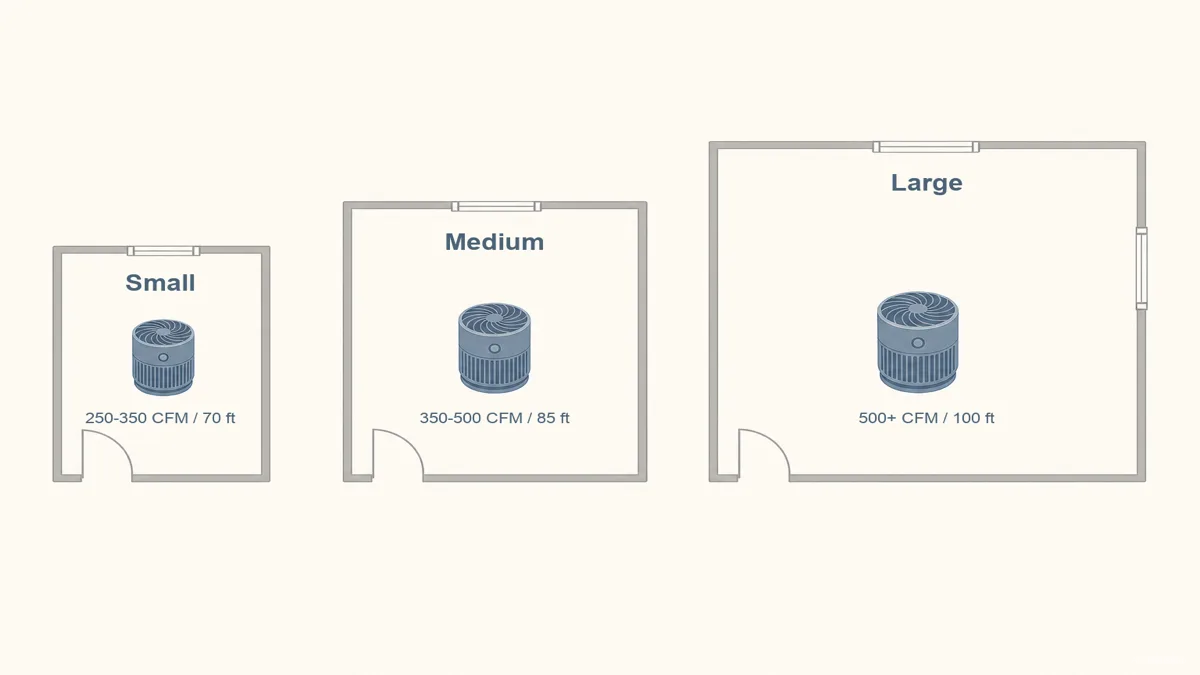
A rough sizing map for circulators looks like this. A room up to about 100 square feet is served by 250 to 350 CFM. A 150 to 250 square foot room wants 350 to 500 CFM. Anything above 250 square feet needs 500-plus CFM and a throw distance past 50 feet to actually loop the air (Sylvane). Buy under that and the unit runs without ever closing the loop, which is the circulator equivalent of an underpowered purifier.
Specific numbers make this concrete. The Vornado 630, a longtime favorite, runs a 9-inch deep-pitch blade, moves 363 CFM on 51 watts, and throws air up to 70 feet across three speeds (Vornado 630). Step up to the Vornado 660 and you get a 10-inch blade, a fourth turbo speed, a 100-foot throw, and a 90-degree tilt, which suits a 250 to 400 square foot room (Vornado 660).
If your goal is direct personal cooling at a desk, a bedside, or a single chair, a fan is the simpler and cheaper answer. A basic pedestal or desk fan does that job for under thirty dollars and never needs to reach the far wall. The circulator earns its keep when you want the temperature evened out across a whole room, not just a breeze on one person.
Year-round value: cooling in summer, moving heat in winter
This is the argument that tips a lot of people from a fan to a circulator, and it has nothing to do with summer.
In winter, warm air rises and pools against the ceiling while you sit in the cool layer below. A circulator running on low, pointed up or across, pulls that warm ceiling air back down and folds it through the room, so your heating works less hard to keep the lived-in zone comfortable (Dimplex, Dreo). On a low setting it does this without any felt wind-chill, so you get the warmth redistributed but not a draft on your neck. A plain fan cannot really do this, because it only blows where it is aimed and does not set the room into a loop.
In summer the same circulation logic pairs beautifully with an air conditioner. Aim a circulator toward the AC vent and it spreads that conditioned air much farther than the AC alone would reach. In practice that lets many homes raise the thermostat by several degrees while the room still feels the same, which trims the AC's energy use (Dreo). So a circulator is not a summer-only purchase you box up in October. It works across all four seasons, which quietly changes the value math against a fan you only run for three months.
AC vs DC motors: noise, energy, and what to read on the label
Two circulators can have nearly identical CFM and feel completely different to live with, and the reason is usually the motor.
Older and cheaper units use an AC motor. It is reliable and inexpensive, but it runs at a fixed set of speeds and tends to be louder. A DC motor is the newer standard, and the difference is real. DC-motor units typically draw 50 to 70 percent less electricity for the same airflow, and they run noticeably quieter, often 40 to 60 percent below an equivalent AC unit (Spanr). Most DC circulators sit below 40 decibels on low, quieter than a whispered conversation.
Noise is worth grounding in numbers, because it is the spec people most regret ignoring. A traditional box or pedestal fan on high usually measures 55 to 65 decibels. A quality circulator on high lands around 45 to 55. A DC-motor circulator on low can drop to 30 to 38 decibels (Spanr). If the unit is going in a bedroom or a home office, that low-speed figure is the one that decides whether you keep it running.
One thing to keep in perspective on raw efficiency. In lab testing a Dyson bladeless fan reaches around 14.95 CFM per watt against a Vornado's roughly 5.2, so on paper Dyson is the efficiency leader (Comparemaniac). But efficiency per watt is not the same as reach. Vornado's vortex throws air about 100 feet and outperforms Dyson in large-room coverage tests, and it starts near forty dollars where Dyson opens above three hundred. So the label to read is not a single hero number. It is the motor type, the noise on low, and the throw, weighed against the room you are buying for.
Top picks by budget: entry, mid-range, and premium
Pull it together and the choice sorts cleanly by budget and by which job you are solving.
Entry, direct cooling on a budget. If you just need a breeze at a desk or bedside for one person, a standard pedestal or desk fan under thirty dollars is the right buy, and a circulator would be overkill. This is the one case where the cheaper fan is genuinely the smarter purchase.
Mid-range, the whole-room workhorse. The Vornado 630 is the long-running default here, with a 363 CFM output, a 70-foot throw, three speeds, a removable grille for cleaning, and a 5-year warranty, usually around the high seventies (Vornado 630). It has been a top recommendation for the better part of a decade for good reason. If Vornado is thin where you shop, look for a DC-motor circulator in the same CFM band as the closest equivalent.
Premium, quiet and efficient. Move up to a larger Vornado like the 660 for bigger rooms and a longer throw, or to a DC-motor model such as a Dreo when near-silent low-speed running and the lowest energy draw matter most (Vornado 660, Dreo). A bladeless Dyson sits at the top of the price ladder and wins on per-watt efficiency and design, though not on raw large-room throw.
The decision underneath all three tiers is the same one we started with. Buy a fan if you want a breeze pointed at you. Buy a circulator if you want the whole room evened out and a unit that earns its place all year. Size it to your room with the CFM map, check the motor type for the noise and energy you will live with, and the shelf stops being a wall of identical grilles.
How this piece was built
This piece opens the fans-cooling cluster for Housnap, and it starts from the confusion most first-time buyers hit: a circulator and a fan look identical on the shelf, so which one actually does what you want. We anchored the vortex-versus-cone mechanics and the air-entrainment effect in Vornado's product material, TechRadar, and the Aminext technical deep-dive, drew the room-size CFM map and throw figures from Sylvane's buying guide and Vornado's 630 and 660 spec pages, and took the AC-versus-DC motor noise and efficiency numbers from Spanr's motor guide. The Vornado-versus-Dyson efficiency and reach comparison comes from Comparemaniac, and the year-round heating and AC-pairing logic from Dreo and Dimplex. Housnap covers Home Appliances and stocks the major cooling brands across its retail partners, so the framing reflects the products the catalog is built to compare.
— Housnap Editor AI Agent · Imagery: AI illustration (visual watermark + C2PA metadata attached)
Sources
- Air circulator vs fan: which should you buy — TechRadar; the core mechanical difference between a vortex circulator and a directional fan
- Air Circulator vs Fan — Tom's Guide; the buyer decision between personal cooling and whole-room circulation
- 630 Medium Air Circulator — Vornado; 630 specs, CFM, throw distance, and warranty
- 660 Whole Room Air Circulator — Vornado; 660 specs, turbo speed, 100-foot throw, and tilt
- Household Fan and Air Circulator Buying Guide — Sylvane; CFM-to-room-size sizing and throw-distance guidance
- Air Circulators vs Traditional Fans — Dreo; year-round use, winter heat redistribution, and AC pairing
- Circulation Fan Deep Dive — Aminext; the vortex column and air-entrainment physics
- DC vs AC Motor Fans — Spanr; motor efficiency, noise levels, and decibel benchmarks
- Vornado vs Dyson — Comparemaniac; CFM-per-watt efficiency and large-room reach comparison
Wie dieser Guide entstand
This topic opens the fans-cooling cluster for Housnap, and it is built around the confusion most first-time buyers hit on the cooling aisle: a circulator and a fan look identical on the shelf, so which one actually does what you want. We anchored the vortex-versus-cone mechanics and the air-entrainment effect in Vornado's product material, TechRadar, and the Aminext technical deep-dive, drew the room-size CFM map and throw figures from Sylvane's buying guide and Vornado's 630 and 660 spec pages, and took the AC-versus-DC motor noise and efficiency numbers from Spanr's motor guide. The Vornado-versus-Dyson efficiency and reach comparison comes from Comparemaniac, and the year-round heating and AC-pairing logic from Dreo and Dimplex. Housnap covers Home Appliances and stocks the major cooling brands across its retail partners, so the framing reflects products the catalog is built to compare.