Your First Automatic Pet Feeder, Gravity vs Programmable vs App-Controlled
You are leaving town for a weekend, or you are just tired of your cat waking you up at 6am for breakfast, and you land on an automatic feeder search. The listings do not make the choice easy. Some are a plastic tower with no plug and no buttons. Some have a screen and a schedule. Some sync to an app and show you a live video of your pet eating. Here is what most product pages skip. These are not three versions of the same thing, they solve different problems. A gravity feeder solves running out of food. A programmable feeder solves feeding on a schedule you set once. An app-controlled feeder solves both of those plus checking in and adjusting from wherever you are. The type you actually need depends on one question: does your pet need portion control, or just reliable access to food? Get that answer right and the rest, capacity, precision, power backup, and food type, falls into place.
What Type of Automatic Feeder Do You Actually Need?
There are three types on the market, and they solve genuinely different problems, not just different price points.
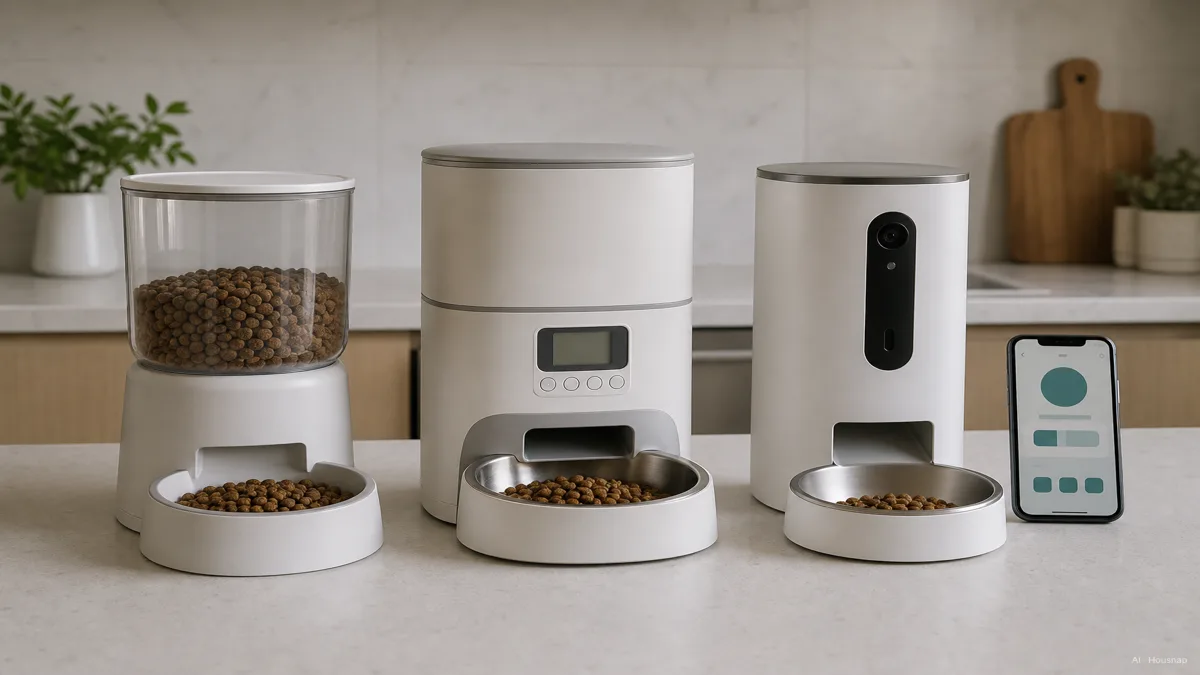
A gravity feeder is a hopper stacked above a tray. Food slides down as the tray empties, refilling by itself with no power and no batteries. It is the cheapest option, usually around 20 dollars, and the easiest to clean since there is nothing electronic to work around. The catch is the one thing it cannot do: it never limits how much food is accessible at once. For a pet that already self-regulates, that is fine. For a cat that needs weight management, an open hopper is a real risk, since nothing stops it from grazing all day.
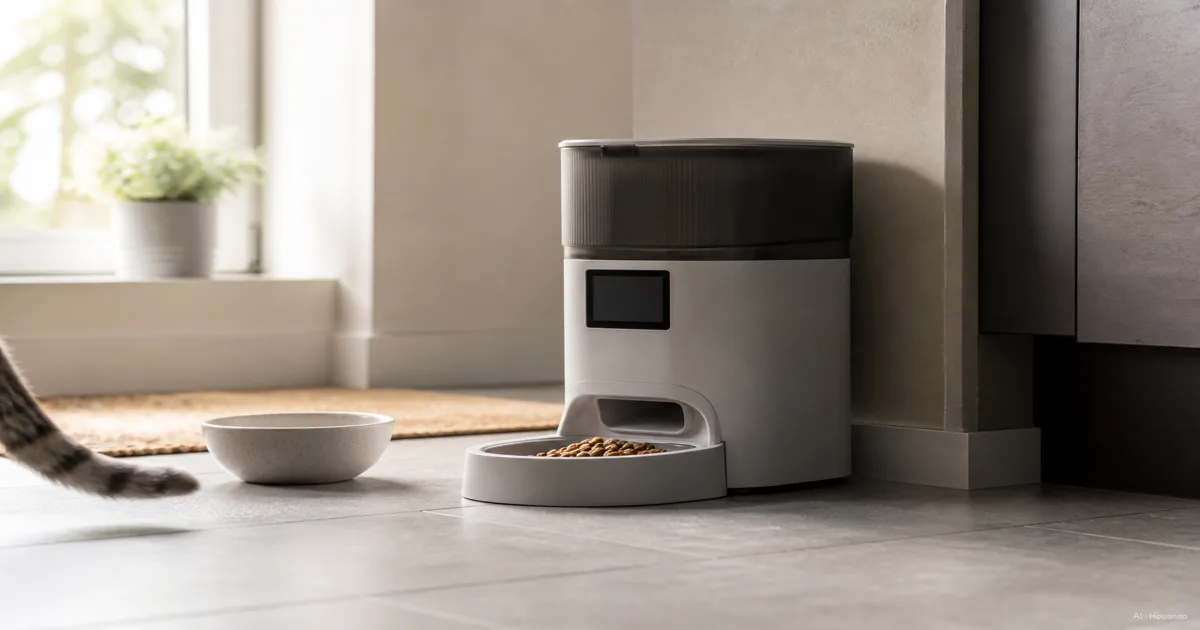
A programmable feeder adds a motor, a timer, and a hopper that dispenses a set portion at set times, usually controlled from buttons or a small screen on the unit itself. This is the workhorse category for most first-time buyers, because it solves the actual behavioral problem: cats do better on several small scheduled meals than on one or two large gravity-fed portions that mimic neither their natural grazing rhythm nor a diet plan.
An app-controlled smart feeder is a programmable feeder with WiFi added. You get the same scheduling, plus the ability to add or skip a meal remotely, get low-food alerts, and on many models watch or talk to your pet through a built-in camera. The added cost buys convenience and peace of mind more than it buys a fundamentally different feeding mechanism.
Capacity and Portion Control: How Much Food Can It Hold and How Precisely Can It Dispense
Two numbers matter more than any brand name: how much food the hopper holds, and how finely it can divide that food into a meal.
Hopper size is usually listed in liters or cups, and the range is wide. A 5-liter hopper holds roughly 21 cups of dry kibble, which works out to about 20 days of food for an average cat. A larger 7-liter hopper holds closer to 29 cups, and some of the biggest models on the market push past 32 cups, enough to cover a longer trip away without a refill. Match the hopper to how long you actually travel, not the largest number on the shelf, since an oversized hopper sitting mostly empty is just wasted counter space.
Portion precision is where feeders differ the most, and it matters more for a small pet or one on a weight-management plan. Some feeders measure food in cup-based scoops, as coarse as an eighth of a cup per meal, with up to a dozen meals a day possible. Others measure in gram increments, letting you set portions down to about 10 grams and adjust in single-portion steps. For a large dog, a cup-based scoop is plenty. For a cat where a few extra grams a day is the difference between a healthy weight and a slow creep toward overweight, gram-level precision is worth paying for.
Power Reliability: Why Battery Backup Is Non-Negotiable
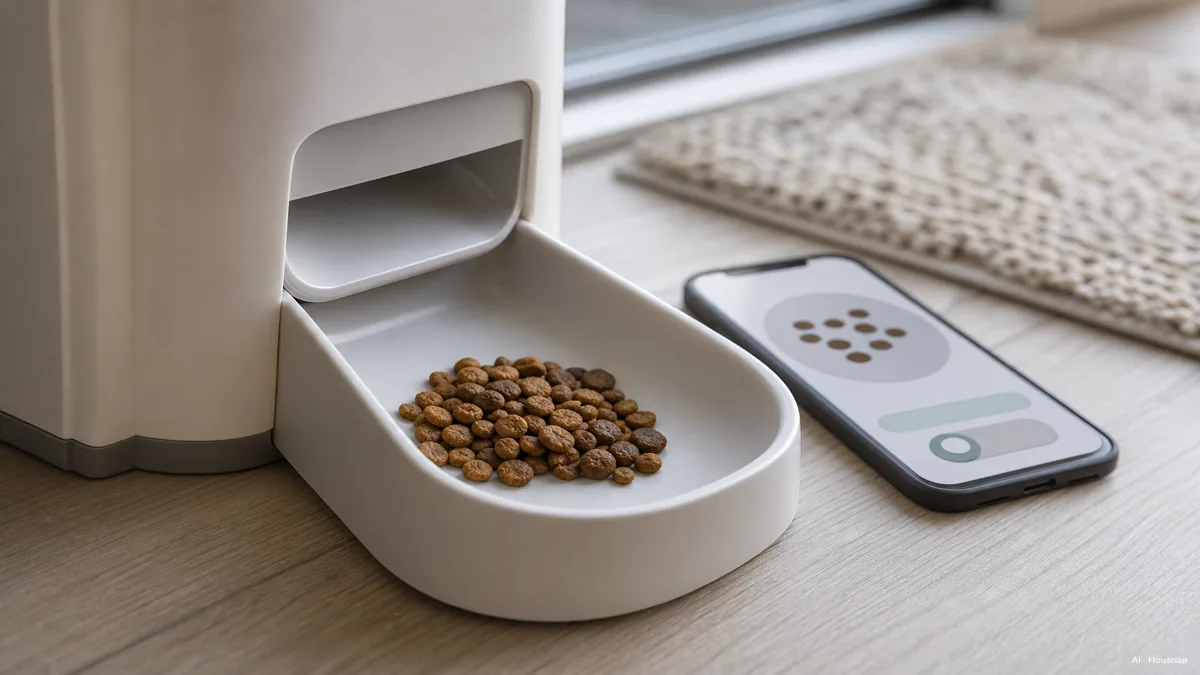
A feeder that only runs on a wall adapter is a feeder that stops working the moment the power goes out, which is exactly when your pet still needs to eat. Look for a dual power design, an AC adapter for everyday use plus a dedicated battery compartment that kicks in automatically during an outage, not a USB port you have to remember to plug into a power bank.
This detail rarely shows up in the headline photos, so check the spec list or the product description directly rather than assuming it is included. Some well-reviewed models are rated to run on batteries alone for close to a year between changes, which matters if you are relying on the feeder while away rather than checking it daily.
Dry Kibble vs Wet, Fresh, or Raw Food: Matching the Mechanism to Your Pet's Diet
Most automatic feeders, gravity, programmable, or app-controlled, are built around a hopper and an auger or wheel mechanism designed for dry kibble. That mechanism does not work for wet food, fresh food, or raw diets, since anything moist or irregularly shaped can clog a hopper built for uniform dry pieces.
If your pet eats wet or fresh food, look instead for a rotating-tray feeder, a different mechanism built specifically for that job. A common design uses five ice-cube-style compartments, each holding around three-quarters of a pound, roughly a cup and a half, that rotate into position on a timer and keep the rest of the food chilled or sealed until it is due. This style is a good fit for a short trip away, since it is not meant to carry weeks of food the way a dry-food hopper is.
More owners are also moving toward high-protein, freeze-dried raw diets, and a plain kibble hopper is usually the wrong tool for that food, since irregular shapes and larger chunks jam an auger built for small dry pellets. If that is your pet's diet, check specifically whether a feeder is rated for it before buying, rather than assuming any automatic feeder will handle any food.
Cleaning, Hygiene, and App Quality: The Details That Separate Good Feeders From Bad Ones
The mechanics get most of the attention, but day-to-day satisfaction often comes down to two things the spec sheet barely mentions.
First, hygiene. A tray and hopper with smooth, rounded interior corners are far easier to keep clean than ones with narrow seams where kibble dust and grease collect over time. Dishwasher-safe parts are worth prioritizing, since a feeder you dread cleaning is a feeder that eventually gets cleaned less often than it should.
Second, for app-controlled models, the app itself. The hardware between two competing smart feeders is often similar, but a stable connection, clear feeding history logs, reliable low-food alerts, and the ability to set different portions for multiple pets are what actually separate a feeder you trust from one you fight with. Before buying, it is worth a quick look at app-store reviews specifically for complaints about connectivity or WiFi stability, since that is the single most common failure point owners report with smart feeders, more than any hardware issue.
A first automatic feeder does not need every feature on the shelf. It needs the right mechanism for your pet's food, enough capacity for how long you are actually away, portion precision that matches how much control your pet's health needs, a battery backup that survives an outage, and a body and app you will not resent maintaining.
Sources
- How Do Gravity Cat Feeders Work? Vet-Verified Pros, Cons & Price Guide — Catster; gravity feeders need no power, cost around $20, and cannot limit how much food a cat accesses at once
- Automatic vs Gravity Feeders: Which One Wins for Cats & Buyers — SZ Pet Trust; cats do better on several small scheduled meals than large gravity-fed portions
- Best Automatic Pet Feeder 2026: Buying Guide — Don't Pick It; dual power (AC plus dedicated battery backup) as a key reliability differentiator, price bands by feature tier, and app connectivity as a common complaint point
- Best Automatic Cat Feeders: Top 7 Models Recommended by Experts — StudyFinds, citing Wirecutter testing; hopper capacity benchmarks (24-cup and other hopper sizes) and rotating-tray feeders for wet or fresh food
- The 13 Best Automatic Cat Feeders in 2026 (We Tested Them All) — Cats.com; portion precision differences between gram-based and cup-based dispensing