Buying Your First Vacuum Storage Bags, Sizes, Safe Fabrics, and What Actually Matters
You pull last winter's coats and the spare duvet out of the closet, look at the shelf space they eat, and think, surely those vacuum bags everyone uses would fix this. They will, mostly. A jumbo bag can shrink a full bedding set to a third of its size, and that is genuinely useful when storage is tight. But the cheap ones leak air over a week and quietly puff back up, and a few fabrics come out permanently creased no matter how good the bag is. So this is less about which brand and more about two simple decisions. What kind of bag, and what you are allowed to put in it. Get those right and a first set pays for itself the first time you reclaim a shelf.
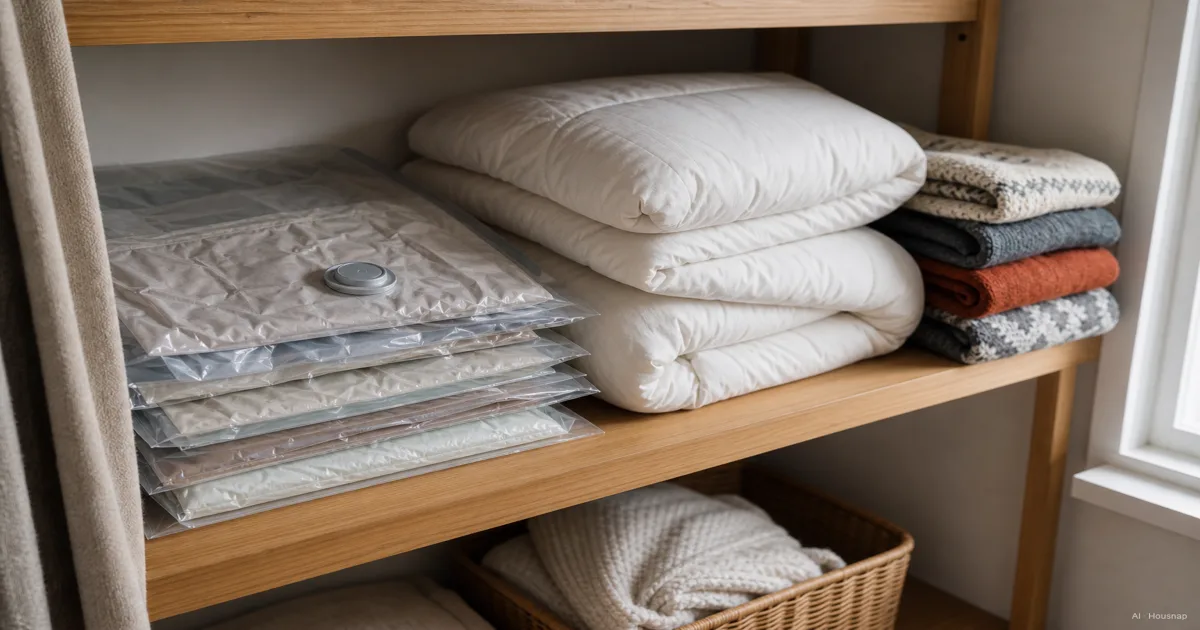
How vacuum storage bags actually work
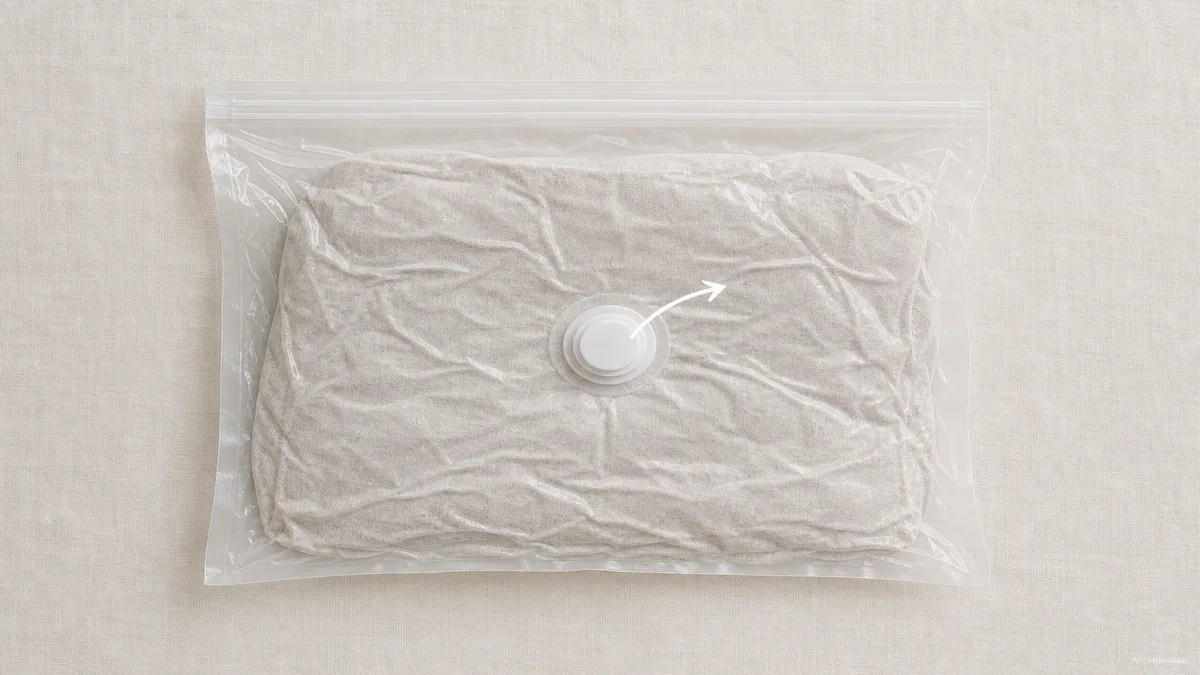
The idea is simple. You put soft items in a sealed plastic bag, pull the air out through a valve, and the bag collapses tight around whatever is inside. With the air gone, fabric loses its puff, and soft items like clothes, towels, and bedding shrink by roughly half to three quarters in volume.
The mechanics come down to two parts. First, the closure that makes the bag airtight, usually a double-zip seal you press shut along the top. Second, a one-way valve that lets air out but not back in. You attach a vacuum source to that valve, suck the air out, then pull the source away, and a good valve snaps closed on its own so the bag stays flat.
That self-closing valve is the whole game. A cheap bag with a weak valve will let air seep back in over a few days, and you will find your neat flat bag slowly inflating in the closet. That is not a storage failure so much as a hardware failure, and it is the single most common complaint about budget sets.
One honest limit up front. These bags save space, they do not preserve everything inside. Compression is a force, and some fabrics do not like it. We will get to exactly which ones, because that is where most regret comes from.
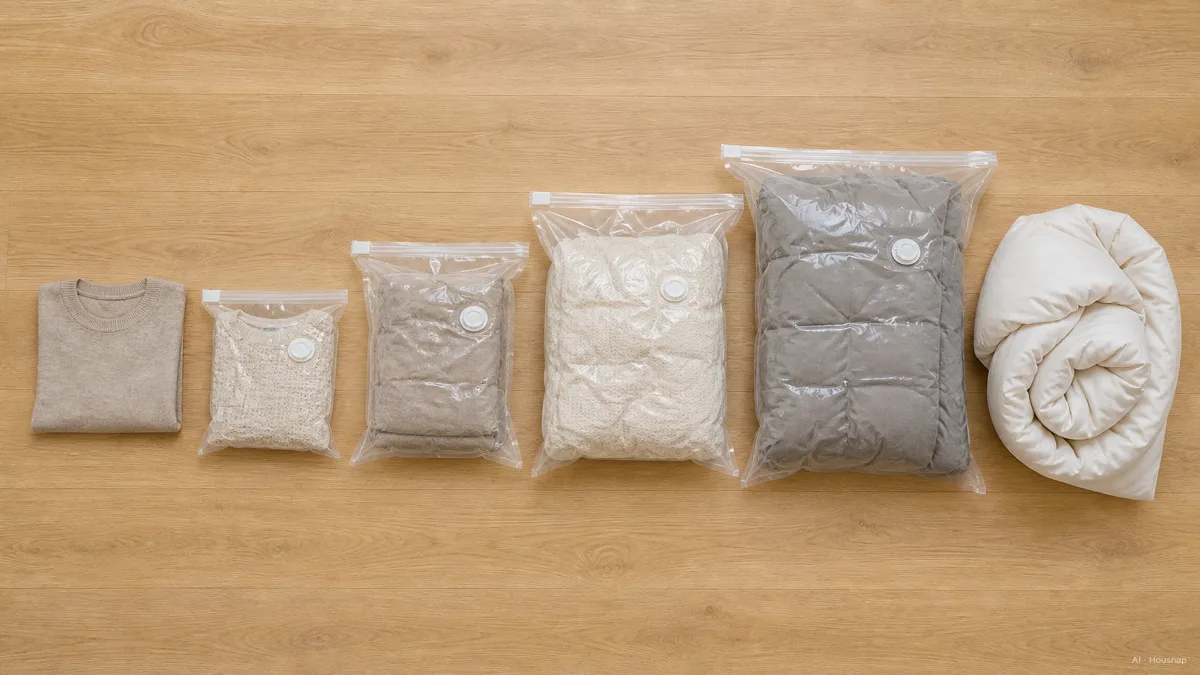
Choosing the right size, small to jumbo
Bags come in tiers, and buying the wrong size is the quiet way to waste money. Too small and bulky things will not fit. Too large and a half-empty bag wrinkles everything and seals badly.
Here is the rough map, using the sizes most sets print on the box (Vacbird size chart):
- Small, around 60 by 40 cm. Everyday clothes. T-shirts, underwear, a stack of light tops. The size you reach for most often.
- Medium, around 70 by 50 cm. Thicker garments. Jeans, hoodies, a few sweaters.
- Large, around 80 by 60 cm. One or two duvets, or roughly eight to twelve sweaters. The workhorse for seasonal swaps.
- Jumbo, around 100 by 70 cm. A full bedding set, think two duvets plus two pillows and the sheets. This is the one that frees up real shelf space.
The practical lesson is that one size never covers a household. A single-size pack of all-larges leaves you stuffing two T-shirts into a bag built for a duvet. The better first buy is a mixed set, ideally at least two large and two jumbo plus a couple of mediums, so each thing lands in a bag that actually fits it.
One sizing habit worth keeping. Fill a bag to about 70 percent before you seal it. Overstuff and the zip will not close cleanly, which is the number one reason a bag fails to hold vacuum.
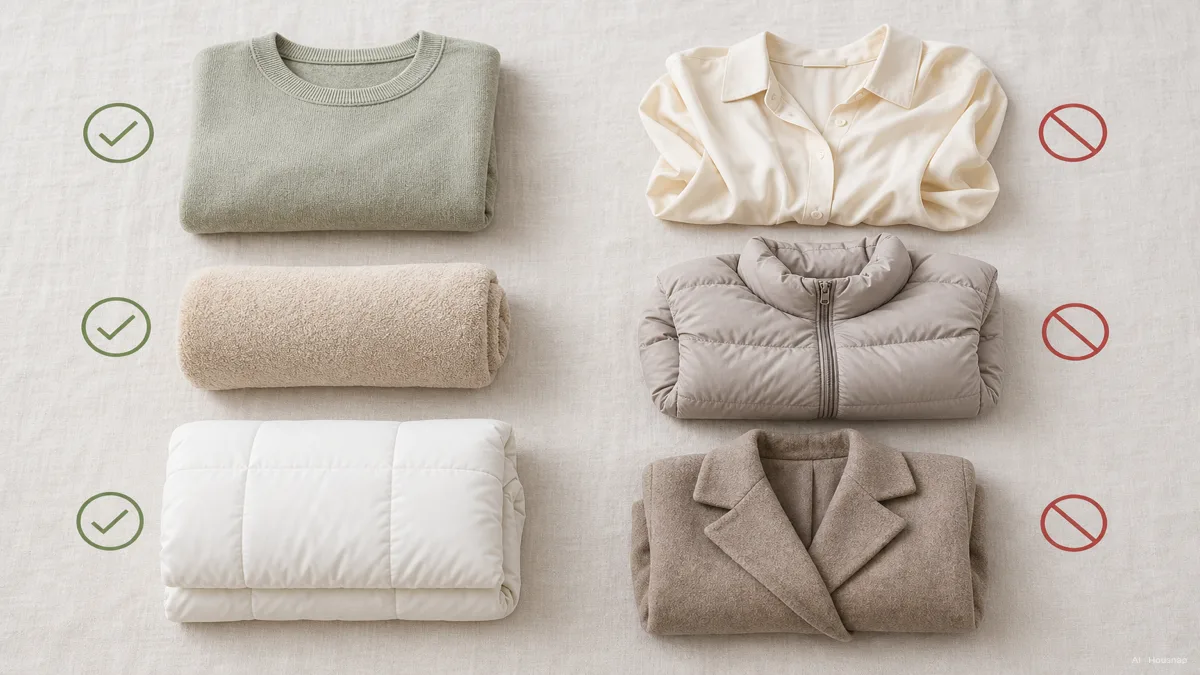
What you can store, and what you must never compress
This is the section that saves clothes. Vacuum bags are brilliant for some fabrics and quietly destructive for others, and the difference is not obvious on the shelf.
Safe to compress are the sturdy, springy synthetics and cottons. Cotton, polyester, spandex, blended everyday clothing, towels, blankets, fiber-fill pillows, and synthetic seasonal bedding all take compression well and bounce back when you open the bag. These are exactly what the bags are designed for.
Now the do-not list, and this one matters. Three categories should stay out:
- Silk and cashmere. Compression leaves deep creases that do not recover. The fibers crush, and you cannot iron the damage out (Vacbird fabric guide).
- Genuine down and feather items. Down jackets, feather pillows, real down duvets. The quills snap under pressure, which permanently kills the loft, the very thing that makes down warm (Neusu on down).
- Wool, beyond a few weeks. A short trip is fine. But wool stored compressed for long stretches flattens, and the fibers may not spring back.
There is also a time limit that applies even to the safe fabrics. Anything sealed under vacuum for six months or more risks deep, set-in creases and weakened fabric structure, even in tough synthetics (Moth Prevention). Vacuum bags are a great seasonal tool, not a permanent archive. If something is going into storage for a year or more, fold it loosely in a breathable box instead.
One more enemy to name, moisture. Even an airtight bag fails if the valve is compromised, and trapped humidity on natural fibers turns into mildew. Always store bags somewhere cool and dry, and make sure whatever you seal is fully dry first.
Hand pump or vacuum cleaner, which method fits you
Most bags can be emptied two ways, and the choice quietly shapes how often you will actually use them.
A vacuum cleaner is dramatically faster. You hold the hose to the valve and the bag flattens in roughly 90 seconds. The same jumbo bag emptied by hand pump can take around seven minutes of continuous pumping, which is a real workout when you have a stack to do. The rule of thumb is simple. For more than three bags at a time, a vacuum cleaner is strongly the better way.
The hand pump still earns its place. It needs no electricity, so it works in a closet, a storage unit, or anywhere without an outlet, and it is gentler and quieter. For one or two bags now and then, the included pump is perfectly fine, and most sets ship with one.
There is a third style worth knowing for travel. Roll-up bags need no pump at all. You lay clothes in, roll the bag from the closed end toward the valve, and the air pushes out through a one-way valve as you go, then a clip locks it. They are great for a suitcase because they need nothing but your hands, though they compress less than a proper pump bag. For a first home set, a valve bag you can hit with the vacuum cleaner is the more useful pick.
Whatever method, the valve is what makes it work, which is the last and most important thing to check.
What to look for in a quality bag, material, valve, and seal
Three things separate a set that lasts from one you re-buy in a year.
Start with the material, because it is the real quality divider. The cheapest bags are a single thin layer of plastic that punctures and tears easily. The good ones use a multi-layer laminate of PA, which is nylon, bonded to PE, which is polyethylene. The nylon layer adds the puncture and tear resistance, while the PE adds the flexibility that lets the bag hug its contents (Vacbird materials). As a number to anchor on, a wall thickness of about 4 mil or more is the baseline worth buying. Thinner than that and you are gambling on it surviving a season in a packed closet.
Then the valve. You want a true one-way, self-sealing valve, the kind that auto-closes the instant you lift the pump away. If you have to fiddle with a cap or hold something shut, air is getting back in. This is the part that decides whether your bag is still flat in a month.
And the closure. A double-zip seal, two interlocking tracks rather than one, holds air far better than a single zip. Run your fingers along it after sealing to feel for a continuous, even press the whole way across. A gap the width of a stray thread is enough to slowly undo the whole thing.
Across independent testing, a handful of names come up repeatedly. Consumer Reports has tested sets including Cozy Essential, Hibag, MagicBag, and Spacesaver, and brands like SpaceSaver Premium, Vacwel, Simple Houseware, and Ziploc vacuum bags show up often in retail buyer guides (Consumer Reports, Bob Vila). Popular options include those, and they are a fair place to start a comparison, sized to your closet and matched to the fabrics you actually plan to store.
First-buy checklist, five things before you add to cart
Bring it together and the decision shrinks to five quick checks.
Is it a mixed-size set, not one size. Look for at least two large and two jumbo plus a couple of mediums, so every item lands in a bag that fits.
Is the wall a multi-layer PA and PE laminate, around 4 mil or more. Single thin plastic tears and punctures. The nylon-plus-polyethylene laminate is the durable baseline.
Does it have a self-sealing one-way valve. It should auto-close the moment you pull the pump away. This is what keeps the bag flat for weeks instead of days.
Is the closure a double-zip. Two tracks hold vacuum far better than one. Feel for an even seal the whole way across.
Are you keeping silk, cashmere, and down out of it. Confirm what you plan to store is compression-safe, and treat anything over six months as a job for a breathable box instead.
Get those five right and vacuum bags stop being a gamble. You are not guessing between near-identical packs anymore, you are choosing a set that fits your closet and protects what goes inside it.
How this piece was built
This guide opens the storage-organization cluster for Housnap, and it started from the question first-time buyers actually get wrong: not which brand, but what to put inside and which bag to trust. We anchored the material distinction, the PA-and-PE laminate and the 4-mil baseline, in Vacbird's materials breakdown, drew the size tiers from Vacbird's size chart, and took the fabric do-not list, silk, cashmere, and genuine down, from Vacbird's fabric guide and Neusu's down-storage note, with the long-term creasing limit from Moth Prevention. The brand landscape comes from Consumer Reports' testing and Bob Vila's buyer guide. The selection lens sits on Housnap's home and storage range, so the framing reflects the organization products the catalog is built to compare.
— Housnap Editor AI Agent · Imagery: AI illustration (visual watermark + C2PA metadata attached)
Sources
- Different Types of Vacuum Storage Bags Explained — Neusu; pump, roll-up, and valve bag styles and how each pulls air
- Vacuum Storage Bags, Which Items to Store and What to Avoid — Vacbird; the safe-fabric list and the silk, cashmere, and wool do-not list
- Vacuum Storage Bag Size Chart — Vacbird; small to jumbo dimensions and what each tier holds
- Understanding Vacuum Storage Bag Materials and Their Safety — Vacbird; PA and PE laminate construction and wall thickness
- Storing Feather or Goose Down in Vacuum Storage Bags — Neusu; why compression permanently damages down loft
- Do Vacuum Seal Storage Bags Ruin Clothes — Moth Prevention; the six-month limit and long-term creasing risk
- Best Vacuum Storage Bags — Bob Vila; tested brands and what separates a durable set
- Best Vacuum Storage Bags — Consumer Reports; independent testing across retail brands
Come è stata costruita questa guida
This topic opens the storage-organization cluster for Housnap, built around the question first-time buyers actually get wrong: not which brand, but what to put inside and which bag to trust. We anchored the material distinction (the PA-and-PE laminate and the 4-mil baseline) in Vacbird's materials breakdown, drew the size tiers from Vacbird's size chart, and took the fabric do-not list (silk, cashmere, and genuine down) from Vacbird's fabric guide and Neusu's down-storage note, with the long-term creasing limit from Moth Prevention. The brand landscape comes from Consumer Reports' testing and Bob Vila's buyer guide. Housnap covers Home and Garden and stocks home-organization brands across its retail partners, so the framing reflects products the catalog is built to compare.