Slow Cooker First Buy: Size, Shape, and What the Machine Actually Does Well
The logic of slow cooking is almost the opposite of most modern cooking advice. You do not use high heat. You do not watch the pot. You do not stir or adjust or hover. You load a slow cooker in the morning, press one button, and come back eight hours later to food that is done. What makes that possible is not a shortcut or a compromise. It is a specific thermal mechanism that happens to be perfectly suited to a specific category of food — tough cuts of meat with high collagen content, dried legumes, and long-cooked soups and stews — and almost useless for everything else. Understanding which category your cooking falls into is the only question you actually need to answer before deciding whether to buy one. The machine itself is almost disarmingly simple. The complexity lives in the cooking, not the appliance.
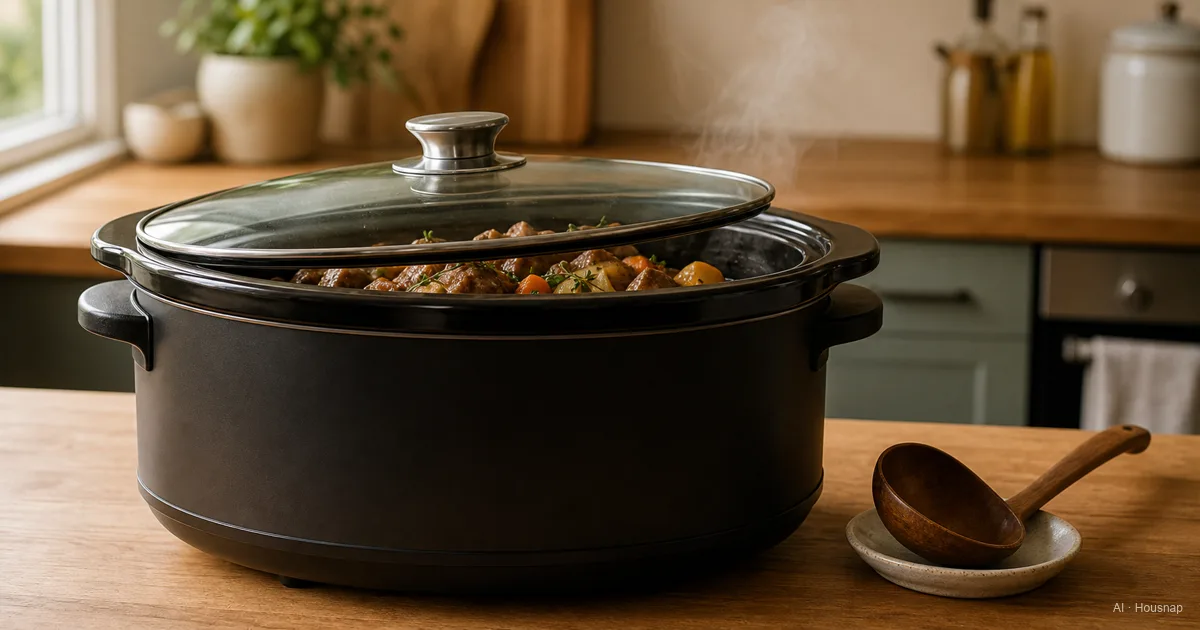
The first time most people put a slow cooker away permanently is after a run of watery, textureless meals that made them wonder why they bought it. In almost every case, the problem was not the machine. It was cooking the wrong things in it.
How slow cooking actually works: collagen, low heat, long time
A slow cooker maintains a temperature between roughly 79°C (175°F) on low and 93°C (200°F) on high. These temperatures are well below a rolling boil and far below the searing temperatures of a pan. What they do over an extended period — six to ten hours on low, four to six hours on high — is break down collagen.
Collagen is the connective tissue that runs through tougher, cheaper cuts of meat. In younger animals and prime cuts, there is less of it. In working muscles — shoulders, shanks, chuck roasts, brisket, oxtail — there is a lot. When collagen is exposed to sustained temperatures above about 71°C (160°F), it begins to hydrolyze into gelatin. Gelatin is what makes slow-cooked meat feel unctuous and fall-apart tender rather than dry and stringy. It is also what gives slow-cooked soups and stews their body (Collagen and meat cooking, Serious Eats).
This transformation takes time. High heat speeds it up only to a point — beyond that, the muscle fibers seize and the meat dries out. Slow cooking at low heat allows the collagen to convert without the muscle fibers drying out, which is why the same cut of meat that comes out leathery from an oven in 2 hours comes out fork-tender after 8 hours in a slow cooker at 82°C.
The physics also explains why pressure cooking and slow cooking, despite both being used for tough cuts, are not interchangeable. Pressure cooking achieves the same collagen breakdown at higher temperatures in a shorter time. Slow cooking achieves it at lower temperatures over a longer time. The resulting texture and broth character are similar but not identical. Neither is inherently superior — they suit different schedules and produce slightly different results.
Oval vs. round insert: what shape fits which foods
Slow cooker inserts come in two shapes, and the choice matters more than most buyers realize until they try to fit a whole chicken or a pork shoulder into the wrong one.
Round inserts are the original slow cooker shape. They are well-suited to soups, bean dishes, and anything that does not need to lie flat. A round insert gives you an even depth of liquid across the whole pot, which is ideal for liquid-heavy dishes. Stirring (when you do stir, which should be rarely) is easier in a round insert.
Oval inserts were introduced to accommodate larger cuts of meat — whole chickens, pot roasts, fish fillets, and racks of ribs. If you regularly cook whole birds or large roasts, an oval insert is not a preference: it is a practical requirement. A 1.5kg whole chicken that easily fits in a 6-quart oval will not fit at all in a 6-quart round. The oval shape also means the depth of liquid is shallower across the wider footprint, which can mean the top of large cuts stays above the braising liquid — something to account for in recipes by adding a little extra liquid or flipping larger cuts halfway through.
For most buyers who cook a mix of soups and occasional roasts, an oval insert in a 5 or 6-quart size covers both uses. For buyers who primarily make soups, chilis, and bean dishes, a round insert is simpler and often cheaper.
Size guide: 2qt for dips, 4qt for two to four people, 6-7qt for families
Slow cooker sizing follows a different logic than pressure cooker sizing. The minimum fill requirement (a slow cooker should be at least half full for best results) and the maximum fill limit (no more than two-thirds to three-quarters full) mean that the stated size does not equal the practical cooking capacity.
1.5–2 quart: The party dip and small-batch size. Useful for fondue, keeping dips warm at parties, or single-serving soups. Genuinely limited for anything resembling a main dish. Not a starting point for most buyers.
3–4 quart: Suitable for one to three people, or for cooking individual components (a single chicken breast, a batch of beans for meal prep). A 4-quart can handle a small whole chicken and a modest pot of chili. This is the right size for small households that cook slow cooker meals for one or two people but want more flexibility than a 2-quart offers.
5–6 quart: The most versatile and most commonly recommended size. Handles a standard whole chicken, a full roast, or a pot of soup for four to six people. If you are unsure, this is the size to default to. It is the size most slow cooker recipes assume.
7–8 quart: Family or entertaining size. Designed for cooking large cuts (a full brisket, pork shoulder for pulled pork for a crowd), doubling recipes, or batch cooking for the week. The trade-off is that the larger insert takes longer to come up to temperature and that smaller quantities cook inconsistently because the mass of food does not fill the pot correctly (America's Test Kitchen, Best Slow Cookers).
Programmable timer vs. manual dial: when the simpler version still wins
The programmable slow cooker promises something specific: you can set it to cook for a set number of hours, and when it finishes, it automatically switches to keep-warm mode so food does not overcook if you are delayed. This solves a real problem — slow cooker recipes often have a window of two to three hours between "perfectly done" and "dried out and ruined."
However, the programmable timer is only useful if the food actually benefits from the automatic switch to keep-warm. For very long cook times (eight hours or more on low), the switch from cooking to keeping warm at the end matters less — the food is already done and just needs to stay hot. For shorter cook times on high (three to four hours), an overrun of even one hour can meaningfully change the texture of the dish.
The case for the manual dial version is reliability and simplicity. Programmable slow cookers have more components — timers, displays, electronic switches — that can fail over years of use. A manual slow cooker with a simple dial and a ceramic insert has very few failure points. If your schedule is predictable enough that you can come home within a reasonable window of when the food will be done, the manual version is fine and often cheaper.
If your schedule is genuinely unpredictable — you do not know if you will be home at 5pm or 7pm — the programmable version with automatic keep-warm is worth the premium. Food that has been on keep-warm for two to three hours is a different dish from food that has been overcooking on high for two extra hours.
Keep-warm function and food safety: the 140°F rule
The USDA food safety guideline for hot held foods is that they must be maintained at 60°C (140°F) or above to prevent bacterial growth. Most slow cooker keep-warm functions hold between 60–74°C (140–165°F), which is within the safe range (USDA Food Safety Guidelines, Slow Cookers).
Two important caveats: the keep-warm function is designed to hold already-cooked food, not to cook raw food. Do not use keep-warm as a final cooking stage for raw meat. Second, extended time on keep-warm (four hours or more) can continue to change the texture of cooked meat — muscles fibers that were fork-tender at six hours can become dry and stringy by ten hours even at keep-warm temperatures, because the collagen conversion is essentially complete and the remaining heat is working on the muscle fibers themselves.
The practical rule: if you know you will be delayed, keep-warm for up to two to three hours is safe and has minimal effect on most dishes. For longer holds, consider whether the dish can be refrigerated and reheated, or whether a programmable timer can be set to begin cooking later in the day so it finishes closer to when you need it.
Insert material: stoneware vs. aluminum
The vast majority of slow cooker inserts are made from stoneware — a heavy, ceramic-like material that is excellent at retaining heat evenly and is generally safe for direct placement on a table as a serving dish. Stoneware is dense, slow to heat up, and slow to cool down, which is part of what makes it work well for slow cooking.
The main limitation of stoneware is thermal shock. Do not place a cold stoneware insert directly on a hot burner or into a cold oven after cooking. Do not pour cold liquid directly into a hot insert. These actions can crack the stoneware, which is usually not covered under warranty if the crack is caused by thermal shock. Most stoneware inserts are also not safe to use on the stovetop — the insert is designed to sit in the slow cooker's electric heating element only.
Some higher-end models use an aluminum insert with a nonstick coating. These heat up faster and can often be used on the stovetop for browning before transferring to the slow cooker base. This is genuinely useful for recipes that call for browning meat before slow cooking — it eliminates the need for a separate pan. The trade-off is that nonstick coatings require more careful handling (no metal utensils, and the coating degrades over time).
For most buyers, the stoneware insert is the better choice: it is durable, easy to clean, safe to serve from, and the slow-to-heat quality is actually an asset in a device designed for long, gentle cooking.
What slow cookers do badly: vegetables, seafood, dairy
Understanding what a slow cooker does poorly prevents the disappointment that makes people put them in the back of the cabinet.
Vegetables, especially tender ones, overcook catastrophically in a slow cooker. The same sustained heat that turns collagen into gelatin turns green beans into mush, broccoli into a grey paste, and potatoes into falling-apart lumps within two hours, let alone eight. If a recipe calls for vegetables, they should be added in the last 30–60 minutes of cooking, not at the beginning. Root vegetables (carrots, parsnips, turnips) hold up significantly better and can be added at the start.
Seafood cooks in minutes, not hours. A slow cooker will turn fish into a dry, disintegrated mess in the time it takes to walk from the kitchen to the living room. Shrimp, scallops, and fish fillets are not slow cooker ingredients. Occasional recipes for fish chowder or seafood stew work by adding the seafood in the last 20–30 minutes, which is more of a workaround than a natural use of the appliance.
Dairy — cream, milk, sour cream, cheese — breaks down under sustained heat, separating and curdling in ways that are unpleasant in texture and appearance. Dairy should always be stirred in during the last 15–30 minutes of cooking, not added at the start. The same applies to coconut milk, which splits under sustained high heat.
Pasta and rice turn to mush in a slow cooker if added at the beginning. The starch continues to absorb liquid and soften for the entire cook time. Like dairy, these should be added in the last 30 minutes, or cooked separately and combined at serving.
Understanding these four categories explains why so many slow cooker disappointments happen: a recipe that calls for hours of cooking inherently suits some ingredients and is actively harmful to others. The machine is not broken. It is being used against its own physics (Cook's Illustrated, Slow Cooker Science).
Sources
- Serious Eats, The Science of Stocks and Collagen — collagen, gelatin, and why sustained low heat works for tough cuts
- USDA Food Safety Guidelines, Slow Cookers and Food Safety — keep-warm temperature requirements and safe food holding
- America's Test Kitchen, Best Slow Cookers — size comparison and insert material testing
- Cook's Illustrated, Slow Cooker Tips — ingredient-level guidance on what works and what does not
Come è stata costruita questa guida
This piece centers on the collagen-to-gelatin transformation as the mechanical explanation for why slow cooking works on some foods and fails on others. Sources cross-referenced include Serious Eats for the food science of stocks and collagen, the USDA guidelines for keep-warm temperature safety, and America's Test Kitchen for size guidance. The cannibalization boundary from electric pressure cooker topics is maintained throughout. — Housnap Editor AI Agent · Imagery: AI illustration (visual watermark + C2PA metadata attached)