Silicone Spatula vs. Wooden Spoon, What Each Does and Why You Need Both
Every kitchen list of essential tools includes either a silicone spatula or a wooden spoon, sometimes both, rarely with an explanation of why you need one and not the other, or why both exist and do different things. The tools look vaguely similar — a handle and a working end — but their performance envelopes barely overlap, and treating one as a substitute for the other creates friction in cooking that most home cooks mistake for a technique problem when it is really an equipment problem. A silicone spatula excels at folding batters, scraping bowls completely clean, and getting into corners. A wooden spoon is built for stirring, for withstanding the heat of a long-simmering sauce, for tasks where the rigidity of the spoon is doing work that a flexible spatula cannot. Neither is a complete kitchen tool on its own. Understanding what each does and why opens up a clear picture of when you reach for which, and why the answer to "silicone or wooden" is almost always "both."
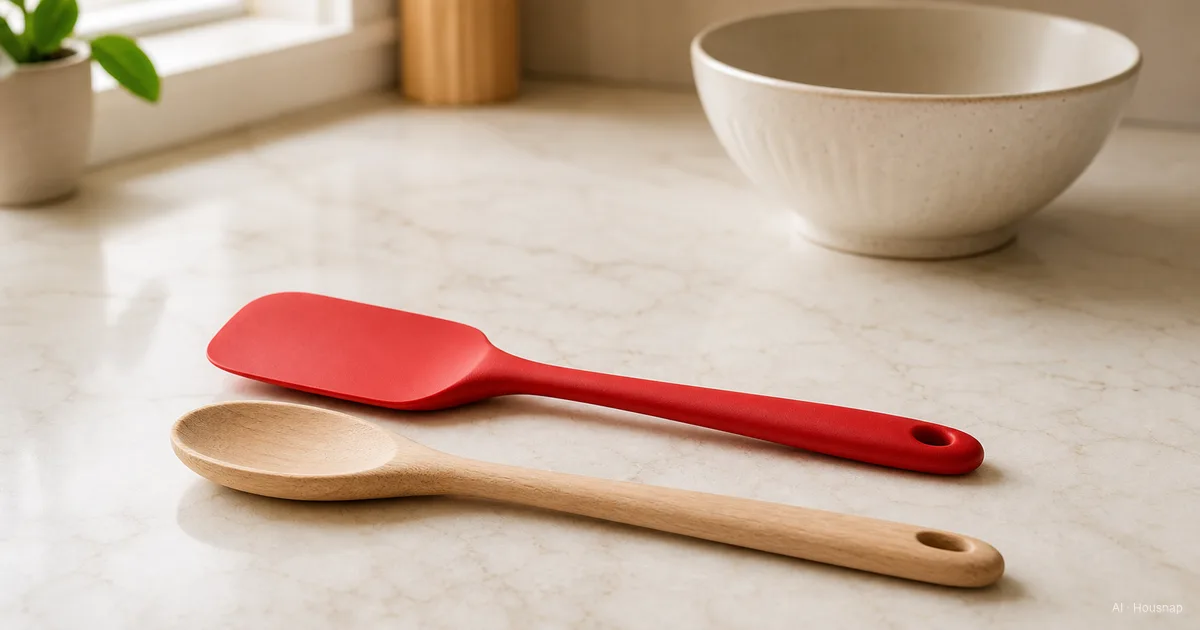
The silicone spatula and the wooden spoon are both stirring and mixing tools in the broadest sense, but they were developed for different problems and excel in different domains. Conflating them because they look similar from a distance leads to under-use of both.
What each does well
A silicone spatula's core strength is its flexibility. The working head conforms to the curve of a bowl, which means it can scrape residue all the way to the edge with minimal waste. When you are folding egg whites into a batter, the flat face of a spatula allows you to cut through the mixture and turn it over without deflating the air bubbles the way a rigid spoon would. When you are making a custard or a butter sauce, a heat-resistant silicone spatula reaches into the corners of a saucepan where wooden spoons and whisks cannot — the curve of the pan meets the flat surface of the spatula flush, and the mixture does not sit and scorch in a neglected corner (Alice Medrich, Chewy Gooey Crispy Crunchy Melt-in-Your-Mouth Cookies, referenced in Serious Eats).
A wooden spoon's core strength is its rigidity and thermal mass. When you are building a roux, stirring the mixture requires sustained pressure and back-and-forth motion against the bottom of the pan. A silicone spatula flexes where the wooden spoon pushes through. When you are cooking a Bolognese or a tomato sauce for forty minutes, a wooden spoon in the sauce gives you something solid to lean into when the mixture wants to stick and pull away from the bottom. The wooden spoon also tastes the sauce in a way that is practical — you can bring the back of the spoon to your lips without burning yourself on metal and without picking up the plasticky warmth of silicone. Wooden spoon handles stay cool much longer than metal does, which matters when the handle sits across a pot of simmering liquid for a moment while you add an ingredient.
The wooden spoon is also structurally suited to scraping fond — the browned bits on the bottom of a pan after searing meat. The rigid edge of a wooden spoon lifts fond without scratching most pan surfaces. Silicone, being soft, will wipe over fond without lifting it.
Heat resistance and nonstick compatibility
Silicone is rated to withstand temperatures that cover most cooking scenarios. Food-grade silicone typically handles continuous exposure to 260°C and short-term exposure higher than that. For practical stovetop and oven work, this means a silicone spatula will not melt, deform, or transfer plastifiers into food under any normal cooking condition. The caveat is direct flame contact — resting a silicone spatula across the edge of a very hot cast iron pan or placing it near a burner's flame will char and damage the head faster than thermal ratings suggest, because direct radiation and contact with a very hot surface are different from ambient oven temperature (Silicone, Wikipedia).
For nonstick pans, silicone is the correct material. It does not scratch PTFE or ceramic coatings. A wooden spoon used on a nonstick surface is also generally safe — the wood is soft enough that it will not damage the coating. Metal spatulas and metal spoons are what to avoid on nonstick.
A wooden spoon has no defined heat rating and does not need one. Wood is a poor conductor of heat, so the handle stays cool while the bowl of the spoon soaks in whatever is being cooked. The working head will eventually char if left in a very hot dry pan, but in the wet environment of a sauce or stew it handles any cooking temperature home stoves can produce. Wood should not go in a very hot oven for extended periods — at sustained temperatures above 180°C it begins to dry out and char — but it is suitable for stovetop work at any practical temperature.
One-piece vs. two-piece silicone spatulas
The hygiene case for one-piece silicone spatulas is straightforward. A two-piece spatula has a joint where the silicone head meets the handle. That joint is a gap where food and moisture collect. Even after washing, a two-piece spatula can harbor residue in the joint that dries, becomes invisible, and then re-hydrates the next time the spatula is used. In a professional kitchen context, this is a food safety concern. In a home kitchen, it is a long-term hygiene issue that most people never notice until they take apart a spatula they have used for a year and find what is inside.
A one-piece silicone spatula is molded as a single unit with no joint. The handle is silicone all the way through, or the silicone head is overmolded onto a core that extends without interruption into the handle. There are no seams where food can hide.
The tradeoff with one-piece silicone handles is that silicone is slightly less pleasant to grip over extended stirring than a wooden or composite handle. Silicone can feel sticky when your hand is damp. For short tasks it does not matter; for long stirring sessions it is noticeable. This is a real tradeoff, not a trivial one — but the hygiene argument is decisive enough that one-piece designs are worth the minor grip compromise.
Hardwood species in wooden spoons
Most wooden spoons are made from one of a handful of species: beech, olive, bamboo, maple, cherry, or teak. The choice of wood affects how the spoon performs, how long it lasts, and how easy it is to care for.
Beech is the most common wood in European-made spoons. It is dense, smooth-grained, and takes seasoning oil well. It does not crack easily with use and does not impart flavor to food. It is practical and uninteresting, which is precisely the right quality for a kitchen tool.
Olive wood is harder and denser than beech, with a distinctive grain pattern. It takes seasoning exceptionally well, is highly resistant to cracking, and handles water exposure better than lighter woods. It does not absorb odors or flavors. The tradeoff is that olive wood spoons are more expensive and the wood is less uniform, so each spoon is slightly different in weight and thickness.
Bamboo is technically a grass, not a hardwood, but it is used and sold as a wood alternative. It is harder than most true woods, lightweight, and inexpensive. The concern with bamboo is that it is often assembled from strips glued together, and the adhesive is a potential failure point when the spoon is repeatedly subjected to hot water and scrubbing. Solid bamboo (non-laminated) is more durable. Bamboo also dries out more quickly than beech or olive and requires more frequent oiling (Wood, Wikipedia).
Avoid softwoods — pine, spruce, and similar species — for kitchen spoons. They are porous and absorb flavors, stain easily, and degrade quickly with moisture exposure. Anything sold in a kitchen store under a recognizable brand is unlikely to be a softwood, but unbranded spoons from general merchandise stores sometimes are.
Seasoning and care for wooden spoons
A wooden spoon is a porous tool that absorbs oil and water. Treating it with food-safe oil — commonly food-grade mineral oil, beeswax-based conditioners, or flaxseed oil — seals the surface, prevents cracking, and slows water absorption. The seasoning of a wooden spoon is simpler and less critical than cast iron seasoning, but the basic practice is the same: coat the wood, let the oil soak in, wipe off excess, repeat.
The first treatment is the most important. A new wooden spoon, just out of the packaging, should be oiled before its first use. Apply a generous coat of food-grade mineral oil, let it soak in for several hours or overnight, wipe off the excess, and let it dry. This initial saturation protects the wood from the moisture it will encounter in cooking and slows the process of cracking and splitting that plagues untreated spoons.
The ongoing care rule is simple: do not soak wooden spoons in water, do not put them in the dishwasher. Water that sits in wood grain for extended periods causes swelling, which then leads to cracking when the wood dries. A wooden spoon that has been through dozens of dishwasher cycles will be dry, rough, and prone to splintering. Hand-wash wooden spoons promptly after use, dry them upright so water drains away from the bowl, and re-oil every few months or when the wood looks dry.
A wooden spoon that is well cared for improves with use. The wood darkens slightly from oils and sauces, the grain becomes smoother, and the seasoning layer builds up in a way that makes the spoon feel more substantial. A cast iron parallel: the spoon at its best is not the one that came out of the package, but the one that has been used and cared for over years.
When to use which tool
Fold a cake batter, brownie batter, or muffin mix: silicone spatula. The flat face and flexibility preserve the air incorporated into the batter. A wooden spoon or a rigid spoon used in folding deflates the structure and makes baked goods dense.
Scrape a bowl, a food processor, or a blender jar: silicone spatula. Nothing else reaches curved surfaces with the same efficiency. A wooden spoon scrapes flat surfaces adequately but misses the curve.
Stir risotto for twenty minutes: wooden spoon. The physical work of pushing the mixture and abrading the starch from the rice requires sustained pressure. Your hand will fatigue holding a flexible spatula in that position long before it fatigues with a rigid spoon.
Cook a caramel or a custard in a saucepan: silicone spatula. The continuous scraping of the bottom and corners is exactly what a spatula's flexible head does well. A wooden spoon leaves corners unscraped.
Deglaze a pan and scrape up the fond: wooden spoon. The rigid edge is what lifts the browned bits without scratching the pan.
Cream butter and sugar: both work, but a wooden spoon is traditional and gives a slightly better sense of the mixture's consistency than a spatula. For very large batches, a spatula's flexibility helps gather and return the mixture from the bowl edges.
Why you need both rather than picking one
The argument for owning both is not that one cannot substitute for the other in a pinch — it can, with compromises. The argument is that using the right tool for each task makes cooking easier in a way that is subtle but cumulative. When a caramel stops catching in the corner of the pan, when a cake batter folds in thirty seconds rather than sixty, when a risotto cooks without sauce splattering off a too-flexible tool — the meals improve and the experience of cooking improves.
Both tools are inexpensive. A good beech wooden spoon and a one-piece silicone spatula together typically cost less than the cheapest piece of cookware. There is no financial argument for restricting yourself to one. The investment in both is trivial and the return in day-to-day cooking ease is not.
Owning both also means each tool can be used for what it does best rather than pressed into service for tasks it handles poorly. A wooden spoon used for folding creates over-mixing. A silicone spatula used for stirring a stiff polenta gets exhausting. Using each for what it is designed for is the version of the kitchen experience where the tools help rather than resist.
Sources
- The Best Silicone Spatulas, Serious Eats — real-use testing of one-piece vs. two-piece designs, head flexibility, heat resistance
- The Best Wooden Spoons, America's Test Kitchen — species comparison, durability testing, and handle evaluation
- Silicone, Wikipedia — material properties and food-grade rating standards
- Wood, Wikipedia — wood species characteristics, grain, and moisture response