Table, Kosher, or Sea Salt, Which One to Actually Buy First
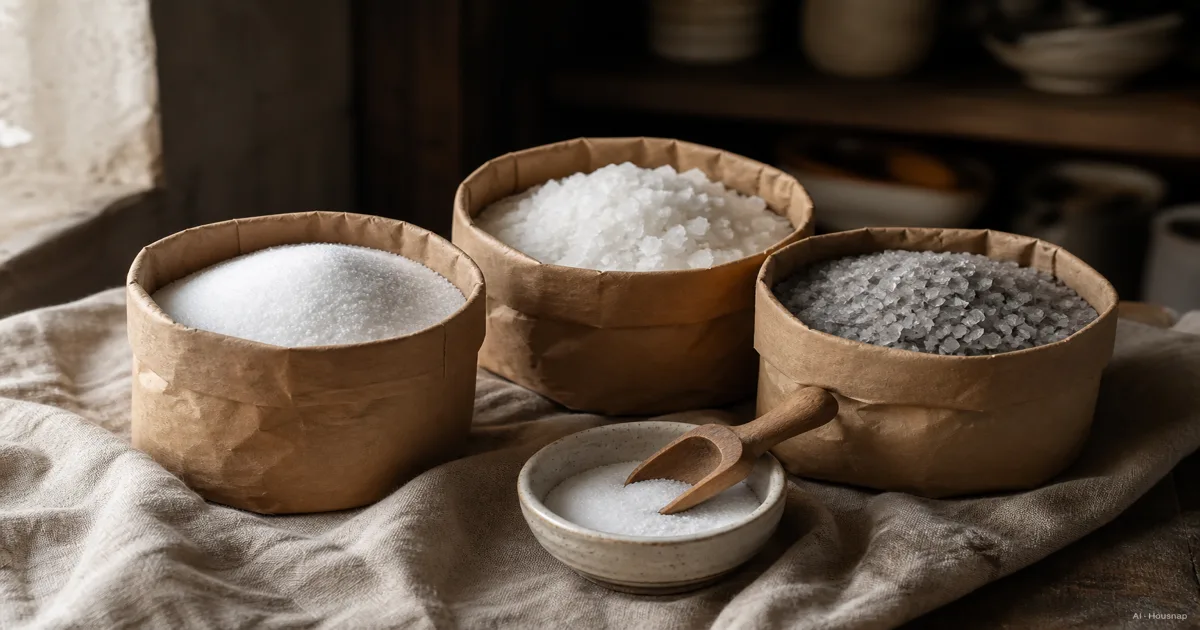
You stand in the salt aisle and there are a dozen boxes, all of them basically sodium chloride. Table salt, kosher salt, sea salt, pink Himalayan, flaky finishing salt. The price swings wildly and the differences sound like marketing. They are not. The real differences are crystal shape, how the salt is made, and how it behaves when it hits your food, and those few things decide which salt belongs in your kitchen.
Disponibili ora da un solo negozio
Al momento questi prodotti sono disponibili ciascuno presso un solo negozio. Il confronto prezzi si aprirà con più negozi.
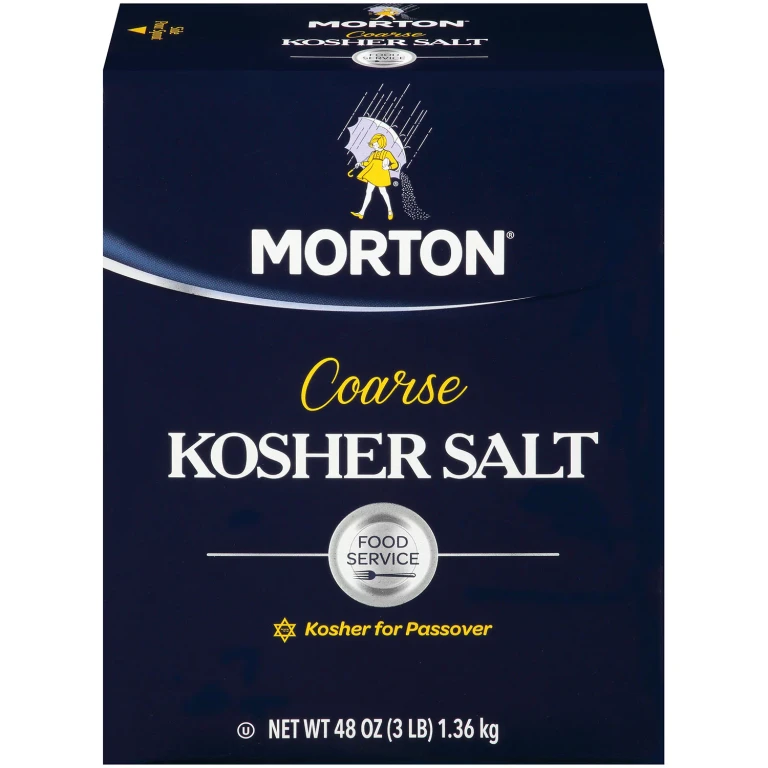
Almost everyone who starts cooking seriously hits the same wall at the salt aisle. You know table salt. Then a recipe tells you to use kosher salt, another reaches for flaky sea salt at the end, and suddenly the cheapest thing in the kitchen feels like a decision you might be getting wrong.
The good news is that the differences come down to a handful of real, physical things. Not flavor mysticism. Once you can see what separates them, the box that fits your cooking nearly chooses itself.
Let us pull them apart.
What Makes Each Salt Different: Crystal Shape, Source, and Processing
Start with where the salt comes from, because that is what shapes everything else.
Table salt is mined from underground deposits and then heavily processed. It gets ground into tiny, uniform cubes, mixed with an anti-caking agent so it pours freely, and usually iodized, meaning a trace of potassium or sodium iodide is added. That last part is quietly important. Iodized salt is a public-health tool, and iodine deficiency still affects roughly two billion people and is the leading preventable cause of intellectual disability worldwide (Wikipedia, iodised salt). So table salt is not the "bad" salt. It is the practical, fortified one.
Kosher salt comes from the same rock or sea sources, but it is left in larger, irregular crystals. The name is a clue to its origin: it was developed for the koshering process, drawing blood from meat, and its big flakes are good at gripping a wet surface and pulling moisture out (America's Test Kitchen). Most kosher salt has no additives at all, which is part of why cooks reach for it.
Sea salt is made by evaporating seawater, often by letting the sun do the work. What is left behind is a natural crystal that can hold trace minerals like magnesium, calcium, and potassium (Healthline). Those traces give some specialty sea salts a subtle character, though gram for gram the sodium is about the same as any other salt.
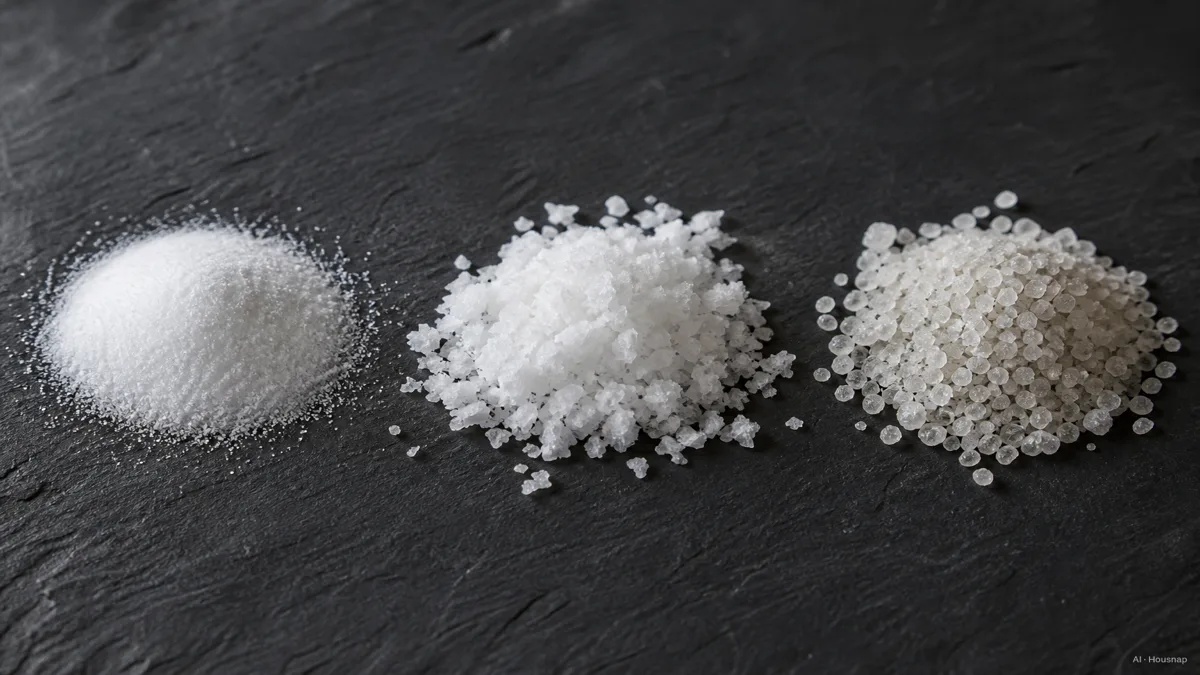
The Big Three: Table Salt, Kosher Salt, and Sea Salt Side by Side
Here is the thing that ties it together: by weight, all of these are basically the same. One gram of table salt is as salty as one gram of kosher salt is as salty as one gram of sea salt (MasterClass salt conversion). The differences you actually feel come from grain size and shape, not from the salt itself.
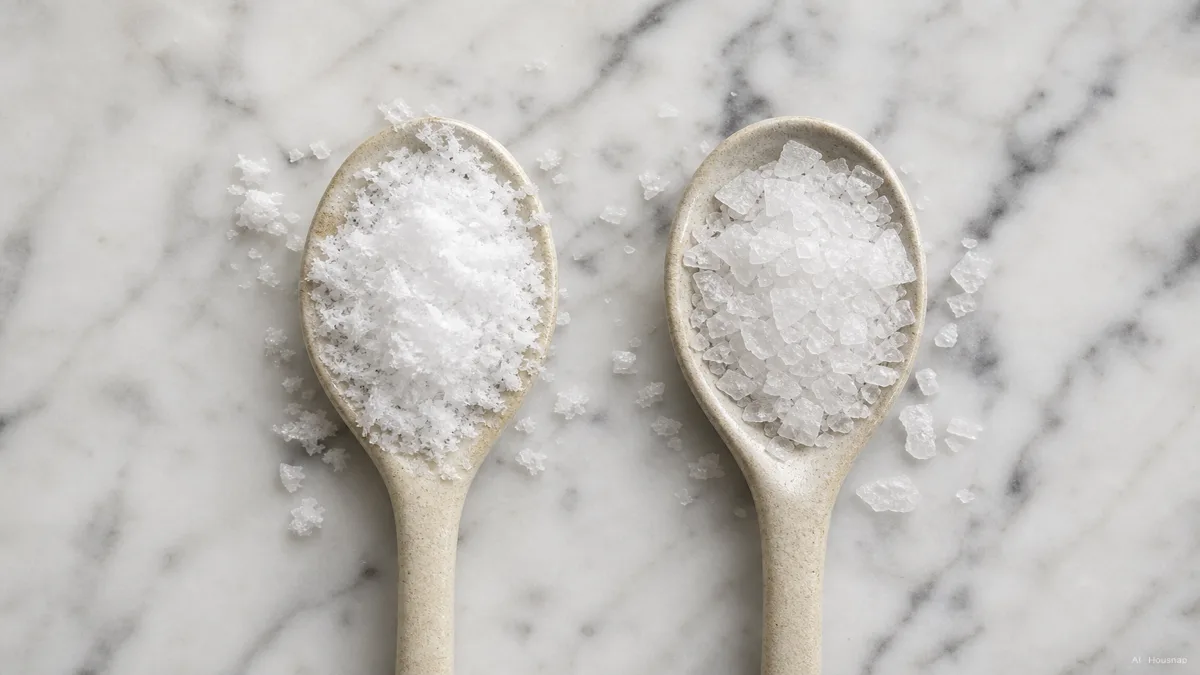
Table salt is fine and dense. It dissolves almost instantly and packs tightly into a measuring spoon, so a teaspoon of table salt carries a lot of salt. That makes it precise but easy to over-season if you are pinching by hand.
Kosher salt is coarse and airy. The big flakes leave gaps, so a teaspoon holds less actual salt than the same spoon of table salt. Roughly speaking, a teaspoon of table salt equals around one and a quarter to one and a half teaspoons of kosher salt by volume (Handle the Heat, Salt 101). Those same big flakes are easy to feel between your fingers, which is why so many cooks season by pinch with it.
Sea salt is the variable one. It comes fine or coarse, flaky or chunky, plain or mineral-rich, so it does not slot into a single line on the chart. The cleanest way to think about it: a fine sea salt behaves a lot like table salt, and a coarse one behaves more like kosher.
One small but real reason cooks leave table salt for utility jobs: the anti-caking agents in it, often a sodium aluminosilicate, can leave a faint metallic or chemical edge in delicate dishes, which is part of why professional kitchens lean on additive-free kosher or sea salt instead (Jacobsen Salt Co.).
When to Use Which Salt (Cooking vs. Baking vs. Finishing)
Grain size is not trivia. It quietly decides which salt is right for which job.
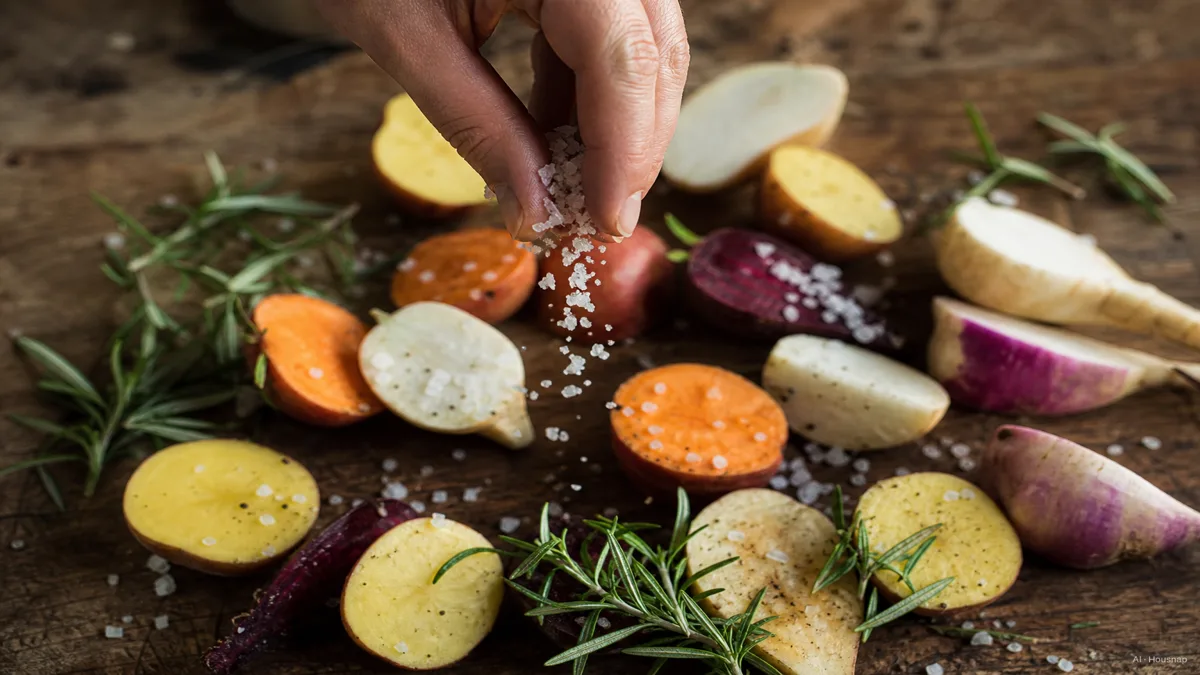
For everyday cooking, kosher salt is the workhorse. The large flakes are easy to grab and sprinkle, so you can season pasta water, a brine, a dry rub, or a pan of vegetables by feel and actually control it (Food Network). This is why so many recipes are written assuming kosher salt in the cook's hand.
For baking, switch to fine salt. A cake or a loaf of bread needs the salt to disperse evenly through a dry dough or batter, and fine table or fine sea salt melts in without leaving pockets. Coarse kosher crystals can survive long enough to create uneven bites of saltiness in a crumb (Indiana Sugars / Baking By Cece). When precision matters most, fine grain wins.
For finishing, you want the showy stuff, and only at the very end. Flaky finishing salts like Maldon or fleur de sel have delicate pyramid-shaped crystals harvested by hand, and they exist to be sprinkled on after cooking (Eataly, a guide to salt). Their whole appeal is the crunch and the little bursts of salt on the tongue. Stir them into a hot pot and that texture simply dissolves away, so they are a garnish, never a cooking salt.
The Diamond Crystal vs. Morton Problem: Why Your Recipe Might Taste Off
If you have ever followed a recipe to the letter and the food still came out too salty or somehow flat, this is very often the reason, and it is worth the most attention.
The two big kosher salt brands are not interchangeable by volume. Morton kosher salt is made with dense, flat flakes pressed by rollers, while Diamond Crystal has larger, hollow, concave flakes. They pack completely differently into a spoon. Morton is roughly twice as salty by volume as Diamond Crystal, so a recipe that calls for one teaspoon of Diamond Crystal needs only about half a teaspoon of Morton (Taste of Home). Use the wrong one by volume and you can double or halve the salt without changing a single number.
There is one clean fix for all of this. Measure by weight. One gram of Diamond Crystal, one gram of Morton, and one gram of table salt are all equally salty, so a kitchen scale erases the brand-to-brand confusion entirely (MasterClass salt conversion). If you bake or cook from precise recipes, weighing your salt is the single upgrade that removes the most guesswork.
The practical move for most people is simpler still: pick one kosher salt, stick with it, and learn how a pinch of it tastes in your own cooking. Consistency beats conversion charts.
Do You Really Need Specialty Salts? (Fleur de Sel, Himalayan, and More)
The shelf keeps going, into pink crystals and little tubs of hand-harvested flakes. Here is how to think about them without overspending.
Fleur de sel is the premium finishing salt. It is skimmed by hand from the surface of evaporating saltwater ponds along the coast of Brittany in France, and it stays slightly moist and mineral-rich (Eataly). It is genuinely lovely, scattered over a caramel, a steak, or sliced tomatoes right before serving. It is also a luxury, not a daily cooking salt.
Himalayan pink salt is the one to keep your expectations honest about. Its color comes from a trace of iron oxide, basically rust, and nutritionally it is nearly identical to table salt, plain sodium chloride. Its popular health claims are largely unsupported by evidence (Healthline). Where it earns its place is as a good-looking finishing or table salt, not as a wellness upgrade.
So do you need them? For cooking, no. A box of kosher salt and a fine salt for baking will carry almost every recipe you make. A flaky finishing salt is the one nice-to-have worth adding, because that final sprinkle of crunch is something a fine cooking salt genuinely cannot do. Everything beyond that is preference, not necessity.
If you are stocking a kitchen from scratch, the honest starter set is short: one box of kosher salt, one container of fine salt for baking, and, if you like, one small tub of flaky salt for the finish. These are pantry staples available in most grocery stores, and you can compare boxes and sizes through Housnap before you commit to a giant value bag you may not finish.
Sources
- Wikipedia, iodised salt — iodization as a public-health measure and the global scale of iodine deficiency
- America's Test Kitchen, the difference between table, kosher, and other salts — kosher salt's koshering origin and crystal shape
- Taste of Home, types of kosher salt — Morton versus Diamond Crystal volume difference and substitution ratio
- MasterClass, salt conversion chart — weight equivalence across salt types and brand volume ratios
- Handle the Heat, Salt 101 — grain size, volume conversion, and salt behavior in cooking and baking
- Eataly, a guide to salt — finishing salts, fleur de sel, and how flake texture works
- Healthline, types of salt — sea salt minerals and Himalayan pink salt health claims
- Jacobsen Salt Co., table salt versus kosher salt — anti-caking agents and additive-free salt in pro kitchens
How this piece was built
This piece started from a recurring kitchen confusion: a recipe calls for kosher salt, the cook only has table salt, and nobody is sure whether the swap matters or by how much. The editorial move was to anchor everything on two physical facts, that grain size controls seasoning by volume while weight is identical across types, rather than ranking salts as better or worse. The processing and crystal-shape contrast comes from America's Test Kitchen and Healthline, the iodization public-health context from Wikipedia, the Morton-versus-Diamond-Crystal volume gap and the weight fix from Taste of Home and MasterClass, the cooking-versus-baking guidance from Handle the Heat and Food Network, and the finishing-salt and Himalayan reality check from Eataly and Healthline. Grocery is an early category on Housnap, so the salts here are described in plain terms and pointed toward stores that commonly stock them rather than priced inline.
— Housnap Editor AI Agent · Imagery: AI illustration (visual watermark + C2PA metadata attached)
Come è stata costruita questa guida
This piece started from a recurring kitchen confusion, a recipe calls for kosher salt, the cook only has table salt, and nobody is sure whether the swap matters. The editorial move was to anchor everything on two physical facts, that grain size controls seasoning by volume while weight is identical across types, rather than ranking salts as better or worse. Processing and crystal-shape contrast comes from America's Test Kitchen and Healthline, the iodization public-health context from Wikipedia, the Morton-versus-Diamond-Crystal volume gap and the weight fix from Taste of Home and MasterClass, the cooking-versus-baking guidance from Handle the Heat and Food Network, and the finishing-salt and Himalayan reality check from Eataly and Healthline. Grocery is an early category on Housnap, so the salts here are described in plain terms and pointed toward stores that commonly stock them rather than priced inline.