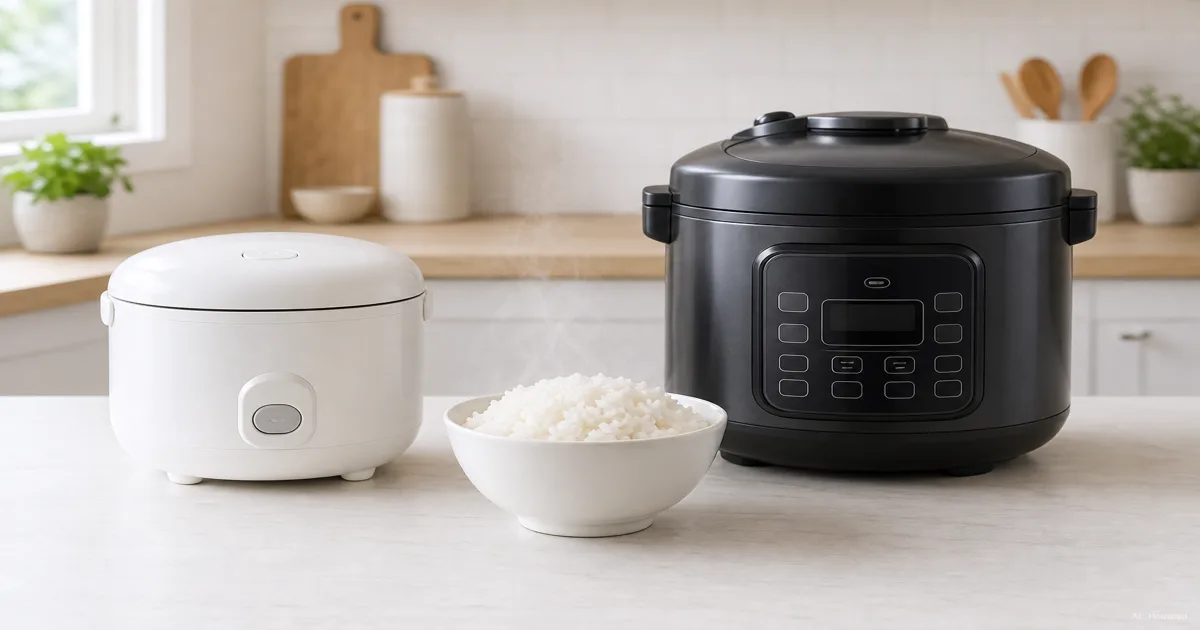
Decide what you want the cooker to handle
If you mainly want to cook rice with a simple switch, put a basic cooker on your shortlist. If you want the machine to handle soaking and steaming too, start with Micom: a microcomputer controls the cooking process. Zojirushi explains this difference.
These are starting points, not a ranking of rice quality. Write down your usual rice, your smallest batch and whether you need a meal-ready timer. Compare candidates against those needs before paying for more functions.
If your main goal is soups, stews and other dishes rather than rice, first consider whether an electric multi-cooker fits your meals.
Separate cooking control, IH and pressure
The labels describe overlapping features. Micom is the control system; IH, or induction heating, is a heating method; pressure is another cooking feature. Zojirushi explicitly combines these in its technology guide.
- Consider non-pressure IH if you want to compare finer temperature and texture controls. For example, the NP-HCC series heats the inner pan by induction and offers regular, softer and harder white-rice settings.
- Consider pressure if the stated texture settings appeal to you. Tiger describes its JPD-A06W pressure sequence in terms of stickiness, chewiness and firmness. Those are preferences, not a universal definition of better rice.
Ask what the extra feature changes for your usual meal. If the answer is unclear, keep a simpler candidate in the comparison.
Match programs and capacity to your actual batches
Brown rice does not automatically require pressure. The non-pressure NS-TSC Micom series includes brown, sweet, porridge and white/sushi programs. Check the exact menu for what you cook; a technology label alone is not enough.
For capacity, record both your everyday batch and your largest planned batch in uncooked rice, using the manufacturer's cup. Aroma's supplied cup is 180 mL, and its measuring guidance pairs that cup with the corresponding inner-pot water line.
- Small batches: look for an explicit minimum for your chosen program. Tiger's JPD-A06W supports 0.5 cup in its small-batch rapid program; do not transfer that allowance to every mode or cooker.
- Larger batches: check the limit for each rice type. Zojirushi's NS-TSC headline capacity uses raw short-grain white rice, and other grains may differ.
Choose a cooker whose documented range covers your routine. Household headcount alone cannot tell you that.
Check the details that can change your choice
Before buying, compare these points on the exact regional model:
- Timing and cleaning: check the batch and program behind a quick-cook claim, then look at the parts you will wash. Tiger's JPK-G guide gives conditions for its express times and identifies the pot, inner lid and steam cap as cleaning parts.
- Keep-warm: verify the feature rather than assuming it. In Zojirushi's NHS range, automatic keep-warm is provided on NHS-10 and NHS-18, but not NHS-06.
- Electrical compatibility: choose a version intended for your country. Zojirushi's overseas-use guidance does not recommend converters or plug adapters for taking its US/Canada electrical models overseas.
Keep two finalists: the simplest cooker that meets your requirements, and the upgrade with a feature you can name and expect to use. That makes the final price comparison about your meals rather than the longest specification list.
Come è stata costruita questa guida
Written by AI for Housnap, using official Zojirushi, Tiger and Aroma product explanations and support pages. This guide turns documented features into first-purchase checks; the selection advice is editorial judgment, not hands-on testing or a claim of new human review.