Puppy Food vs Adult Dog Food, What to Buy First and When to Switch
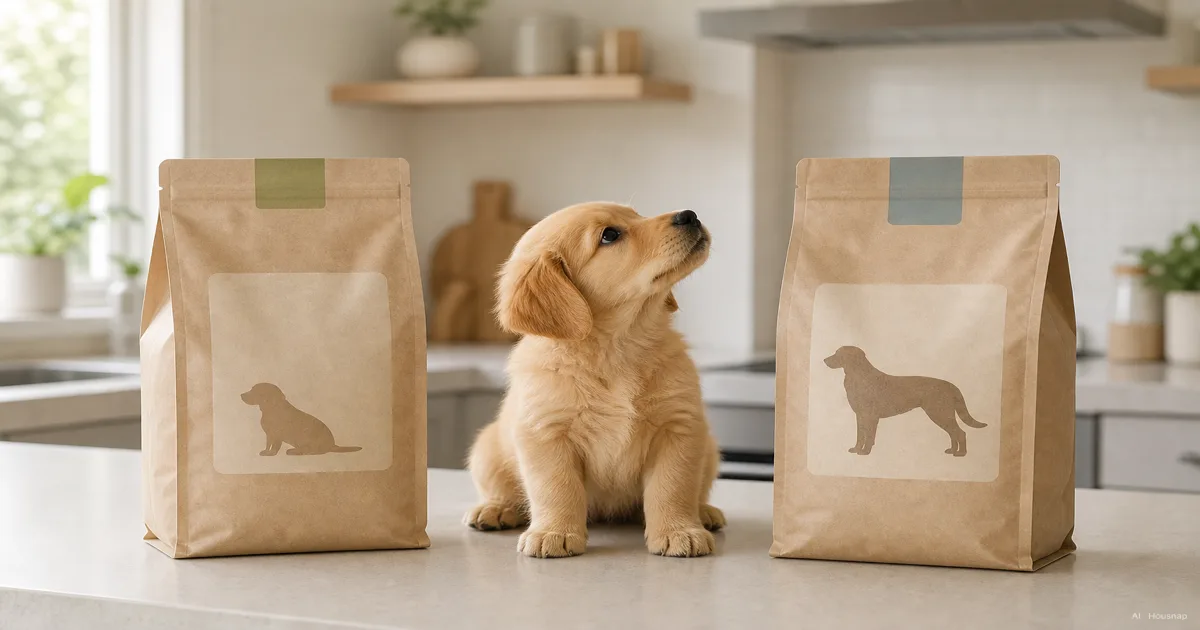
You bring a puppy home, and within a day you are standing in front of a wall of bags. Most look almost identical. Same brand, same picture of a happy dog, but one says puppy and one says adult, and they cost about the same. So a reasonable first thought is that the puppy version is just marketing. It is not. The difference is built into the recipe, and it exists because a puppy is doing something an adult dog is not. It is growing, fast, building bone and muscle and a nervous system in a matter of months. Feed it the wrong formula and you do not see a problem the first week. You see it later, in joints, in weight, in growth that went too quick. Here is the good news. You only really have to get three things right. The first is understanding what makes puppy food different so you can read a label with intent. The second is knowing whether your dog is a large breed, because that flips one rule completely. The third is timing the switch to adult food by your dog's eventual size, not by the calendar. Get those three, and the rest is just picking a bag.
Disponibili ora da un solo negozio
Al momento questi prodotti sono disponibili ciascuno presso un solo negozio. Il confronto prezzi si aprirà con più negozi.
What Makes Puppy Food Different: Protein, Fat, and DHA
Start with the numbers, because they are the reason the two bags are not interchangeable. AAFCO sets a higher floor for growth than for adult maintenance. Puppy food needs a minimum of 22.5 percent protein on a dry matter basis, against 18 percent for adult food, and at least 8.5 percent fat against the adult minimum of 5.5 percent, as the AAFCO guide to selecting pet food lays out. That higher fat is not indulgence. It is fuel. A growing puppy burns energy at a rate an adult dog simply does not, and fat is the densest way to deliver it.
Then there is one ingredient that adult food often skips entirely: DHA. That is docosahexaenoic acid, an omega-3 fatty acid, and it does something specific. It supports brain and eye development during the window when a puppy's nervous system is still wiring itself. Brands like Purina, Hill's Science Diet, and Royal Canin add it deliberately, and the PetMD overview of puppy nutrition treats it as a growth-stage staple. On the guaranteed analysis, look for DHA listed at a minimum of around 0.1 percent.
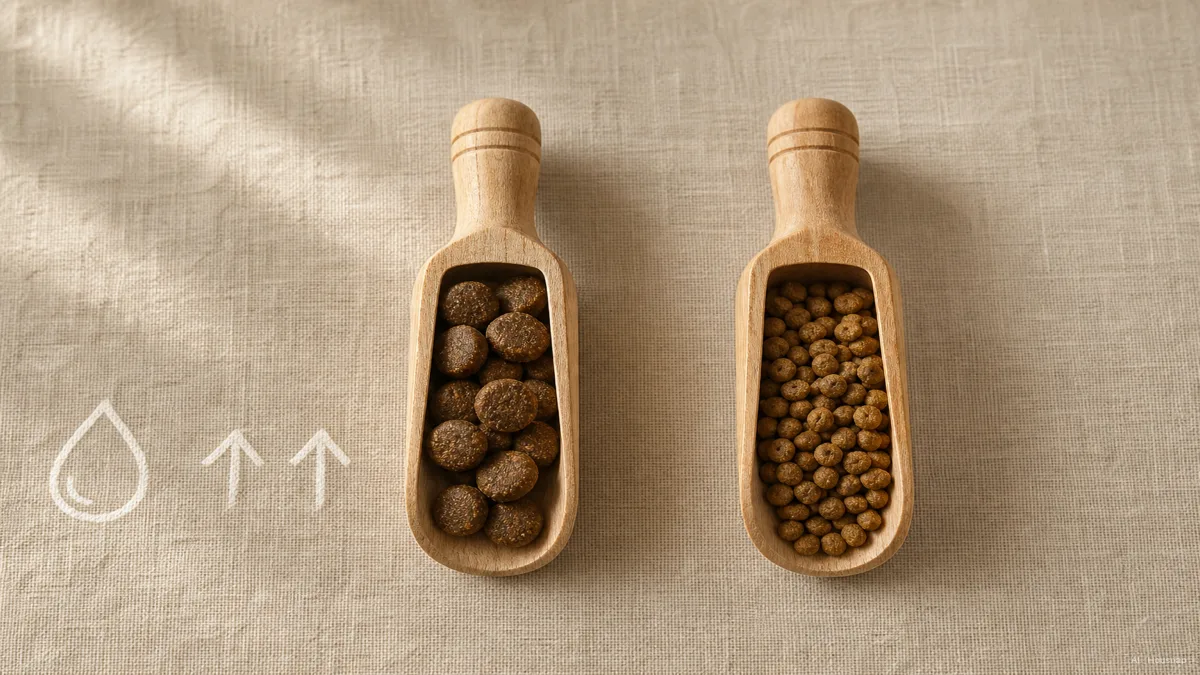
Caloric density follows the same logic. Puppy food typically runs 400 to 500 kcal per cup, while adult food sits closer to 350 to 400. That gap matters in both directions, and it is the most common first-time mistake, feeding the right food in the wrong amount. A cup of puppy food is not a cup of adult food. Measure by your dog and the bag's chart, not by habit.
One practical marker ties it together. Puppies usually eat three meals a day; adult dogs settle into two. When you notice the feeding schedule naturally shrinking, you are already near the territory where the food itself is about to change.
The Large-Breed Trap: Why Your Big Puppy Needs a Special Formula
Here is where one rule flips, and it catches a lot of well-meaning owners. For a small or medium puppy, more calcium and more calories mean healthy growth. For a large or giant breed puppy, the same abundance becomes a risk.
The reason is biology. Most adult dogs regulate how much calcium they absorb from the gut, taking what they need and passing the rest. Puppies cannot do this. As VCA Animal Hospitals explains, a young puppy absorbs excess dietary calcium rather than excreting it, so a calcium overload genuinely accumulates. In a breed that is already growing fast and carrying weight, too much calcium and too much energy push the skeleton harder than it can safely keep up with.
The stakes are not cosmetic. Overfeeding calories and calcium to a large or giant breed puppy, meaning one whose expected adult weight is over 50 pounds, raises the risk of developmental orthopedic diseases like hip and elbow dysplasia. That is why large-breed puppy formulas are deliberately lower in calcium and less energy-dense than standard puppy food. They are engineered to slow growth down to a safer pace, not speed it up.
So the practical rule is simple. If your puppy will grow into a large or giant adult, buy a formula that says large breed on it, not just puppy. This is the one place where a generic puppy bag, however premium, can be the wrong choice.

When to Switch: A Simple Breed-Size Timeline
The switch to adult food is not tied to a fixed age. It is tied to size, and the cleaner rule of thumb is to make the change when your dog reaches about 80 percent of its expected adult size. Because breeds grow at different speeds, that lands at very different ages.
The American Kennel Club's breed-size timeline breaks it down cleanly. Small breeds under about 25 pounds finish growing early and can switch around 9 to 12 months. Medium breeds between 25 and 50 pounds switch later, roughly 12 to 15 months. Large and giant breeds over 50 pounds keep growing the longest and should stay on puppy or large-breed puppy food until 15 to 24 months. A toy breed eating puppy food at 18 months is overdue; a Great Dane eating adult food at 10 months switched far too soon.
Switching too late is its own mistake, not a safe default. Keep a fully grown dog on puppy food and the extra calories and fat tip toward obesity, while the sustained high calcium can stress bones and joints in a body that no longer needs the growth support. The PetMD switching guide frames it as a real window, not an open-ended option.
When you do switch, go slow. Transition over 7 to 14 days, mixing a rising share of adult food into a falling share of puppy food, exactly the gradual approach VCA Animal Hospitals recommends for any diet change. An abrupt swap is the fast track to an upset stomach.
How to Read the AAFCO Label Statement (the One Thing That Actually Matters)
If you remember only one habit from all of this, make it this one. Before any bag goes in the cart, find the AAFCO nutritional adequacy statement on the back. It is the fastest, most reliable quality signal a label gives you.
For a puppy, you want a sentence that says the food is complete and balanced for growth, or for all life stages including growth of large-size dogs if you have a big breed, as the AAFCO selecting-pet-food guide describes. A formula labeled only for adult maintenance is not appropriate for a puppy, no matter how good the brand or how premium the price. That single line tells you the recipe was actually formulated for the life stage you are feeding.
The large-size growth wording matters specifically for big breeds. An all life stages food that does not carry that qualifier may not be controlled for calcium the way a giant-breed puppy needs. So if your dog is going to be large, the label has to say so, not just imply it.
Put the checks together and the decision gets concrete. Confirm the AAFCO statement matches growth, pick a large-breed formula if your dog will be big, and plan the switch by adult size rather than by age. From there the useful next move is to filter puppy and adult options side by side, see what the leading brands charge across stores for the same formula, and check that the bag you land on lines up with the dog you are actually raising.
Top Brands to Consider: Puppy and Adult Picks by Life Stage
Brand choice matters less than getting the life stage and the AAFCO statement right, but a few names come up again and again for a reason, and knowing the landscape makes the comparison less daunting.
Purina Pro Plan and Hill's Science Diet are the two most broadly vet-recommended kibble lines, and both run dedicated puppy, large-breed puppy, and adult formulas, so you can keep a single brand across the switch if your dog does well on it. The NBC News Select roundup of vet-recommended puppy food leans heavily on both. Royal Canin takes a different angle, with 40-plus breed-specific and size-specific formulas, which is useful precisely when breed size is the deciding factor in this guide.
Beyond those, IAMS, ORIJEN, and Taste of the Wild show up across mainstream and specialty stores, and the Dog Food Advisor best puppy foods list is a reasonable place to sanity-check a shortlist against independent scoring. None of this replaces the label check. A breed-specific bag still has to carry the right AAFCO growth statement, and the brand is the last filter, not the first.
The practical takeaway is to treat the brand as a tiebreaker. Decide the life stage, decide whether you need large breed, confirm the AAFCO line, and only then compare prices across the names that actually stock both puppy and adult lines, so the choice stays grounded in what you can really buy.
Sources
- Selecting the Right Pet Food — AAFCO; growth minimums of 22.5 percent protein and 8.5 percent fat versus adult 18 and 5.5 percent, and reading the nutritional adequacy statement
- Nutritional Requirements of Large and Giant Breed Puppies — VCA Animal Hospitals; why puppies absorb excess calcium, the orthopedic risk, and gradual diet transitions
- Transitioning from Puppy to Adult Food Based on Breed Size — American Kennel Club; switch timing by small, medium, and large/giant breeds
- When Should You Switch From Puppy to Adult Dog Food? — PetMD; DHA in growth formulas, the 80 percent size rule, and the cost of switching too late
- Puppy Food vs. Adult Dog Food — Purina; higher energy needs of puppies, DHA, and feeding frequency
- Best Puppy Foods — Dog Food Advisor; independent scoring to sanity-check a shortlist
- Best Puppy Food, According to Veterinarians — NBC News Select; vet-recommended brands with puppy and large-breed sub-lines