Identify which zipper does what
Start with the cube empty and expanded. Identify the zipper that opens the clothing compartment and the separate zipper that reduces its depth; check your model’s instructions if their paths are unclear. Two pull tabs on one zipper do not, by themselves, identify two different functions.
Generation Nomad’s operating instructions put the steps in this order: distribute the clothes evenly, close the cube, then tighten its compression closure. This guide follows that sequence for cubes with separate opening and compression zippers.
Compression has a limited job. For its medium cube 3204859, Thule describes removing excess air between clothes and lists pants, shirts and sweaters as intended contents. That is not a promise that any load will compress enough to fit your bag.
Fix the load before pulling the zipper
Eagle Creek accepts both rolling and folding and advises against overstuffing. Choose the method that spreads your particular clothes evenly, rather than treating a tight roll as the answer to every packing problem.
With the compression zipper open, try this loading check:
- Spread the clothes across the base instead of building one tall pile in the middle.
- Move a thick waistband or folded hem away from an already bulky corner. Keep sleeves and loose edges inside the compartment.
- Try closing the main opening. If you have to drag its edges together with the zipper, reopen it and remove an item or rearrange the pile.
Use that last check as a practical stopping rule, not a manufacturer-specified fill line. There is no universal item count or fill percentage established by these sources.
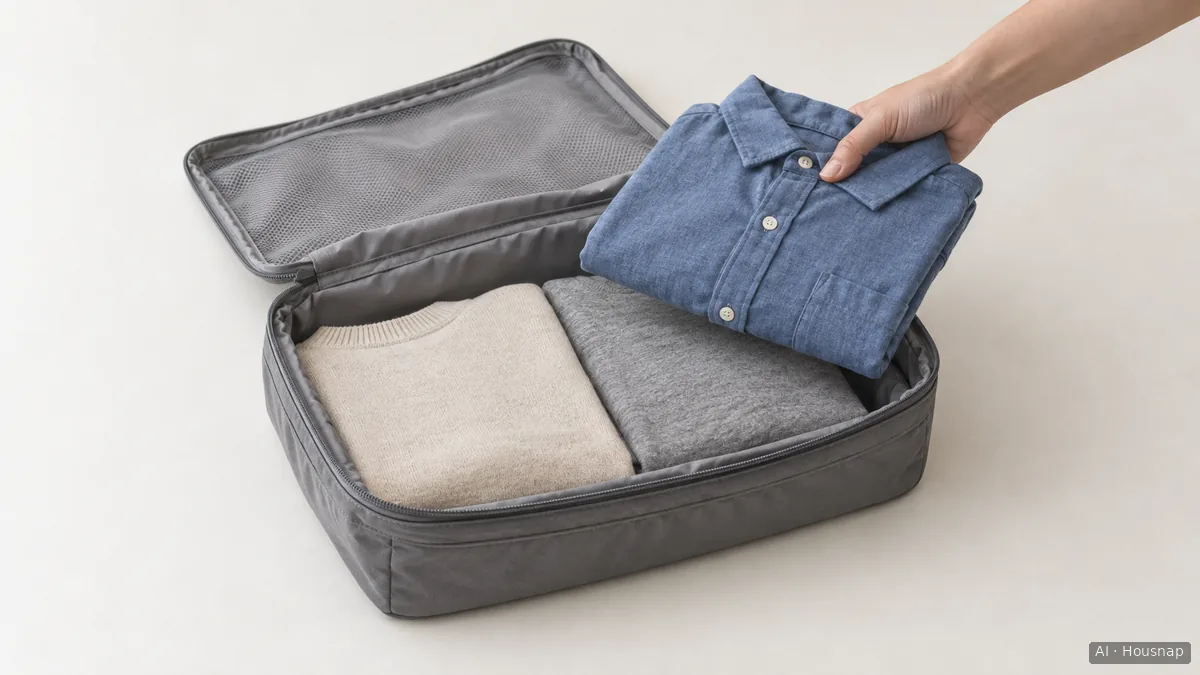
The illustration shows reducing the load before trying again. It does not depict a particular brand’s zipper construction.
When compression stops, check for caught fabric
Once the main opening is closed, move the compression zipper slowly while watching the fabric ahead of the slider, the moving part attached to the pull tab. Keep loose cloth out of its path without pulling the zipper against your fingers.
A reluctant zipper does not always mean too many clothes. Generation Nomad warns that loose fabric can catch when a cube is unevenly filled or not full and is zipped quickly. Do not add clothes simply to eliminate that loose fabric; first check where it is going.
- Fabric caught at the slider: stop pulling forward. YKK advises gently moving the slider the other way to loosen trapped material and warns against forcing it. If it will not release gently, stop the attempt.
- No visible snag, but the load resists closure: reopen only as far as it moves freely, then redistribute or remove clothing before retrying.
- Torn fabric, opening seams or a zipper that still catches when empty: stop using that closure and ask the cube’s maker about assessment or repair. Pulling harder is not a repair method.
Check the packed cube in your actual bag
A closed cube is only half the check. Eagle Creek’s packing guidance also considers how the cubes arrange together inside the travel bag.
Put your loaded cubes in the bag you already own, alongside the shoes, toiletries and other essentials you actually plan to carry. Try closing the bag normally and taking out an item you will need during the journey. If the cubes only fit when the outer bag is forced shut, rearrange them or reduce the load; do not use the bag’s zipper to finish compressing them.
For the return journey, try repacking once without your most careful folds. Leave out anything that makes that ordinary repack unworkable. The aim is a load you can close again during the trip, not just once at home.
No new cube set or compression tool is needed to perform these checks. If your essential load still does not fit and you decide to change the travel bag, continue with choosing a duffle or weekender by its usable layout and loaded fit.
Come è stata costruita questa guida
AI wrote this guide for Housnap using Eagle Creek’s packing guidance, Thule’s identified product information, Generation Nomad’s operating instructions and YKK’s zipper guidance. The loading checks and stop conditions are editorial applications of those sources, not hands-on testing or a universal capacity specification.