Food Processor vs Blender: Which One to Buy First
Most people buying their first kitchen appliance in this category already have a specific problem. Maybe it's the hummus that keeps coming out gritty because you're trying to make it with a blender. Maybe it's the onions you're still chopping by hand, one by one, while your cooking takes twice as long. Or maybe smoothies are what you actually make every morning, and a food processor would just sit there unused. The food processor and the blender look similar on the counter. Both have motors, bowls, and blades. But they solve genuinely different problems, and the confusion about which one to buy first comes from assuming they overlap more than they do. Here is the real difference: a blender needs liquid to work. The vortex it creates only functions when there is enough fluid to pull ingredients down into the blade continuously. Take the liquid away, and the machine stalls. A food processor works on solid and semi-solid food. The S-shaped blade rotates slowly, chopping through whatever is in the bowl in controlled bursts. That is why you can chop an onion in a food processor and why you absolutely cannot do it in a blender. And it is why a food processor makes hummus with the consistency you want, while a blender either overpowers it into something runny or struggles to reach the chickpeas at the bottom. Understanding what you actually cook — not what you plan to cook someday — makes the choice clear.
The core difference: chopping vs blending
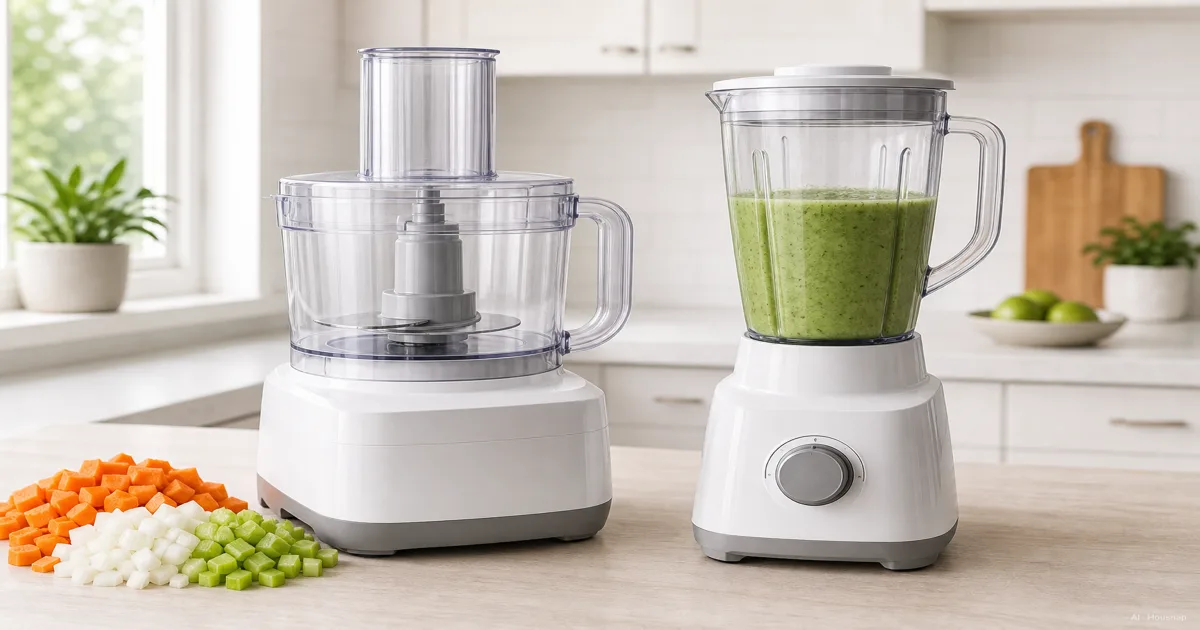
The simplest way to understand the split is to look at the container shape. A blender jar is tall and narrow. That shape exists specifically to create a vertical vortex — liquid and soft ingredients get pulled down continuously and circulate through the blade at the bottom. Take away the liquid, and the vortex collapses. Nothing moves. This is why you cannot chop an onion in a blender: there is not enough liquid to keep the onion pieces circulating, so they just sit there while the blade spins uselessly underneath (KitchenAid).
A food processor bowl is wide and shallow. The S-shaped blade sits lower and sweeps the full diameter of the bowl. You use short pulses — one or two seconds each — to chop solid ingredients without grinding them into paste. The wider bowl also gives space for disc attachments: a slicing disc, a shredding disc, a fine grating disc. These turn the machine into a tool that can slice a full cucumber in seconds, shred a block of cheddar in under a minute, or turn two cups of almonds into almond butter with extended processing.
The practical rule that KitchenAid and most cooking sources agree on: use a blender if the result is something you drink or pour. Use a food processor if the result is something you eat with a fork or spoon (KitchenAid).
What a food processor does that a blender cannot
Chopping is the most frequent daily use. Onions, garlic, herbs, shallots — any of these can be done in a food processor with two or three one-second pulses. What takes four minutes by hand takes fifteen seconds in the machine, with consistent results. The pulse function is key: you control the chop size by the number and duration of pulses rather than letting the blade run continuously.
The disc attachments extend the machine into something closer to a prep station. A shredding disc turns a block of mozzarella into even strands for pizza in about forty seconds. A slicing disc cuts a potato into uniform rounds for gratins. A fine grating disc handles parmesan. These tasks would otherwise require a box grater, a mandoline, or a lot of hand work.
Thick pastes and semi-solid foods are where the food processor genuinely outperforms a blender. Hummus is the classic example — the wide bowl allows the blade to reach and work the chickpeas evenly, and the relatively low liquid content means you get a thick, consistent paste rather than the watery result a blender produces (Chef Approved Tools). Pesto, tapenade, and almond butter all follow the same logic: enough oil or liquid to bring the paste together, but not enough to create a pourable liquid.
Pastry and cookie doughs are another area where the food processor is the right tool. Cold butter in small cubes, pulsed into flour a few times, creates flaky pastry faster and with less warmth from your hands than the traditional cut-in method. The machine stops before the dough develops gluten and toughens — provided you pulse rather than run it continuously.
Where blenders win
Blenders are optimized for liquids and for smooth results. The vortex effect combined with a high-speed motor — most consumer blenders run between 300W and 1,500W — means that ingredients get broken down to a consistent fine texture that a food processor simply cannot match for liquid applications.
Smoothies are the clearest win. Frozen fruit, ice, protein powder, and liquid all benefit from the vortex pulling everything through the blade at high speed. A food processor cannot crush ice effectively because there is no liquid vortex to keep the ice pieces moving into the blade.
Soups blended smooth — like the butternut squash or tomato bisque situations — are better in a blender once cooled (or in an immersion blender, which is covered in a separate topic in this cluster). The blender produces a silkier texture from cooked soft vegetables than a food processor can achieve.
Nut milks, batters, and sauces poured directly into dishes also belong in the blender. The tall jar contains liquid splashing, the vortex distributes ingredients evenly, and the cleanup for liquid recipes is usually simpler — add hot water and a drop of soap, blend for thirty seconds, rinse.
High-end blenders like Vitamix (running at 1,200–2,000W) can blur the line somewhat: at that power level you can make nut butter, process hot soups directly, and get results close to what a food processor does for some pastes. But this is a $400–600 machine. At the price ranges where most home cooks shop, the distinction holds cleanly.
Mini vs full-size food processor
This is the decision most people face once they have decided to buy a food processor at all.
A mini food processor (typically 3–4 cups, $30–60) handles the tasks most home cooks reach for every day: chopping garlic and ginger, mincing herbs, pureeing a small quantity of sauce. The Cuisinart Mini-Prep 3-Cup is the reference model in this class — at around $30–40, it fits in a kitchen drawer and gets used almost every cooking session for prep tasks. The limitation is capacity: you cannot shred a full block of cheese, make a large batch of hummus, or slice vegetables for a gratin. You are also limited to the S-blade only — no disc attachments in the mini size.
A full-size food processor (7–11 cups, $80–200) adds the disc attachments and capacity for batch work. The Cuisinart 7-Cup Classic and the 11-Cup Custom are the most common reference models at $100–160. At this size you can make full batches of hummus, shred enough cheese for a casserole, and make pastry dough in the machine. The tradeoff is size — a full food processor takes up real counter or cabinet space, and cleaning the full disc set takes longer.
For most home cooks who want to try the category, the mini is the lower-commitment entry. If you cook frequently and know you will use the slicing and shredding discs, go directly to the full-size. If you are unsure, start with the mini and upgrade when the capacity limitation actually becomes a problem in practice.
If you can only buy one
The honest answer depends on what you cook most. But there is a useful frame: food processors are kitchen prep tools, and blenders are beverage and smooth-texture tools.
If your cooking is mostly savory — you cook dinners, make dips and sauces, do a lot of chopping and prep work — the food processor will earn its place faster. You can make smoothies in a food processor if you add enough liquid, but the result is coarser and the cleanup more annoying than a dedicated blender.
If smoothies, protein shakes, frozen drinks, or blended soups are your primary reason for buying, a blender is the right first purchase. You can roughly chop an onion in a blender with enough pulsing and some liquid added, but the result is uneven, and you will quickly find the food processor-shaped hole in your kitchen.
If budget forces a single choice at around $100: a full-size food processor covers more ground in daily savory cooking. A $60–80 mid-range blender covers more ground if drinks and smooth sauces are the priority. The food processor is the less obvious choice because smoothies are more visible, but for cooks who prepare meals regularly, it gets used more often.
Budget reference:
- Mini food processor: $30–60 (Cuisinart Mini-Prep class)
- Full-size food processor (7-cup): $80–160 (Cuisinart 7- or 11-cup class)
- Entry blender: $40–80 (Ninja, Oster class)
- Mid-range blender: $100–200 (Ninja Professional class)
- High-end blender: $350–600 (Vitamix class, blending only)
Both for around $150–200 covers the core needs without choosing: a mini food processor for prep and a mid-range blender for smoothies. That combination handles the full range of daily kitchen tasks.
Sources
- Food processor vs blender: what's the difference? — KitchenAid US; container shape, blade design, use case rules
- Food Processor vs Blender: When To Use Each — Chef Approved Tools; thick paste comparison, hummus use case, chopping vs blending outcomes
- When to Use a Blender Versus a Food Processor in the Kitchen — Food Network; liquid requirement, daily use scenarios
- Beginner's Guide to Food Processor — A Sweet Pea Chef; pulse function, dough, attachments, mini vs full-size practical guidance
- Food Processor vs. Blender: What's the Difference? — Abt; bowl shape engineering, vortex physics, price tiers