Separate the clothes that should not hang
Start with the garment’s instructions, construction and condition. The fibre name alone does not settle the question: Woolmark recommends folding knitted garments and hanging woven wool on shaped or padded hangers. A wool sweater and a woven wool jacket therefore need different support.
Put sound knitwear in the folding group. Keep fragile clothes, heavily embellished pieces and garments with weakened shoulder seams in a separate flat-support group. Flat storage does not mean forcing a delicate dress into a tight folded stack.
The Canadian Conservation Institute’s costume-storage guidance also advises against hanging bias-cut garments, whose fabric is cut diagonally across the grain. These are conservation guidelines, not a requirement to turn a household closet into a museum; the useful principle is to avoid making vulnerable fabric carry the garment’s weight.
If the piece you are putting away is cashmere and cleaning or pilling remains unresolved, see the cashmere washing, pilling and storage guide.
Fit the width, then check the shoulder shape
Try an existing hanger first. Look at whether it supports the garment’s shoulder shape without pushing into the sleeves or leaving the shoulder area collapsed. These are practical fit checks, not a universal centimetre rule.
For a garment with clearly defined shoulder seams, NAKATA HANGER’s sizing method measures between the seams at the two shoulder tips, then subtracts 2–4 cm to choose a hanger width. For example, a 44 cm measurement gives a 40–42 cm starting range under that method. It is NAKATA’s guidance, not a standard for every maker or garment cut; do not apply it mechanically to dropped shoulders or raglan sleeves, where those reference points differ.
Use a measuring tape you already own. Check how the seller measures its hanger, and assess the garment on it before replacing more hangers.
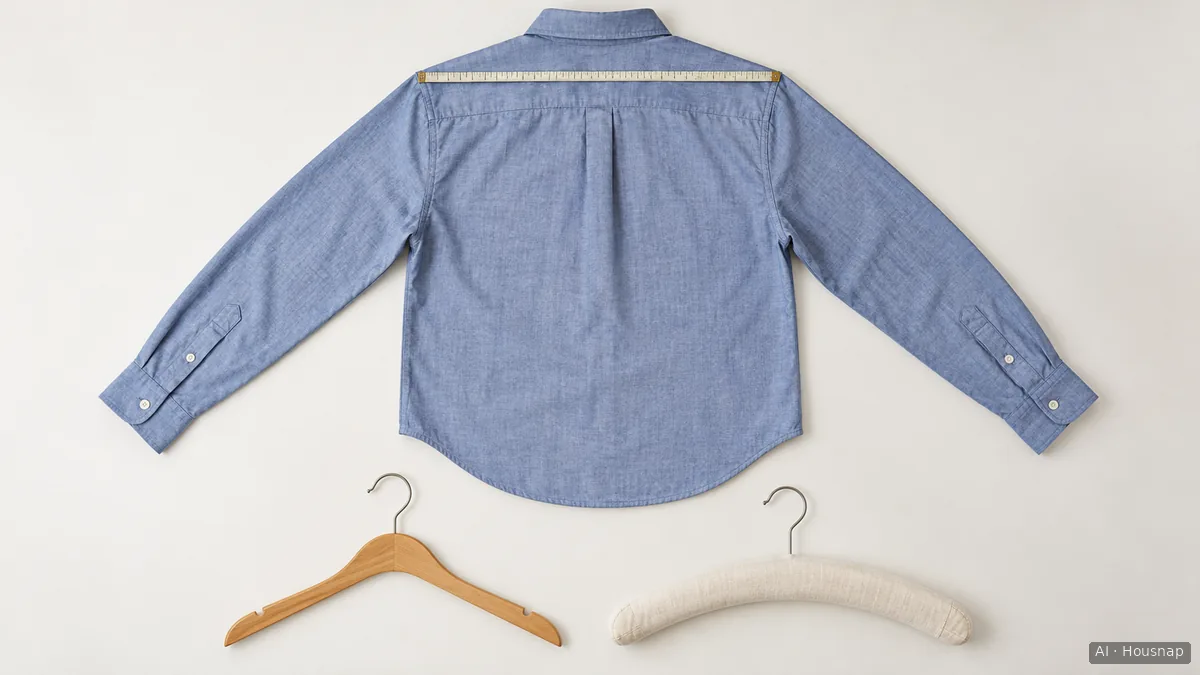
Width is only part of the fit. CCI recommends choosing a hanger’s style and size for the individual garment and rounding its support into a broad, cushioned shape without sharp edges. For hangable garments that need more shoulder support, compare a shaped or padded clothing hanger with your current one. A wider end-to-end span does not by itself provide broader shoulder contact.
Give skirts and trousers their own support check
Do not assume that a good jacket hanger also solves trouser storage. CCI’s conservation method hangs sound skirts and trousers from the waist with a cushioned clamping hanger.
For an everyday closet, consider that arrangement only when the waistband is sound and the garment’s instructions allow it. Check where the padded jaws grip and whether they leave pressure marks or let the waistband slip. Padding is a feature to inspect, not a guarantee that a clamp suits every fabric.
If the waistband is weak, the fabric is fragile or the clamp visibly stresses it, use flat support while seeking garment-specific advice. Do not buy a stronger clamp to compensate for a weak garment.
Reassign your hangers before buying a set
Make three groups: clothes to fold or support flat, clothes already well supported, and clothes needing a different hanger. Buy only for the last group, recording the garment, the missing support and any relevant measurement.
For wool garments, Woolmark advises emptying pockets and removing belts and accessories before storage to avoid sagging and bulging. CCI also describes fabric dust covers as protection from dust, light and contact with other garments. Reuse a suitable cover if you have one; a cover cannot correct a poorly fitting hanger.
Keep material-specific care separate from hanger selection. If an owned smooth-leather jacket also needs drying, conditioning or a storage-cover decision, continue to the leather jacket care and storage guide. This closet sort does not establish whether a treatment is safe for its finish.
Come è stata costruita questa guida
This guide was written by AI for Housnap using Canadian Conservation Institute, Woolmark and NAKATA HANGER guidance. It turns their support and sizing principles into a household sorting process while keeping museum guidance and manufacturer-specific measurements in scope; it does not report original product testing.