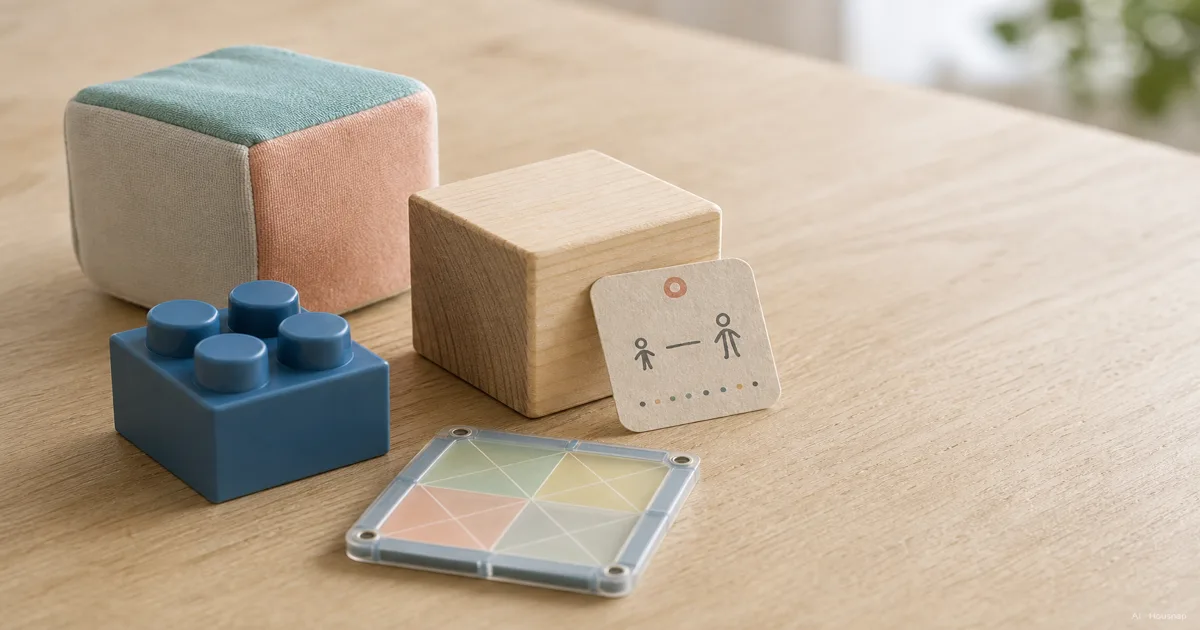
Check the age label before choosing a material
Keep toys with small parts away from children under three, and follow the specific set’s age guidance. Being good at stacking does not cancel a choking warning. CPSC’s toy guidance
There is no reliable “every side must be at least 5 cm” shortcut. The US small-parts test asks whether an object fits entirely inside a specified cylinder; pieces released during testing can count too. CPSC’s small-parts explanation
Then ask what you want the set to let your child do. Grasp and explore? Start with the infant option below. Connect pieces? Compare chunky bricks. Stack towers and arrange buildings? Look at wood. Join panels into shapes? Consider magnetic tiles after checking their age and supervision requirements.
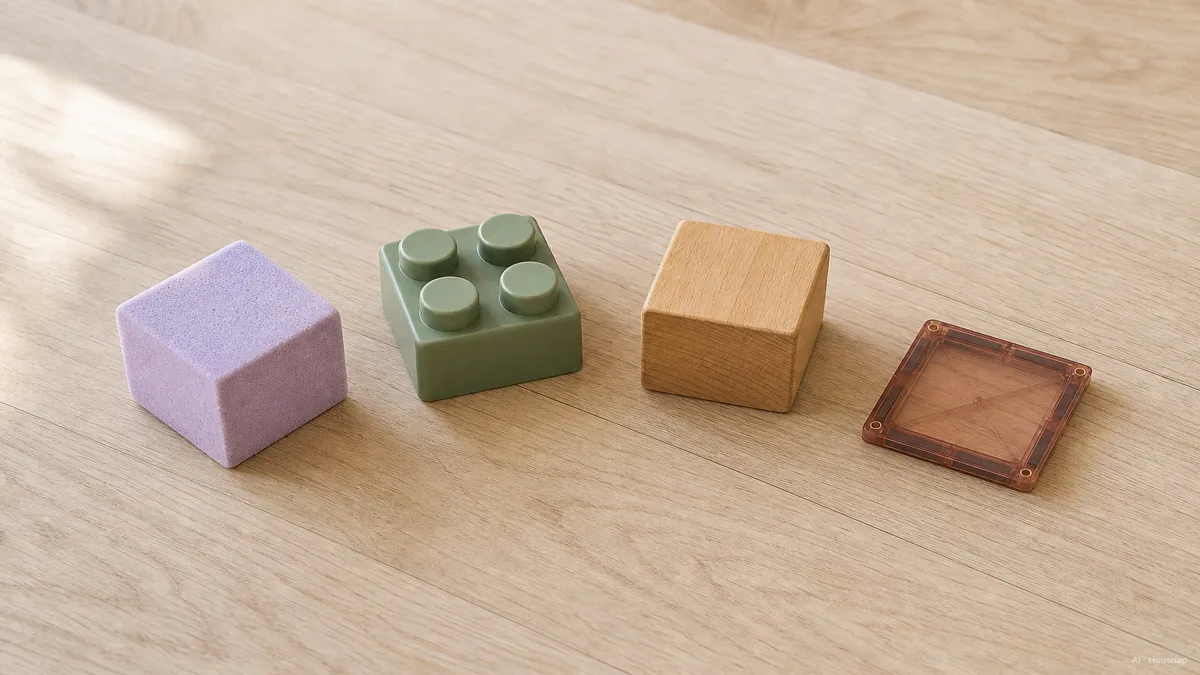
For infants, choose something to handle before something to build
At six months, only consider blocks explicitly labeled for that age. For later infancy, large soft blocks are one option: NAEYC includes them for ages 7–12 months, while stressing that development varies. NAEYC’s age-and-stage guide
For a first purchase, look for a few graspable pieces and cleaning instructions you can follow. “Soft” or “foam” alone does not establish that a block is suitable for chewing or machine washing. Check the actual product instructions, including any inserts or detachable features.
Choose this format if handling the pieces is the point of play. You do not need a large construction collection yet.
For toddlers, compare the starting age and the connection
Two familiar chunky-brick choices begin at different ages. Mattel labels the referenced First Builders Big Building Bag for one year and older; LEGO DUPLO starting ages begin at 18 months and vary by set. Those are product-specific starting points, not permission to buy any box carrying either brand name.
If a suitable demonstration set is available, let your child try connecting two pieces and pulling them apart. If an adult has to do every connection, consider loose stacking blocks instead. This is a practical selection check, not a developmental test.
Do not choose between these systems on an unsupported claim that one always grips better. Check the exact set’s pieces and compatibility before buying additions.
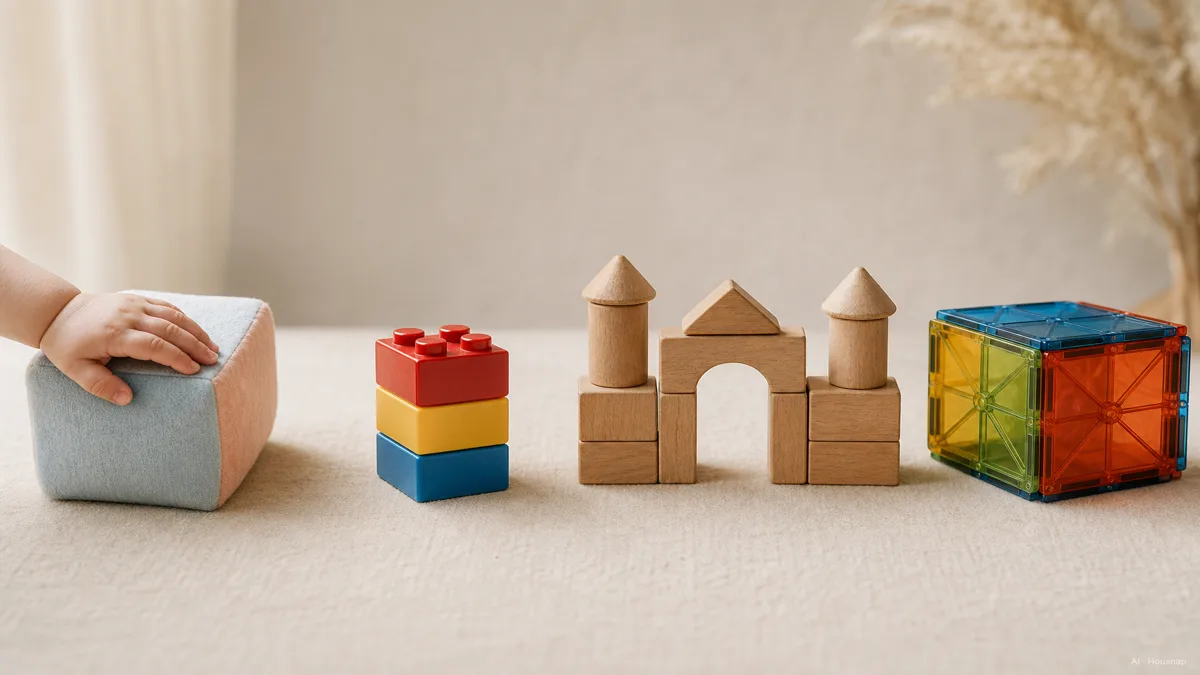
The illustration shows different ways of playing, not a schedule for buying a new material at each age.
Choose wooden blocks for stacking and rebuilding
If your child wants to arrange roads, balance towers or make an enclosure, consider ordinary loose wooden blocks. Their pieces rest on one another rather than locking together; a wooden-block set example illustrates the mix of shapes used for stacking and balancing.
Inspect the contents, not just the total count. For the structures you have in mind, would repeated rectangles be more useful than extra decorative shapes? Choose a set with an explicit suitable age label, and check for splinters or damaged edges. CPSC’s guidance on hazardous edges
Wood is an alternative to connecting bricks, not a compulsory next stage. A preschooler who still enjoys chunky bricks does not need to switch.
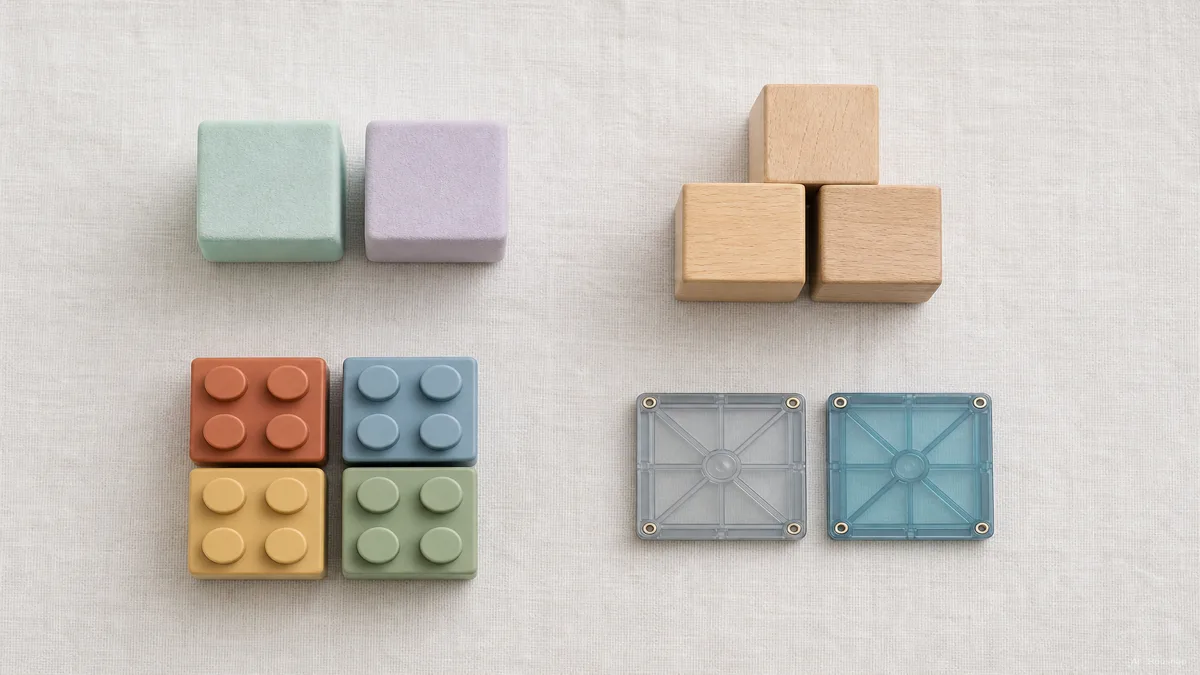
Use the material comparison to choose an activity: loose stacking, pressing bricks together or joining panels. It is not a ranking of educational value.
Choose magnetic tiles only if the household can manage them
For a child interested in joining panels into a house or cube, magnetic tiles are another option. MAGNA-TILES recommends ages three and up; check other products individually. Its FAQ also says to inspect pieces and stop using damaged tiles.
Before buying, decide who will supervise, check pieces and put them away from younger siblings. If your child still mouths toys, delaying this format is a sensible precaution. These are household selection decisions, not a claim that every three-year-old is ready.
Check cleaning requirements too: MAGNA-TILES should not be submerged. Do not assume all plastic toys can go in the bath. If you suspect a child has swallowed a magnet, seek immediate medical attention. CPSC magnet guidance
Buy one workable set, then decide whether to add anything
Compare two sets of your chosen type using these questions:
- Can you identify the product? Look for the maker, model, age guidance and instructions. If the listing and packaging disagree, ask the manufacturer before buying.
- What can the included pieces make? Check shapes and quantities against a simple build you want to try. A larger headline count is not a reason on its own to spend more.
- Will it fit your home? Decide where you will play and store it, especially if younger children share the room.
- Does it add something missing? If you already own blocks, identify the missing shape or activity before buying another system. Confirm compatibility rather than assuming it.
Safety-standard names are not age recommendations. In the US, ASTM F963 sits within mandatory toy requirements and manufacturers or importers issue a Children’s Product Certificate. EU-market toys must bear CE marking. These are different compliance arrangements, not interchangeable “safe for every child” badges. CPSC, European Commission
For a five- or six-year-old, first try a new challenge with the existing set, such as building a home for a toy. If, around six or later, the real aim is a shared game with turns and rules, use the family board-game buying guide to compare age suitability, player count and playing time instead of automatically buying more blocks.
Sources
Come è stata costruita questa guida
Written by Housnap’s AI editor using CPSC and European Commission guidance, NAEYC’s age-and-stage advice, and manufacturer information. The buying sequence is an editorial interpretation for choosing a first set, not a developmental assessment or a hands-on product test.