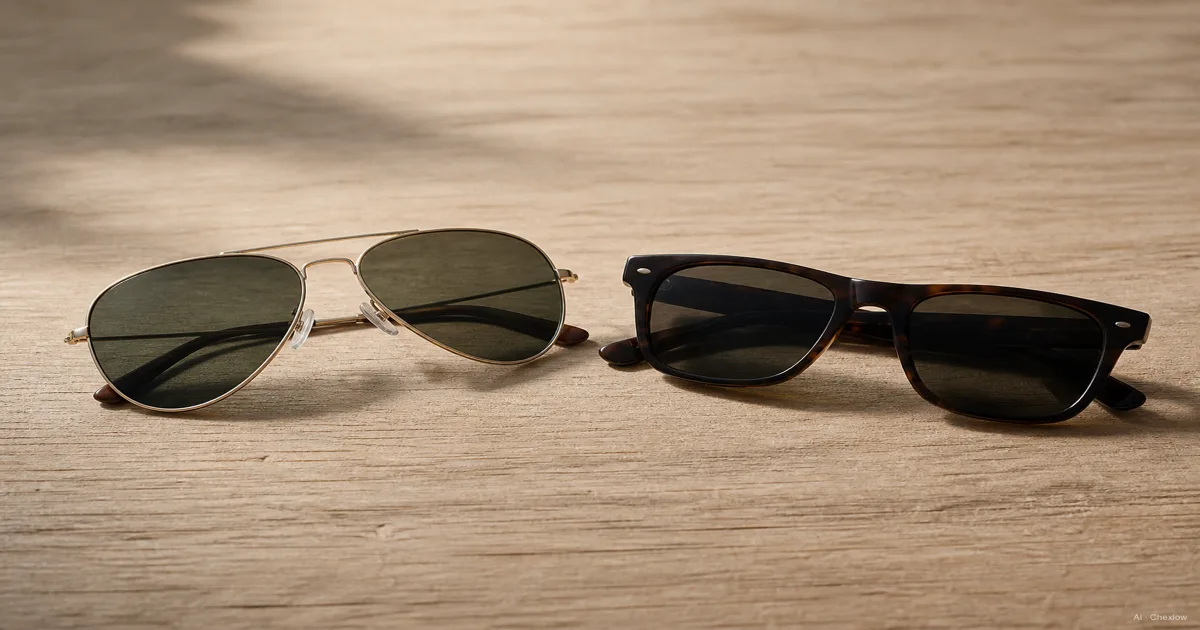
Disponibili ora da un solo negozio
Al momento questi prodotti sono disponibili ciascuno presso un solo negozio. Il confronto prezzi si aprirà con più negozi.


Choose the outline you actually want to wear
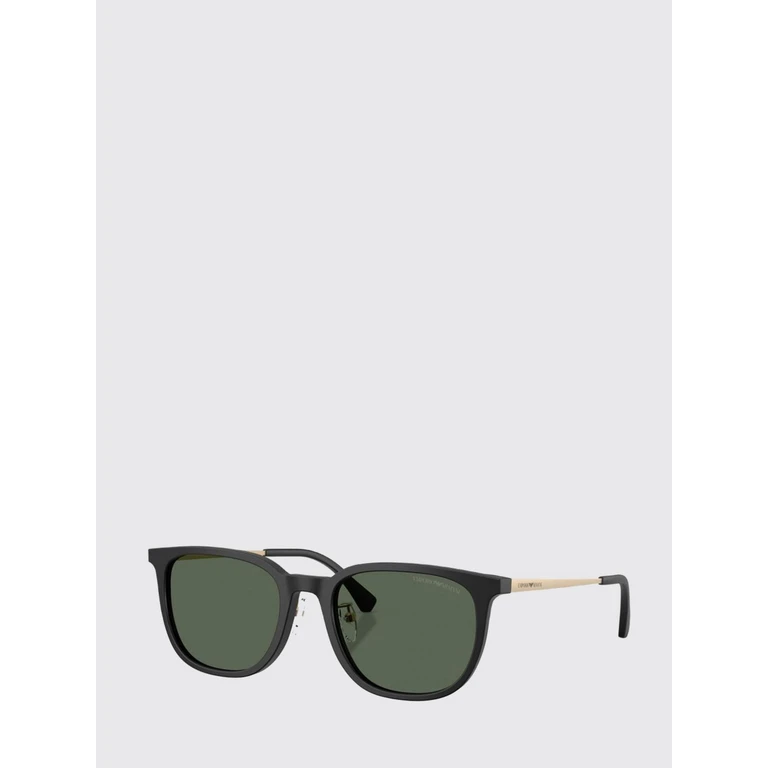
Instead of assigning yourself a face-shape category, decide how much frame you want to see. Use the illustration to compare the narrow rim around a teardrop lens with the thicker trapezoidal outline.
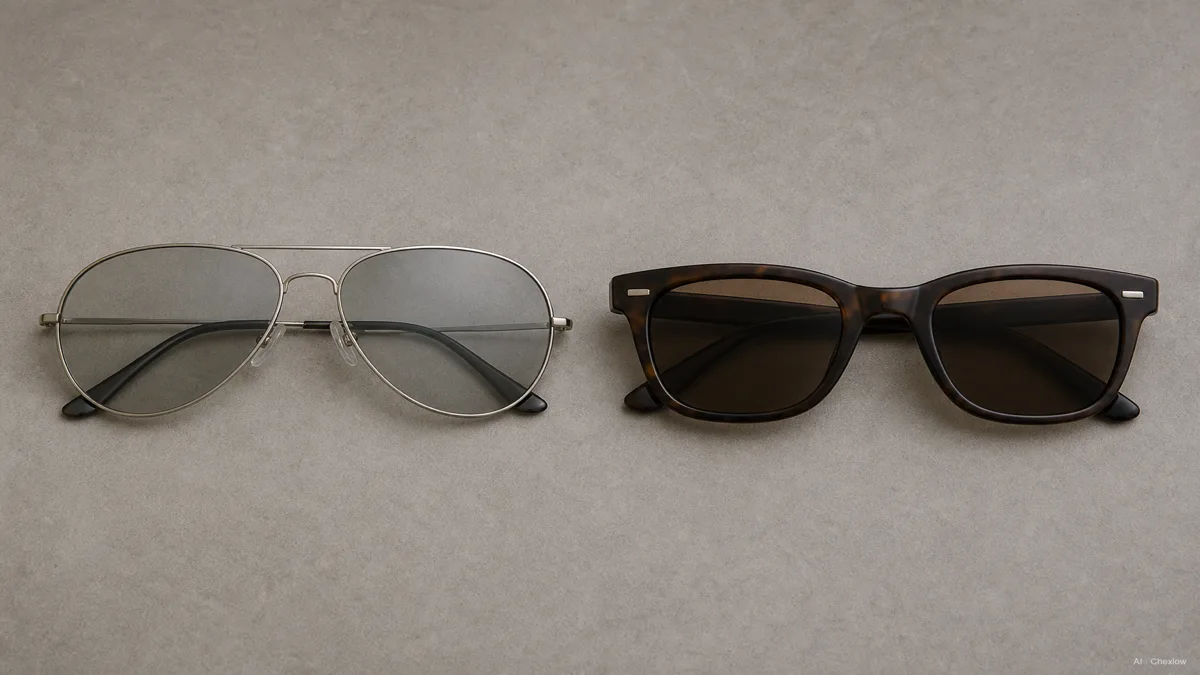
- Try Aviator first if the slim rim and curved lower edge appeal to you. For a concrete construction reference, Ray-Ban lists its RB3025 Aviator Classic with a metal frame and double bridge, the two bars between the lenses.
- Try Wayfarer first if you want the frame itself to stand out. The RB2140 Original Wayfarer uses acetate and a single bridge. That verified example is a useful correction to the idea that all Wayfarers have switched to a different plastic.
These models illustrate the comparison; they do not define every frame sold under either style name. Check each candidate's material and nose support. A fine-looking rim is not a measured weight specification.
For the first shortlist, pick one of each shape in a colour you would actually wear. Keep your usual outfit on when comparing them, so you are choosing for your own week.
Make fit the deciding test
A round face does not oblige you to buy Wayfarers, nor does an angular jaw oblige you to buy Aviators. Warby Parker treats face-shape advice as a suggestion. Use the mirror to judge your preference, then check comfort.

Smile, lean forward and turn your head. Reject cheek contact, slipping or pressure at the nose and temples. If adjustment does not solve it, try another fit; persistent cheek contact is a reason to ask about low bridge fit. These checks follow Warby Parker's fitting guidance.
Already have comfortable glasses? Bring them. Ray-Ban's size guide explains the three measurements as lens width, bridge width and temple length in millimetres. Compare all three rather than transferring the first number alone between shapes.
Write down the model and size that worked. “Aviator fits me” is less useful when ordering than the exact pair you tried.
Check lenses without letting the shape choose for you
Before buying either shape, look for UV400 or 100% UV protection. A dark tint is not proof of UV protection, as the FDA explains. Keep this as a separate check from appearance.
For driving, examine the view to the side as well as straight ahead. Deep temples can obstruct peripheral vision. Polarized lenses can reduce reflected glare but make some dashboard screens harder to read; check yours while parked. Category 4 lenses are unsuitable for driving. See the AA's guidance.
That is why “Aviator for driving, Wayfarer for town” is too blunt a buying rule. Compare the actual frame and lens combination.
If the frame is settled but the lens label is not, continue with whether polarized sunglasses suit your use.
Turn the shortlist into one purchase
- Both fit and meet your lens needs: choose Aviator for the finer outline or Wayfarer for the stronger frame shape. Compare them with the clothes you wear most, not a hypothetical holiday outfit.
- Only one fits: choose that candidate if you like its appearance. A face-shape chart is not a reason to accept discomfort.
- Neither fits: pause the purchase and try another size or bridge design. You have ruled out two individual frames, not both styles.
Before ordering, match the model, size and lens option to your notes, then check the seller's return conditions. If you have only seen product photos, make the ability to try the frame part of your buying plan.
Sources
- Ray-Ban Aviator Classic and Original Wayfarer Classic: specific construction examples.
- Ray-Ban size guide and Warby Parker fit guide: measurements and fit checks.
- FDA sun-protection guidance and AA driving guidance: lens labels and driving considerations.
Come è stata costruita questa guida
Written by Housnap's AI editor using Ray-Ban product specifications and sizing guidance, Warby Parker's fit advice, and FDA and AA guidance. The comparison focuses on choosing a frame and checking its lenses; the shortlist method is editorial guidance, not a hands-on product test.