Your First Tire Inflator, What PSI and CFM Actually Tell You Before You Buy
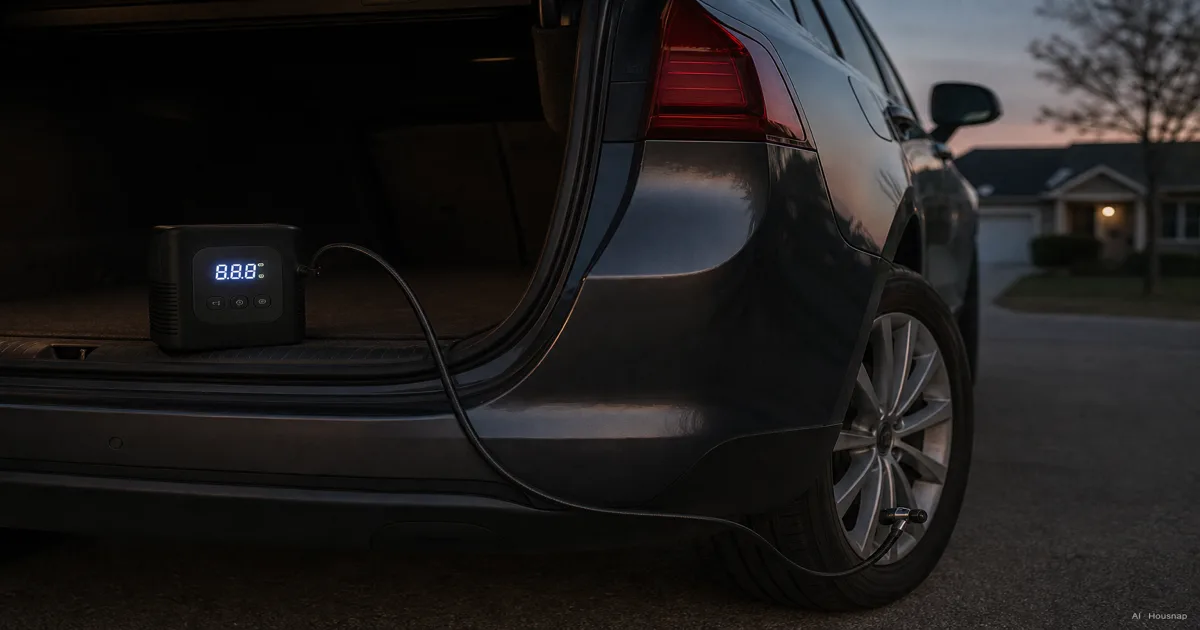
You search tire inflator and the results split the same way a car vacuum search does. One type has a coiled cord that plugs into your 12V outlet. The other is a small cordless brick you charge on a shelf and grab on the way out the door. Both promise to fix the same problem, a soft tire before a long drive, a slow leak you keep topping off, or a fully flat spare you need to save a trip. The spec sheets, though, throw PSI and CFM at you without saying which one actually matters for your situation. Here is the shortcut. PSI tells you the ceiling, the maximum pressure the pump can reach, and almost every consumer inflator clears what a passenger car or SUV tire needs. CFM (or the metric LPM) tells you the speed, how much air moves per minute, and that number is what separates a quick top-off from a five-minute wait watching a gauge climb. Power source is the other fork: corded 12V units draw straight from the car for steady, faster fills, while cordless units sacrifice some of that speed for portability and unlimited placement. This guide walks through what PSI and CFM actually mean, when cordless makes sense over corded (and vice versa), how to find the tire pressure your car actually wants (it is not the number on the tire itself), and the features worth paying attention to before your first purchase.
Disponibles actuellement chez une boutique
Ces produits ne sont proposés pour l’instant que par une seule boutique chacun. La comparaison de prix s’ouvrira avec plus de boutiques.

What PSI and CFM Actually Mean (and Why Both Matter)
PSI stands for pounds per square inch, and on a tire inflator spec sheet it is the maximum pressure the pump can build. Compact, budget-friendly inflators are typically rated in the 120 to 150 PSI range, which covers passenger car tires and most spare tires with room to spare. Higher-end units push past 160 PSI, enough headroom to handle both light-vehicle and full-size truck tires.
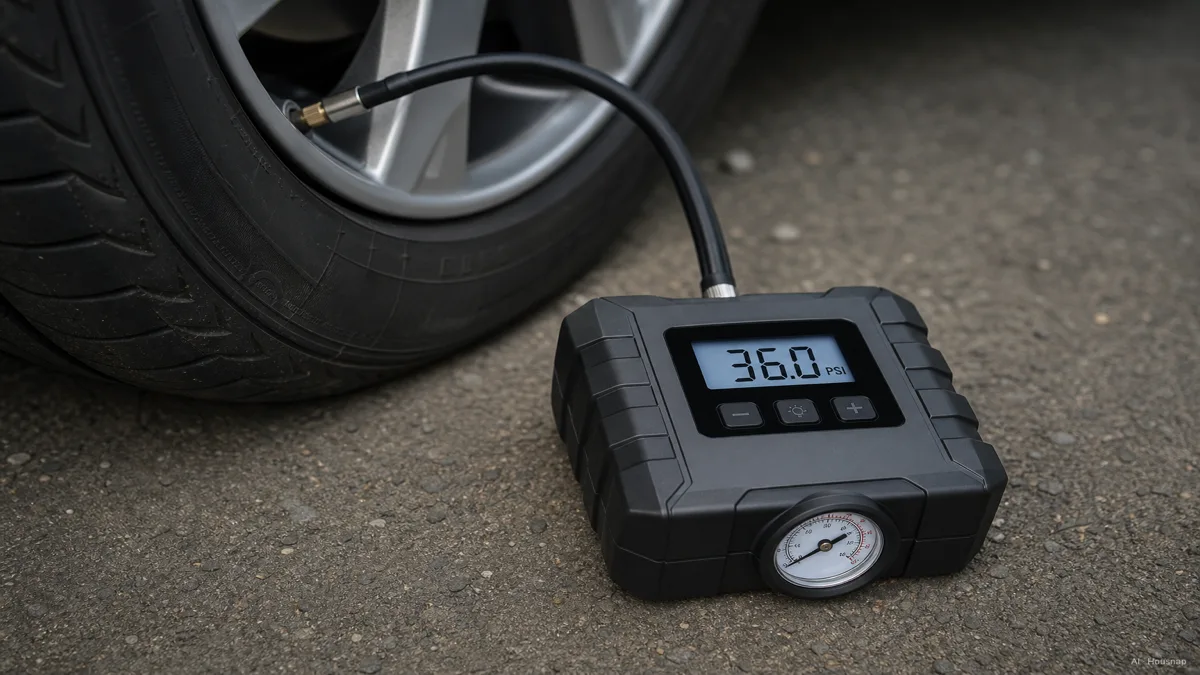
CFM, cubic feet per minute (or LPM, liters per minute, on many spec sheets), measures airflow volume, and that is what actually decides how long you stand there waiting. A higher CFM or LPM rating means faster fills, and the gap becomes obvious on larger tires or a tire that started fully flat. In one real-world test, a high-end cordless unit rated around 30 LPM filled a flat 195/60R14 tire to 36 PSI in under three minutes, while a more modest 1.47 CFM battery-powered unit took nearly six minutes to bring a much larger 33x12.5-inch tire up to 30 PSI.
The takeaway: PSI tells you whether a pump can reach the pressure your tires need, and almost every inflator on the market clears that bar. CFM or LPM tells you how quickly it gets there, and that is where budget and premium models actually diverge.
Cordless vs. Corded (12V): Which Type Fits Your Use Case
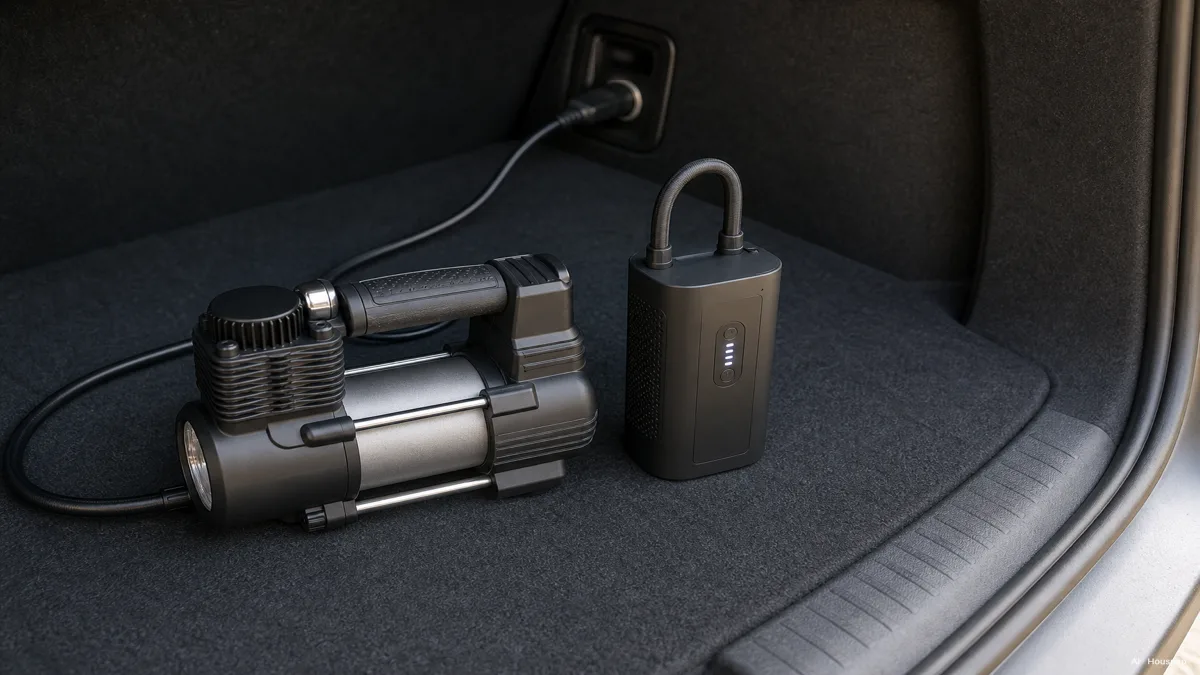
A corded 12V inflator plugs into the car and draws power directly from it, which means unlimited runtime and no battery to keep charged in the trunk. That steady power delivery generally means more consistent, higher CFM output, making corded units the stronger choice for larger tires or a tire that started out fully flat.
A cordless inflator runs on its own rechargeable battery, so it is not tied to the car at all. That is a real advantage for topping off a tire that is only a few PSI low, inflating something away from the vehicle entirely (a bike tire, a basketball, a paddleboard), or reaching a tire when the car will not start. The tradeoff is that a cordless unit can run slower on a fully flat truck or SUV tire, and the battery drains even when the tool sits unused, so it needs an occasional top-up charge to be ready when you need it.
Neither type is the objectively correct pick. If your main use case is dealing with a fully flat tire on the road, a corded 12V inflator gives you the speed and unlimited runtime to do it properly. If you mostly top off slightly low tires, want to inflate things that are not tires, or want one tool that works whether or not you are near the car, cordless earns its extra cost and occasional charging chore.
Finding Your Vehicle's Correct Tire Pressure (Not the Tire's Max PSI)
The single most common mistake with a new inflator is filling to the number printed on the tire's sidewall. That number is the tire's maximum rated pressure, not the pressure your car actually needs. The correct number is on a placard, usually on the driver's side door jamb, or in your owner's manual, and it reflects what the vehicle manufacturer tuned for ride, handling, and tire wear, according to NHTSA's TireWise program.
As a rough guide, passenger cars typically run about 30 to 35 PSI, while SUVs and trucks usually call for 35 to 40 PSI, but the placard number for your specific vehicle is always the one to trust over any general range. NHTSA also recommends checking pressure cold, meaning the car has not been driven in at least three hours, since a warm tire reads higher than its true pressure. Check monthly, and do not skip the spare.
NHTSA classifies a tire as significantly underinflated once it drops 20 percent below the recommended PSI, for example 25.6 PSI on a tire rated for 32 PSI. Federal TPMS rules require a dashboard warning once a tire falls 25 percent below placard pressure (for one to four tires) or 30 percent below on any single tire, so if that light comes on, your tires are already well past a minor top-off.
Key Features to Compare Before You Buy (Gauge Accuracy, Auto Shut-Off, Battery, Portability)
Once PSI, CFM, and power source are settled, a handful of smaller details decide whether an inflator earns a permanent spot in your car or ends up forgotten in a drawer.
Gauge accuracy and auto shut-off. A digital gauge that reads a few PSI off defeats the purpose of checking pressure carefully. Auto shut-off, where the pump stops once it hits a pressure you set, removes the guesswork and the risk of overinflating while you are distracted.
Physical size and weight. An inflator that will not fit in a glovebox or a trunk organizer tends to get left at home exactly when you need it. Compact cordless models win here, while larger corded units trade portability for a stronger, faster motor.
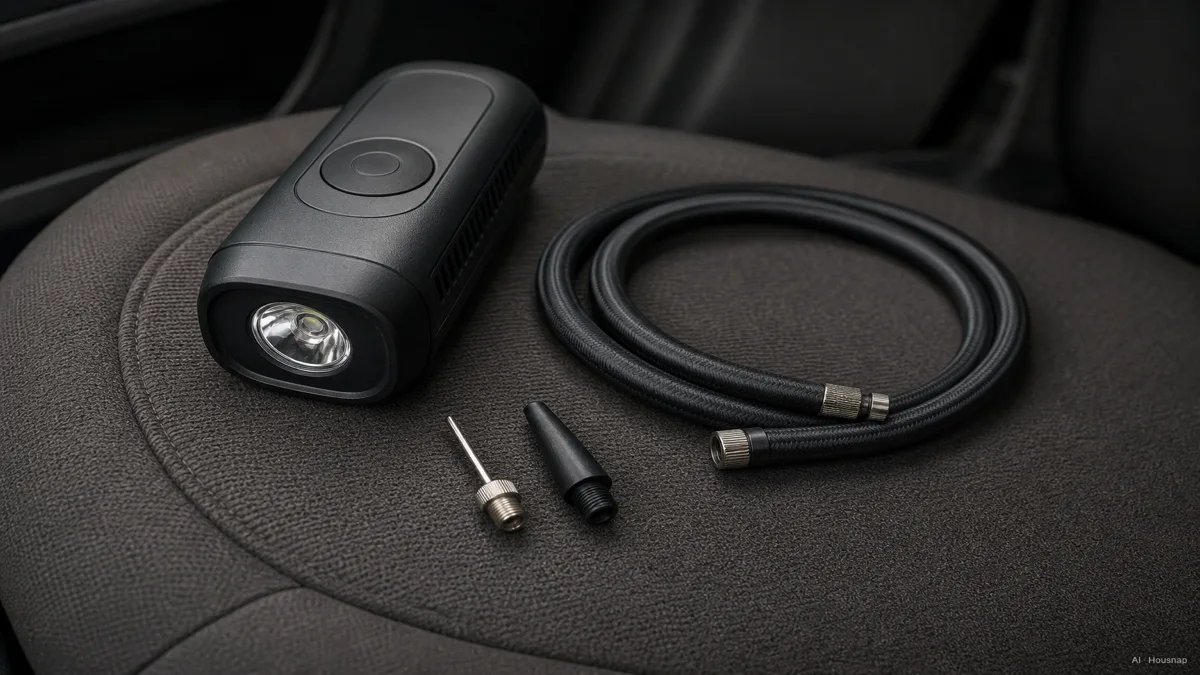
LED work light. A small light built into the unit matters more than it sounds like, since a surprising number of flat tires happen at night or on the side of a dim road.
Versatility beyond tires. Many inflators are rated for more than car tires, bikes, sports balls, inflatable rafts, paddleboards, and air mattresses. If you already own several of those, a versatile inflator with the right nozzle attachments does double duty instead of adding another single-purpose gadget to the trunk.
Top-Rated Models and What They're Best For
Buying guides in 2026 point to a fairly consistent lineup, though which one fits you still comes down to the tradeoffs above. GearJunkie's tested comparison and Consumer Reports' cordless inflator review both point to the DeWalt 20V MAX Tire Inflator as a strong overall pick, rugged enough to handle both light-vehicle and full-size truck tires, with Consumer Reports specifically praising its ease of use, quiet operation, and logical hose storage after testing it against Bauer, Craftsman, Makita, and Milwaukee models.
For a lower-cost option, Reviewed.com's roundup names the Avid Power 20V Cordless Inflator a strong value pick at around 55 dollars. If speed is the priority, the Fanttik X9 Ultra is built around high-speed cordless inflation, with reviewers clocking it topping off a tire in about 15 seconds and filling a fully flat tire in just over a minute. Buyers who want maximum runtime without recharging might look at the ETENWOLF VORTEX S6, a dual-cylinder model built around a large 19,200mAh battery rated for a 100 percent duty cycle, while the AstroAI Handheld Cordless remains a common budget recommendation for buyers who just need occasional top-offs.
How this piece was built
This piece is the third entry in the automotive-accessories cluster, following the dash cam channels-and-resolution guide and the car vacuum first-buy guide. It starts from the same fork those two topics use: a first-time buyer searches tire inflator and gets a corded 12V unit and a cordless handheld back, with PSI and CFM numbers that do not explain themselves. We anchored the PSI and CFM/LPM ranges and the real-world fill-time benchmarks on EVparts4x4's cordless-vs-12V comparison, the model picks on GearJunkie's 2026 tested roundup, Consumer Reports' cordless inflator review, Reviewed.com's budget pick, and CNN Underscored's testing, and the correct-pressure guidance on NHTSA's TireWise program, which is also the source for the placard-versus-sidewall distinction and the underinflation thresholds. Catalog coverage for tire inflators in this vertical was not directly queried in this research pass, so the body stays comparative and category-broad rather than citing live offer counts, and this topic remains a draft pending that catalog fit check.
Sources
- The Best Portable Tire Air Compressors, Tested — GearJunkie; PSI/CFM ranges across compact and premium units, tested model comparisons
- Cordless Tire Inflators Review — Consumer Reports; brand-by-brand testing (Bauer, Craftsman, DeWalt, Makita, Milwaukee), DeWalt standout performance
- Cordless vs 12V Tire Inflator — EVparts4x4; 7 key differences with real-world fill-time benchmarks
- The Best Portable Tire Inflator — CNN Underscored; 12 portable tire inflators tested, top picks for speed and price
- 9 Best Portable Tire Inflators and Air Compressors of 2026 — Reviewed.com; Avid Power budget/value pick
- Tires — NHTSA TireWise; placard PSI vs sidewall max PSI, cold-check guidance, underinflation and TPMS thresholds
Comment ce guide a été conçu
This piece is the third entry in the automotive-accessories cluster, following the dash cam channels-and-resolution guide and the car vacuum first-buy guide. It starts from the same fork a first-time buyer hits when they search tire inflator, a corded 12V unit and a cordless handheld, with PSI and CFM numbers that do not explain themselves. We anchored the PSI and CFM/LPM ranges and the real-world fill-time benchmarks on EVparts4x4's cordless-vs-12V comparison, the model picks on GearJunkie's 2026 tested roundup, Consumer Reports' cordless inflator review, and Reviewed.com's budget pick, and the correct-pressure guidance, including the placard-versus-sidewall distinction, on NHTSA's TireWise program. Catalog coverage for tire inflators in this vertical was not directly queried in this research pass, so the body stays comparative and category-broad rather than citing live offer counts, and this topic remains a draft pending that catalog fit check.