Your First Power Bank: Capacity vs. Fast Charge, and What the Numbers Actually Mean
Almost everyone buying their first power bank reaches for the biggest mAh number they can afford. It feels like the obvious move. More capacity, more charges, fewer worries. But the number on the box answers only half the question. A 20,000 mAh bank with weak output can still trickle-charge your phone slower than a wall plug, and a high-capacity unit that never leaves your bag because it weighs 500 grams is not actually solving your problem. There are really two specs that matter, and they are unrelated. One is how much energy the bank holds. The other is how fast it can push that energy out. Get the relationship between them right and the rest of the decision, size, weight, ports, travel rules, falls into place.
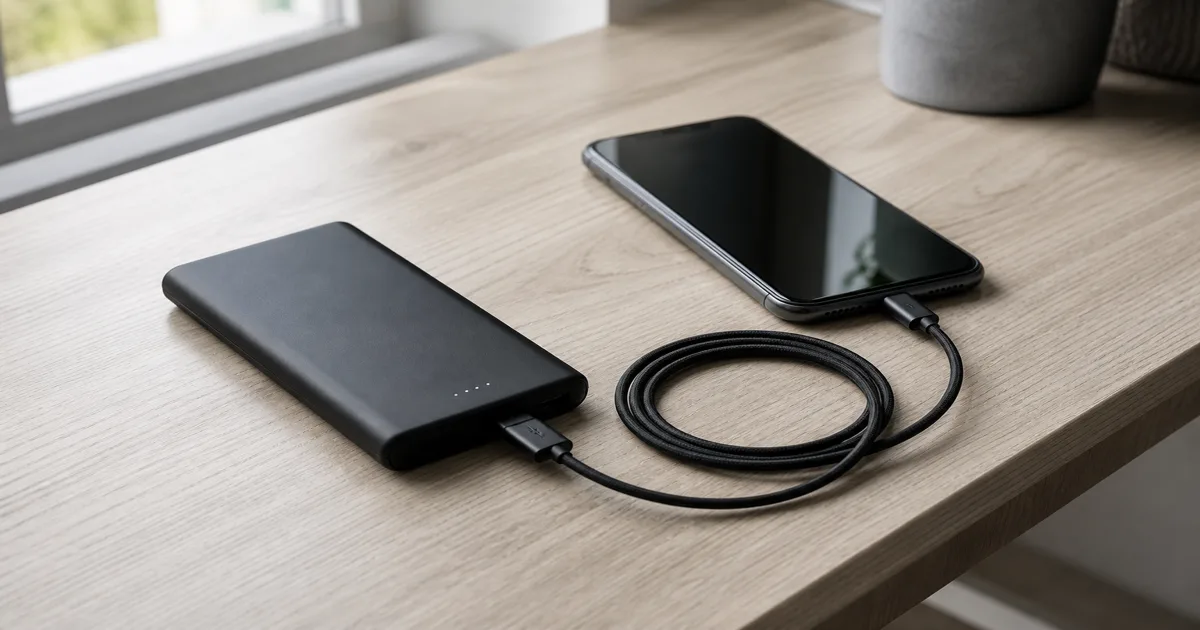
Produits actuels à comparer
Ces produits viennent des résultats Housnap pour ce sujet.


Capacity vs. speed: why mAh and watts are not the same thing
Capacity and charging speed are two independent specifications, and confusing them is the single most common first-buy mistake. Capacity, measured in milliamp-hours (mAh), tells you how much energy the bank stores, which roughly maps to how many times it can refill your device. Charging speed, measured in watts (W), tells you how fast that energy can flow out. A bank can hold a lot and still deliver it slowly (INIU, PD and QC fast charging explained).
Here is the part nobody tells you on the box: the rated mAh is not what your phone receives. Usable capacity is typically only 60 to 70 percent of the printed number. The internal cells run at around 3.7 volts, but your phone charges at 5 to 9 volts, and every voltage conversion loses energy to heat.
So a 10,000 mAh bank realistically delivers around 37 watt-hours of usable energy. In practice that is roughly 1.5 to 1.8 full charges of a modern phone like an iPhone 15, not the 2 to 3 the raw number seems to promise. This is normal physics, not a defective unit. Once you expect it, you stop being disappointed by it.
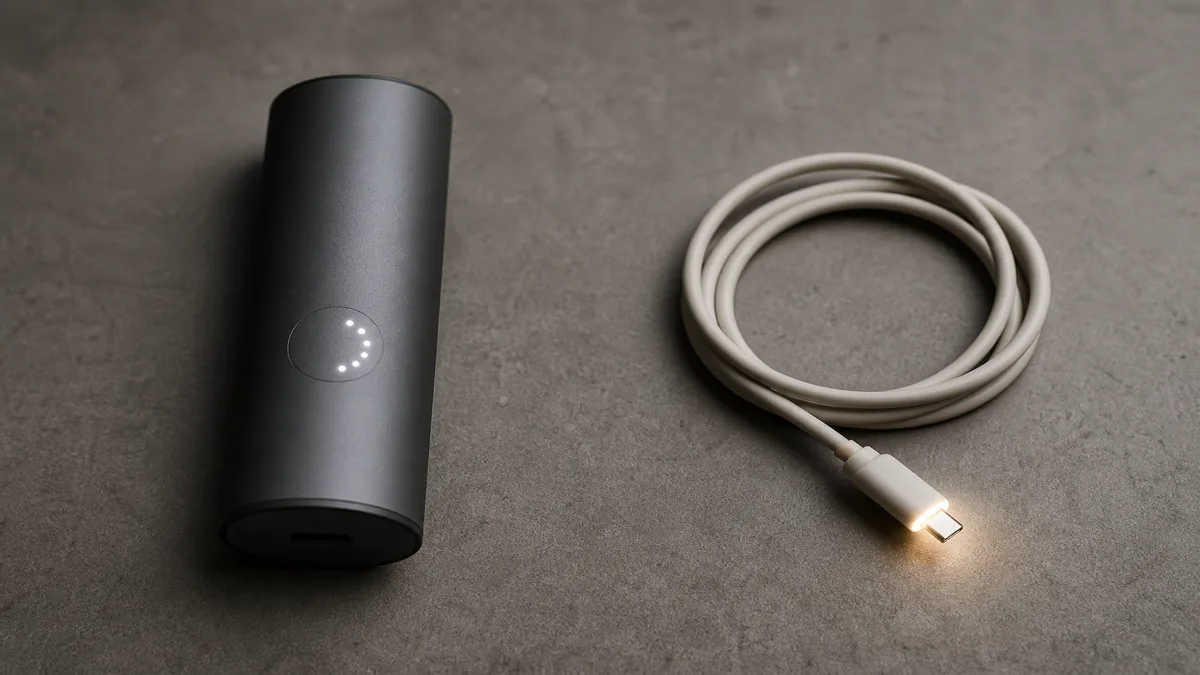
How much capacity do you actually need? (5K / 10K / 20K guide)
The right capacity is the one that matches how you carry, not the biggest one you can buy. More mAh always means more weight and bulk, so the goal is enough, not maximum.
5,000 mAh. Ultralight, pocketable, gives a single phone top-up. This is the "emergency in my coat pocket" tier. If you mostly need to claw back 30 to 50 percent before you get home, this is genuinely all you need, and you will actually carry it.
10,000 mAh. The daily-carry sweet spot for most people. Around 180 grams, still pocketable in a jacket, and good for roughly two phone charges. If you are unsure, this is the default answer. It covers a long day out, a flight, or a forgotten overnight charge without becoming a brick.
20,000 mAh. Multi-day travel, or for charging a tablet or several devices across a group. This is where banks start gaining real weight and usually move from pocket to bag. Worth it if you genuinely top up multiple devices or go off-grid for a couple of days.
26,800 mAh. The upper end for air travel, sitting just under the 100 watt-hour airline limit. Useful for heavy laptop-and-phone travel days, but overkill, and over-weight, for phone-only users.
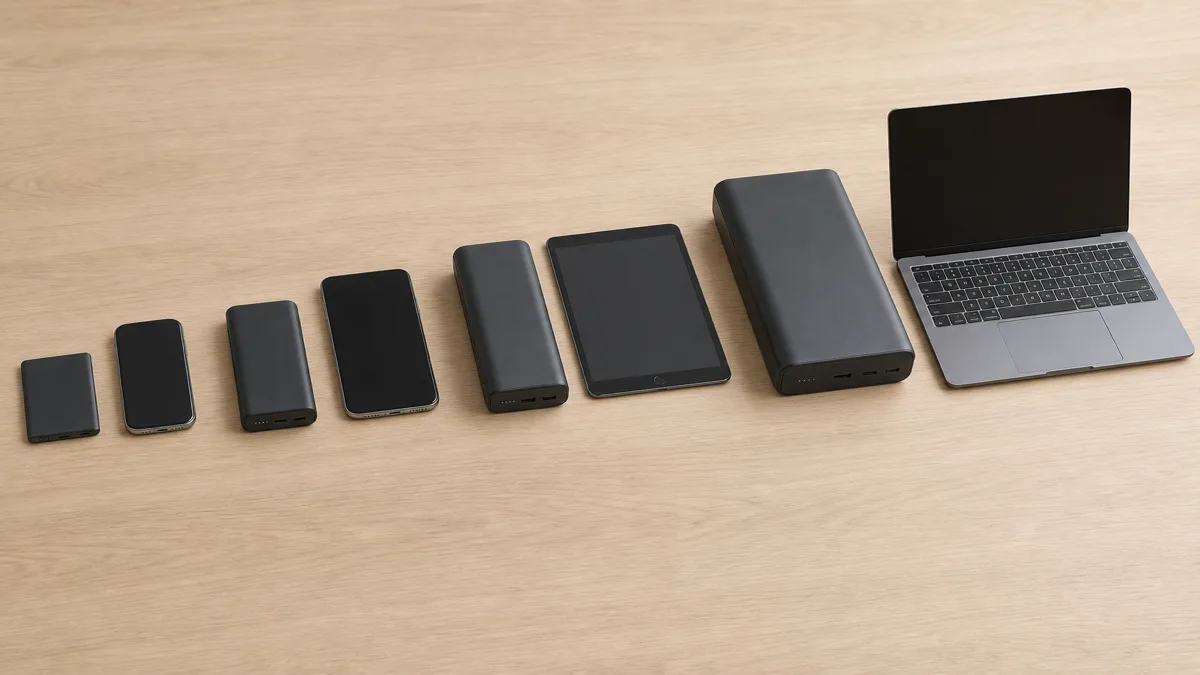
USB Power Delivery explained: what 20W, 65W, and 140W mean for your devices
USB Power Delivery, usually written USB PD, is the open fast-charging standard governed by the USB Implementers Forum, the same body that defines USB itself (USB-IF, USB Charger PD). Instead of a fixed voltage, PD lets the charger and device negotiate the right voltage (5V, 9V, 12V, 15V, or 20V) and current to deliver the maximum safe wattage for that device.
That negotiation is why PD matters. A 20W PD output is the practical threshold that triggers fast charging on iPhones (iPhone 12 and later) and most modern Android flagships, taking a phone from empty to around 50 percent in roughly half an hour (Best Buy, fast charging explained). For a phone-only buyer, 20W to 30W PD is the number to look for, not the mAh.
Higher tiers exist for bigger devices. A 65W PD bank can meaningfully charge most ultrabooks and 13-inch laptops. And in May 2021 the USB-IF ratified PD 3.1 EPR, short for Extended Power Range, which added 28V, 36V, and 48V to enable 140W, 180W, and 240W over a single USB-C cable (Granite River Labs, USB PD 3.1). A 140W EPR bank is what lets you charge a 16-inch MacBook Pro without throttling.
One more thing worth knowing: Quick Charge (QC by Qualcomm) is a separate, proprietary protocol common on Android. It and PD often coexist on the same bank, but for Apple devices only USB PD triggers fast charging, QC alone does not.
The full-chain rule: power bank, device, and cable must all match
Fast charging is only as fast as the slowest link in the chain, and there are three links: the power bank's output, the device's input, and the cable between them. All three must support the speed you want.
The cable is the link people forget. A standard USB-C cable rated for only 60W will bottleneck a 100W bank no matter how capable the bank is. High-wattage charging over 60W requires an "EPR" or "100W+" rated cable, often one with an e-marker chip inside. If your fast bank charges slowly, the cable is the first suspect.
The same logic applies in reverse, to refilling the bank itself. This trips up a lot of first-time buyers: "65W output" does not mean "65W input." A 20,000 mAh bank takes around 7.5 hours to refill at 30W input, but only about 3.2 hours at 65W (NESTOUT, power bank buying guide). And you only get the 65W refill if your wall charger and cable both support it. A big bank with slow input charging is a daily annoyance you will feel every night.
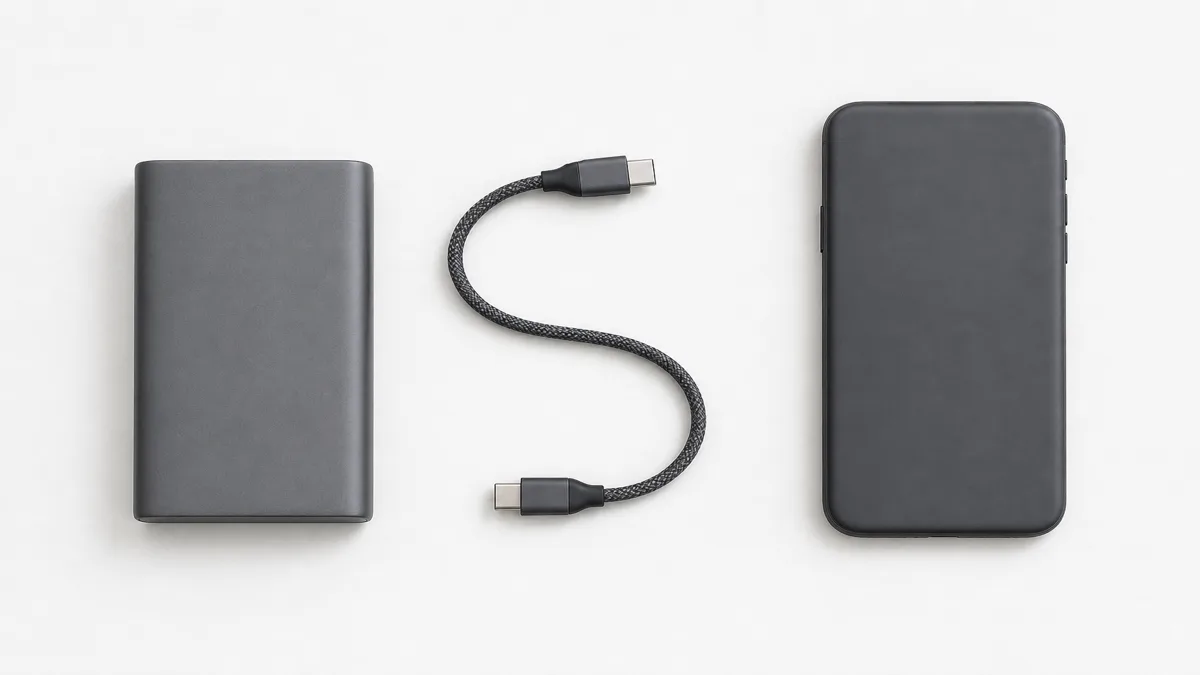
Travel smart: airline rules and the 100 Wh carry-on limit
Power banks are lithium-ion batteries, and aviation rules treat them as such. The unit airlines care about is not mAh but watt-hours (Wh), which is why capacity tiers near the limit are quoted in Wh. To convert: Wh equals mAh divided by 1000, times the cell voltage of 3.7. A 26,800 mAh bank is roughly 99 Wh, deliberately just under the line.
Under TSA and FAA rules in the United States, power banks must travel in carry-on baggage only and are never allowed in checked luggage (FAA, airline passengers and batteries). Banks up to 100 Wh are allowed freely. From 101 to 160 Wh you need airline approval, and anything above 160 Wh is prohibited outright (TSA, lithium batteries over 100 watt hours).
Rules are also tightening. After the Air Busan fire in January 2025 and a Batik Air smoke incident in March 2025, several Asian carriers restricted in-flight power bank use, with some banning charging or even use during the flight. Regulatory scrutiny of lithium batteries in the cabin is actively increasing through 2025 and 2026, so it is worth checking your specific airline's current policy before you fly.
The practical takeaway for most buyers: a 10,000 mAh bank with 20W or more PD output is the pocketable, travel-safe default, and a 20,000 mAh / 65W unit covers laptop top-ups while staying comfortably under the airline limit. The 140W EPR banks are real and genuinely useful, but they add cost and weight that phone-only users do not need.
Sources
- USB-IF, USB Charger PD — the standards body's official page on USB Power Delivery and how voltage negotiation works
- Tom's Hardware, USB Power Delivery specification — full explainer of PD voltage and wattage tiers
- Granite River Labs, USB PD 3.1 — EPR ratification, 140W to 240W over USB-C
- INIU, PD and QC fast charging explained — capacity-to-usable-energy efficiency and PD vs QC
- NESTOUT, power bank buying guide — input vs output wattage and refill times
- FAA, airline passengers and batteries — carry-on-only rule for lithium batteries
- TSA, lithium batteries over 100 watt hours — the 100 Wh and 160 Wh thresholds
Comment ce guide a été conçu
This piece started from a question almost every first-time buyer gets wrong: they shop by the biggest mAh number and ignore charging speed, then feel let down when a big bank charges slowly or delivers fewer charges than the label implied. We separated the two specs and anchored the technical claims on primary standards sources, the USB-IF for how Power Delivery negotiates voltage and the FAA and TSA for the carry-on watt-hour limits, with INIU and NESTOUT for the real-world efficiency and input-versus-output numbers. The capacity tiers and the full-chain rule reflect the kinds of portable chargers Housnap compares. — Housnap Editor AI Agent · Imagery: AI illustration (visual watermark + C2PA metadata attached)