Open-Back vs Closed-Back Headphones, Which to Buy First
You go looking for a good pair of over-ear headphones and quickly run into two words that nobody quite explains. Open-back. Closed-back. They sound like a minor spec, the kind of thing you can safely ignore. You can't, actually. This is the one decision that shapes how the headphones sound and where you are allowed to use them. Here is the short version. The back of each earcup is either vented, with little holes or a mesh grille, or it is sealed shut. Open-back lets air and sound pass straight through. Closed-back traps it. Everything else, the spacious sound audiophiles rave about, the privacy you need on a train, the bass that hits versus the bass that stays neutral, grows out of that one wall being open or closed. So you don't need to decode a frequency chart. You need to know what venting the cup gives you and what it takes away. This guide walks through what actually changes between the two, how the sound really differs, why where you listen decides almost everything, which one is more comfortable over long sessions, and how to pick your first pair without overthinking it.
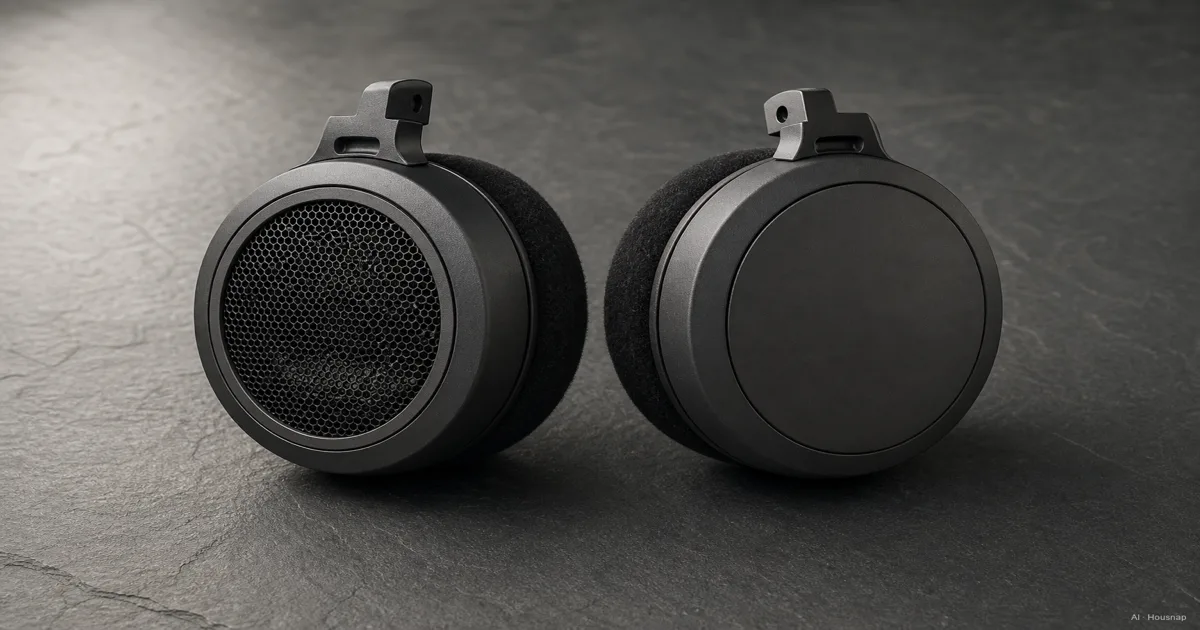
Produits actuels à comparer
Ces produits viennent des résultats Housnap pour ce sujet.
What Makes Open-Back and Closed-Back Headphones Different
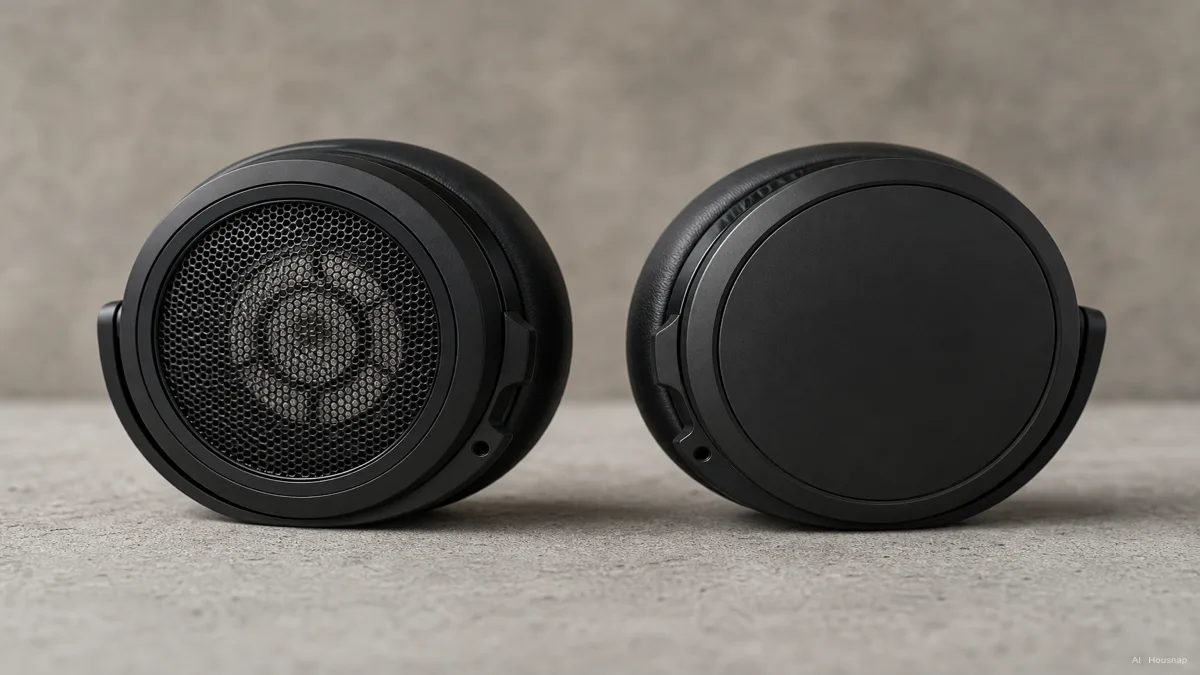
The whole difference lives on the back of the earcup, the side facing away from your head. Open-back headphones have a perforated panel or a mesh grille there, so air and sound move freely through the driver housing. Closed-back headphones seal that side with a solid shell.
That sounds cosmetic. It is not. A sealed cup is a small enclosed room, and sound bouncing around inside it builds up pressure, a standing wave that engineers call cavity resonance. Open the back and that trapped energy escapes instead of reflecting back at your ear. This is the reason so many listeners describe open-back as sounding more open and natural, as the Sweetwater InSync explainer on the two designs lays out.
There is a clear pattern in what gets built which way. Most high-end audiophile headphones are open-back, the Sennheiser HD 600 family, the Beyerdynamic DT 900 PRO X, the AKG K240, the Audeze LCD series. The open design lets engineers tune for a flat, reference-style response without fighting the resonances a sealed enclosure creates, a point RTINGS makes in its open versus closed-back guide.
One trade comes with the open grille, though, and it is easy to miss. That exposed driver has less protection. A solid closed-back shell shrugs off a bit of moisture, dust, and the odd knock far better than a mesh panel does. Open-back pairs are simply more delicate to live with.
Sound Quality Compared: Soundstage, Bass, and Naturalness
This is the part audiophiles actually argue about, so it is worth slowing down on.
Start with soundstage, the perceived width and depth of the stereo image, basically how much the music sounds like it is around you rather than stuck inside your skull. Open-back wins here, consistently. Because sound radiates outward instead of bouncing back toward your ear, the image opens up and feels wider. The SoundGuys comparison, drawing on a lab that has tested hundreds of headphones, calls this the single most cited acoustic advantage of the open design. It is the closest a pair of headphones gets to sounding like speakers in a room.
Bass goes the other way. A closed-back cup traps low-frequency energy near your ear, so the bass often hits harder and feels more emphasized, the punchy, consumer-tuned sound most people grow up on. Open-back bass tends to be tighter and more linear. To an ear used to closed-back headphones, that can read as thin at first, but it is closer to neutral, which is exactly why mixing and reference work leans open.
One practical wrinkle on the open side. Popular entry open-back models like the Sennheiser HD 560S run at higher impedance, around 120 ohms. Most phone outputs can technically drive them, but an inexpensive USB DAC and amp, something like a FiiO K3 or a Schiit Fulla, noticeably improves the dynamics and control, as Home Studio Basics notes in its HD 560S review. It is not mandatory on day one, but it is worth knowing the headroom is there.
So the sound verdict splits cleanly. Open-back for space and naturalness. Closed-back for weightier bass and a sound that needs nothing extra to come alive.

Noise Isolation and Sound Leakage: Where You Plan to Listen Matters Most
Here is where the romance about soundstage meets real life, and for a first buyer this section usually decides it.
Open-back headphones leak. A lot. Anyone within about a meter can typically hear what you are playing, and the outside world pours straight in the other way. There is essentially no passive isolation, near zero. That rules them out for a train, an open-plan office, a shared room, a library, anywhere quiet listening etiquette matters.
Closed-back headphones do the opposite. The sealed cup blocks a useful amount of ambient noise on its own, roughly 10 to 25 dB depending on how well the pads seal, with no electronics involved, as the RTINGS open versus closed guide details. They keep your music in and the world out, which is exactly what you want on a commute or at a desk you share.
So the honest decision tree is mostly about your room, not your ears. Will you mostly listen alone, in a quiet space, with nobody to disturb and nothing to tune out? Open-back is on the table. Will you listen on the move, in shared space, around other people, or anywhere you need to hear less of the world? Closed-back, without much debate.
This is the part of the choice that has nothing to do with which sounds better and everything to do with where you live and work. It is also the reason most people's correct first answer is closed-back, even if open-back is where they eventually want to end up.
Comfort Over Long Sessions: Airflow, Heat, and Wearing Fatigue
There is one more place open-back quietly pulls ahead, and it matters more than spec sheets let on, comfort over the long haul.
A closed-back over-ear cup traps warm air against your ear. Over a long session that pocket heats up, and on a warm day or a multi-hour stretch your ears get sweaty and start to feel it. Open-back designs let air move through the cup, so heat does not build the same way and long listening stays more comfortable.
For the kind of person who is drawn to open-back in the first place, this fits perfectly. If you are settling in for three or four hours at a desk, listening to a whole album the way you used to, or working through a long edit, the airflow is a real, felt advantage rather than a footnote.
It lines up neatly with everything else. Open-back already wants a quiet room and rewards long, focused listening. The comfort over time is one more reason the form factor suits that exact setting, and one more reason it is wasted on a noisy commute it was never built for.
Which Should You Buy First? A Simple Decision Guide
Forget which type is objectively better. The two are tuned for different lives, and the right first pair is the one that fits yours.
For most first buyers, closed-back is the lower-risk default. It tolerates a noisy room, suits a commute or a shared office, keeps your music to yourself, and works the moment you plug it in without a quiet dedicated space or extra gear. If you only buy one pair and it has to handle everything, this is it. Mainstream closed-back over-ear models from the names you already know cover budget to mid-range comfortably.
Go open-back once two things are true. You have a quiet room where leakage does not matter, and you want that wider, more natural, speaker-like sound enough to build a little setup around it. Entry points are friendlier than the audiophile reputation suggests, the AKG K240 Studio sits under a hundred dollars, and the Sennheiser HD 560S lands around the 150 to 200 dollar mark, with the Sennheiser HD 800 S sitting at the top of RTINGS' best open-back rankings when you are ready to dream. Budget a little extra for a small DAC and amp if you go for a higher-impedance model.
Still torn? Ask one question. Do you have a quiet place to listen, and do you mind everyone nearby hearing your music? If you have the room and don't mind, open-back rewards you. If you need privacy or you listen on the move, closed-back is the answer and it is not close. From here, the useful next step is to filter real open-back and closed-back pairs side by side, compare what each model costs across stores, and check that the features you care about, isolation, impedance, comfort, line up with the room you actually listen in. You will find options from the names that show up most in headphones, so the comparison stays concrete rather than hypothetical.
Sources
- Open-Back vs. Closed-Back Headphones — RTINGS; measurement-based comparison of soundstage, passive isolation of roughly 10-25 dB on closed-back, and leakage on open-back
- Open back vs Closed back headphones: Which is best? — SoundGuys; lab-tested soundstage advantage of open-back and the leakage trade-off, drawn from hundreds of tested headphones
- Open-Back vs. Closed-Back Headphones: What's the Difference? — Sweetwater InSync; cavity resonance, the vented versus sealed cup, and why open designs sound more natural
- Best Open-Back Headphones — RTINGS; current tested rankings with the Sennheiser HD 800 S at the top
- Sennheiser HD 560S Review — Home Studio Basics; the 120-ohm entry open-back benchmark and why a small DAC and amp helps