Electric Kettle First Buy: Variable Temperature vs. Fast Boil, and What Actually Matters
An electric kettle is one of the most straightforward appliances in the kitchen, and also one of the most frequently over-bought. The basic function — boil water, shut off automatically, pour — can be accomplished by a $25 model and a $150 model with nearly identical results for most people most of the time. The variable temperature feature that accounts for much of the price difference between the two categories is genuinely useful for a specific subset of drinkers, and nearly irrelevant for everyone else. Whether you are in that subset depends almost entirely on what you make with the hot water. This guide starts with that question, then works through the other decisions: interior material, capacity, keep-warm, base design, and the maintenance task that determines how long the machine actually lasts.
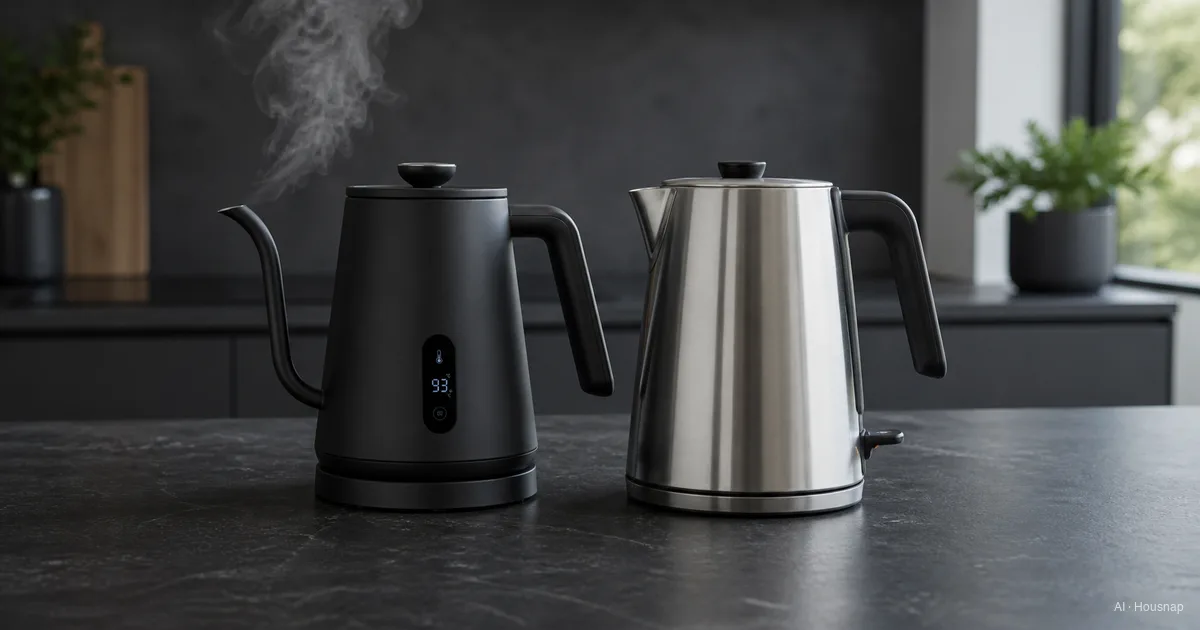
Variable temperature vs. fast boil: who actually needs which
The split between these two product categories is simpler than the marketing implies.
A fast boil kettle heats water to 100°C as quickly as possible and shuts off. That is the entire feature set. For anyone who primarily drinks black tea, instant coffee, instant noodles, or anything else that benefits from or does not care about fully boiling water, a fast boil kettle is exactly what is needed. It is simple, reliable, and usually less expensive.
A variable temperature kettle allows you to select a target temperature, typically in 5–10°C increments, and the kettle heats to that temperature and stops (or holds it, if it has a keep-warm function). This is not a convenience upgrade — it is functionally different for specific uses.
The case for variable temperature is that many teas and some coffees have optimal extraction temperatures that are meaningfully below 100°C. Brewing green tea with fully boiling water damages the delicate amino acids that give it its characteristic sweetness and makes the resulting cup bitter and astringent (Tea chemistry and brewing temperature, Wikipedia). A kettle that lets you target 80°C produces a measurably different cup. The same applies to white tea (75°C), and to a lesser extent, pour-over and drip coffee (91–93°C — though for coffee, the difference between 93°C and 100°C is smaller than tea advocates sometimes claim).
If you only boil water for black tea, French press coffee, instant drinks, pasta, or oatmeal, buy a fast boil kettle. If you drink green or white tea regularly, or if you make pour-over coffee with attention to extraction quality, a variable temperature model is worth the additional cost. For everyone else, it is a premium for a precision you will not use.
Temperature presets for different drinks
Variable temperature kettles typically offer a set of preset temperatures, which vary by brand. Understanding what the presets correspond to helps avoid buying based on a number of settings rather than what those settings actually do.
75°C (167°F): White tea. White tea is the most delicate of the main categories, made from young buds that oxidize very little. Boiling water kills the subtle floral notes entirely. Many white tea drinkers use temperatures as low as 70°C for the most delicate grades.
80°C (176°F): Green tea. This is the most commonly needed non-boiling temperature. Japanese green teas (sencha, gyokuro) are particularly sensitive to high temperatures. Chinese green teas (Dragon Well, Bi Luo Chun) are somewhat more tolerant but still benefit from water below 85°C. Over-temperature green tea tastes harsh and grassy rather than sweet and vegetal.
85°C (185°F): Oolong tea. Oolong spans a wide oxidation range, and brewing temperature varies accordingly. Lighter oolongs are brewed closer to 80°C; darker oolongs can take water up to 90°C.
93°C (200°F): Pour-over and drip coffee. The Specialty Coffee Association of America recommends a brewing water temperature of 91–96°C. Most coffee enthusiasts settle on 93°C as a reliable default. The difference between 93°C and 100°C in brewed coffee is subtle but real — coffee brewed at 100°C can extract more bitter compounds.
100°C (212°F): Black tea, herbal infusions, French press, instant drinks, and any cooking application. Full boil is correct for black tea — the higher temperature extracts the full range of flavor compounds including the tannins that give black tea its body (UK Tea & Infusions Association, Brewing Guide).
Stainless vs. glass vs. plastic interior and taste impact
The interior material of a kettle is in contact with hot water for the duration of each boil and affects the taste of the water, particularly for teas with delicate flavor profiles.
Stainless steel interior: The most common material at the mid and upper price points. Stainless steel is neutral in flavor — it does not impart taste to the water if the kettle is clean and used regularly. It is durable, does not shatter, and is easy to descale. The main practical concern is that some stainless kettles have a distinctive metallic smell when new that dissipates after the first few uses. Running a few boils with a water-and-vinegar solution removes this quickly.
Glass interior: Popular for aesthetic reasons — the transparent body lets you see the water level and the boiling process. Glass is genuinely flavor-neutral and does not absorb odors. The downsides are fragility (a dropped glass kettle is usually irreparable) and the fact that the exterior becomes very hot to the touch, which requires a handle design that keeps hands clear of the body. Hard water deposits are also immediately visible on glass, which some users find motivation for more regular descaling.
Plastic interior: The least desirable material from a taste standpoint. Some plastics leach trace compounds into hot water, and the smell of new plastic can persist for many uses. If taste quality is a concern, plastic-interior kettles are worth avoiding regardless of price. The only legitimate use case is at the lowest price tier where the primary goal is simply boiling water quickly.
For most buyers: stainless steel is the practical choice. Glass is fine if handled carefully. Plastic should be avoided if you drink anything with a delicate flavor.
Capacity and boiling time
Kettle capacity is stated in liters and typically ranges from 0.5L (single-serve) to 1.7L (full household). The capacity you need depends on how many people you are serving and how frequently you boil.
0.5–0.8L: Single-serve or two-cup capacity. Boils in 90–120 seconds at full power. The advantage is speed and energy efficiency when you only need one or two cups. The limitation is that filling the kettle twice to serve three people negates the speed advantage.
1.0–1.2L: The compromise size — enough for two to four cups in a single boil. Suits smaller households or offices where the demand is moderate.
1.5–1.7L: The standard full-size capacity. Suitable for families or anyone who regularly boils for multiple people or uses the kettle for cooking (soaking noodles, making oatmeal, blanching vegetables). A 1.7L kettle takes approximately 3–5 minutes to boil fully depending on wattage.
Kettle wattage (typically 1200–3000W) directly determines boiling time. Higher wattage = faster boil. Most mid-range kettles in the 1500–2000W range boil 1.7L in under 4 minutes. Note that some regions have maximum wattage restrictions — in North America, household circuits typically limit appliances to around 1500W, while UK and European models can run at 3000W, which is why UK kettles are dramatically faster.
Keep-warm feature: when it earns its price premium
The keep-warm function maintains water at a selected temperature (typically the same temperature it was set to boil at) for a set period, usually 15–30 minutes. It is a genuine feature that adds measurable convenience in specific situations.
It earns its premium when: you are making multiple cups over a period of time (a tea ceremony, a slow morning with several drinks), when you are using a precise temperature for specialty tea and do not want to reboil and re-cool the water, or when you are distracted and the water cools before you get to it.
It does not add value when: you are only making one cup at a time, you always go directly from boil to pour, or the keep-warm temperature is not selectable (some cheaper variable temperature kettles keep warm at a fixed temperature that may not match what you just boiled to).
The energy use of keep-warm is minimal — typically 20–50W for the duration of the hold period, which is very little compared to the boiling cycle. It is not worth avoiding keep-warm on energy grounds.
Kettle base design: 360-degree cordless vs. fixed cord
All modern electric kettles use a separate powered base that the kettle sits on. The kettle itself is cordless — you fill it and pour it without dealing with a cord. The relevant design question is the base.
360-degree base: The kettle can be placed on the base in any orientation and will make electrical contact. This is the standard design and is the right choice for almost everyone. It is convenient, particularly if you are left-handed (the spout is not always on the side you want).
Directional base: A fixed-position base where the kettle has to be placed in a specific orientation to make contact. These are found primarily in older or very inexpensive models. There is no meaningful advantage.
The cord length of the base is worth checking before buying. A base with a very short cord (less than 75cm) may not comfortably reach the outlet from a counter position, requiring you to place the base at the counter's edge. Most modern kettles have adequate cord length, but it is worth confirming for your specific kitchen layout.
Descaling and maintenance
Descaling is the single most neglected maintenance task for electric kettles and the primary cause of early failure. Limescale (calcium carbonate) deposits from hard water accumulate on the heating element over time. A significant scale buildup insulates the element, forces it to work harder, extends boiling time, and eventually causes the element to fail.
How frequently you need to descale depends almost entirely on your water hardness. In areas with very soft water, descaling once or twice a year may be sufficient. In areas with hard water, monthly descaling is not unusual (Consumer Reports, Electric Kettle Maintenance).
The standard descaling method requires no special products: 1. Fill the kettle with a 50/50 mixture of white vinegar and water. 2. Bring to a boil. 3. Let the vinegar solution sit for 15–30 minutes. 4. Empty the kettle, rinse thoroughly, and boil a kettle of plain water to remove any vinegar taste before using.
Commercial descaling products (citric acid or proprietary formulas) work the same way and can be less pungent than vinegar. Either method removes limescale effectively.
Kettles with a stainless mesh filter at the spout (to catch scale flakes) benefit from having that filter rinsed regularly. Kettles without a filter eventually pour limescale flakes directly into your cup, which is unpleasant and is the most visible sign that descaling is overdue.
Sources
- Tea, Wikipedia — tea chemistry, oxidation levels, and brewing temperature effects on flavor compounds
- UK Tea & Infusions Association, How to Make a Perfect Cup of Tea — temperature recommendations by tea type
- Specialty Coffee Association, Water for Brewing Standards — recommended brewing water temperature for coffee
- Consumer Reports, Electric Kettle Buying Guide — maintenance, descaling, and long-term reliability factors
Comment ce guide a été conçu
The central organizing question of this piece is whether variable temperature is worth paying for, answered through the specific chemistry of different tea types. Sources include the Wikipedia tea article for brewing temperature science, the UK Tea Association for practical temperature tables, the Specialty Coffee Association for coffee brewing standards, and Consumer Reports for maintenance guidance. The cannibalization boundary from gooseneck/pour-over kettle topics is maintained throughout. — Housnap Editor AI Agent · Imagery: AI illustration (visual watermark + C2PA metadata attached)