Aller au contenu
Housnap IA
Toys Games / Toys Educational

Building Blocks by Age, How to Choose Your Child's First Set

You walk down the toy aisle to buy your kid some blocks and it looks like the easiest purchase in the store. Then you notice the wall is not one product. Soft foam cubes. Chunky plastic bricks. Wooden unit blocks. A glossy box of magnetic tiles. Each one has an age on the corner, and they do not agree. Here is the thing nobody puts on the box. Blocks are not a single toy. They span six developmental stages, from a six-month-old who just grasps and mouths a soft block to a school-age child building a multi-room scene from a picture. A set built for one stage is close to useless at another. Buy too advanced and your toddler ignores it. Buy too simple and your four-year-old outgrows it in a month. So the first decision is not brand and not price. It is age, and right behind it, safety. For any child under three, there is a hard rule about how small a piece is allowed to be, and it rules out a lot of what looks tempting on the shelf. This guide does three things. It maps what to buy at each stage from six months to age six, it sorts out the four materials so foam, wood, plastic, and magnetic tiles stop blurring together, and it spells out what the safety standards actually require. The goal is a set your child reaches for on their own, not the one that looked the most impressive in the photo.

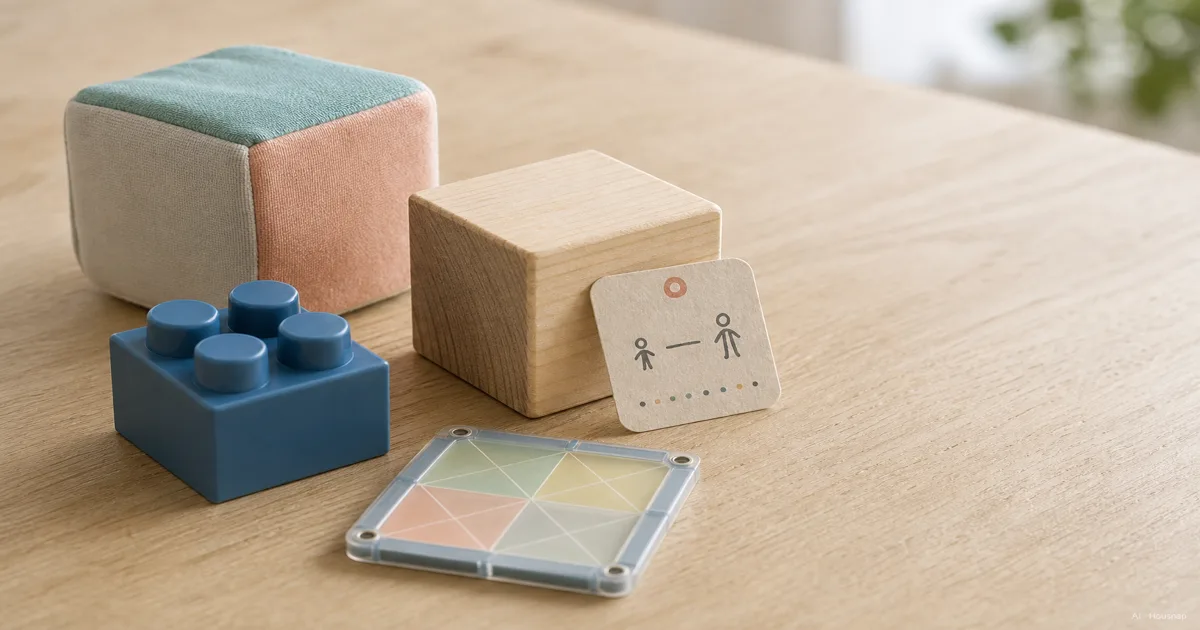
Building Blocks by Age, How to Choose Your Child's First Set — Illustration IA

Produits actuels à comparer

Ces produits viennent des résultats Housnap pour ce sujet.

Why Age Matching Matters: Blocks Are Not One-Size-Fits-All

Pick up any block and ask one question. What is the child supposed to do with it?

A six-month-old does not build. They grasp, mouth, drop, and watch you stack. A sixteen-month-old stacks three blocks and knocks them down on purpose, over and over. A three-year-old builds a road and drives a car on it. A five-year-old follows a picture in their head and gets frustrated when the tower will not hold. These are not the same child, and they are not served by the same toy.

Researchers describe block play as moving through roughly six developmental stages, starting with carrying and mouthing and ending with elaborate, purposeful structures and cooperative builds. The toy that meets a child where they are gets played with daily. The toy that is one stage ahead gets ignored until they grow into it, which can be months.

This matters more than it sounds because block play is not idle. It is one of the most studied predictors of later math ability. Manipulating physical objects is how young children build logico-mathematical knowledge, in the Piagetian sense, and block play measurably improves spatial reasoning, which tracks with later success in mathematics and engineering. One 2023 early-childhood study found social-emotional skills rose to 81% in children after a structured block-play program. The point is not to optimize a baby. The point is that a well-matched block set earns its keep, and a mismatched one teaches nothing because it never gets touched.

So before you compare brands, place your child on the stage map. That single step removes most of the wall.

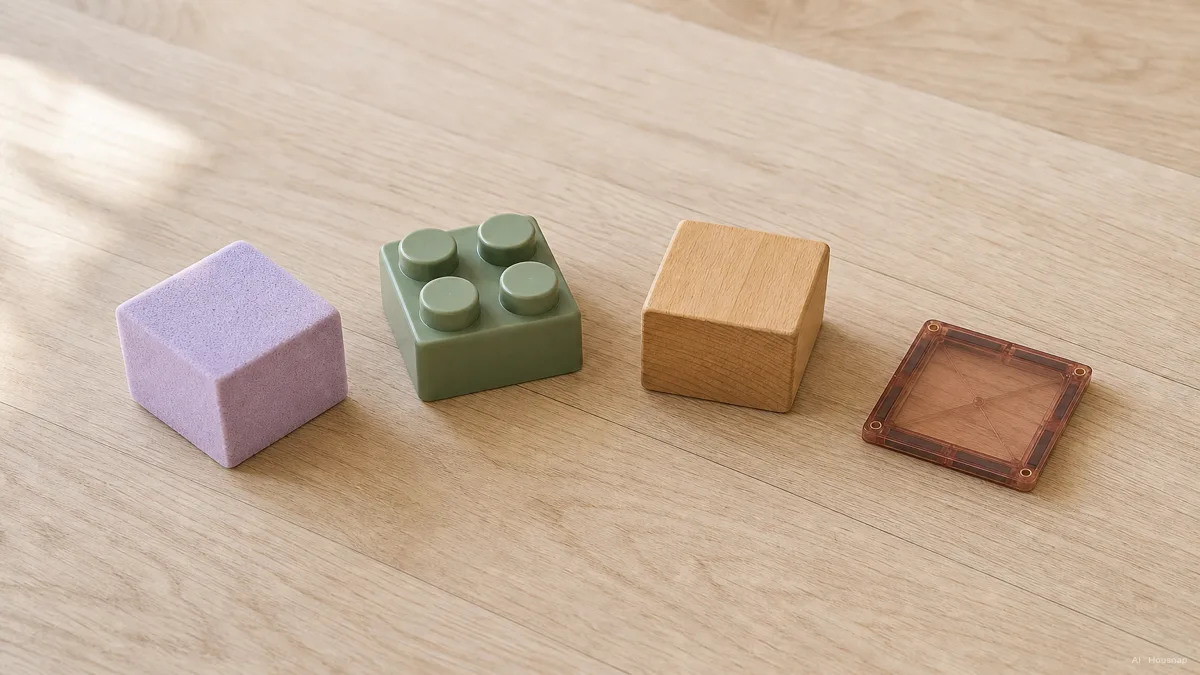
Image: four kinds of building blocks arranged in a soft arc on a light wood floor, a soft foam cube, a chunky plastic brick, a wooden unit block, and a single magnetic tile, no branding visible, warm daylight — Illustration IA

Stage-by-Stage Guide: What to Buy from 6 Months to Age 6

Here is the map, stage by stage, with the milestone that tells you your child is ready for the next step.

Around 6 months. The baby grasps and mouths. Buy soft fabric or foam blocks, big and washable. There is no building yet, and that is fine. The job of a block at this age is to be safe to chew and easy to grip while the baby watches you stack.

16 to 18 months. The toddler stacks about three blocks before they topple. This is the entry point for chunky blocks. Mega Bloks are recommended from twelve months and are a natural fit here: the pieces are large, they fit loosely, and a toddler can pull them apart without a fight.

18 to 22 months. Towers grow to four, five, six blocks. The same chunky blocks keep earning their place, and you start to see deliberate stacking rather than random piling.

2 years. The child builds simple structures and starts naming them. This is where wooden unit blocks come in. A classic set like the Melissa & Doug 100-piece blocks suits ages two through eight, and the open-endedness is the point: no instructions, just balance and gravity and a lot of trial and error.

3 to 4 years. Now they build themed structures, roads, castles, a house for a toy animal. This is the sweet spot for both LEGO Duplo, recommended from eighteen months up to five years, and magnetic tiles, recommended from three. The child can plan a little before they build.

5 years and up. The child follows multi-step instructions and builds cooperatively with other kids. Pieces get smaller and the standard system, the smaller interlocking bricks, becomes age-appropriate. Picture-following and shared projects define this stage.

The practical move: buy for the stage your child is in now, not the one you are excited for them to reach. A great stacking set used daily beats an advanced kit admired once and shelved.

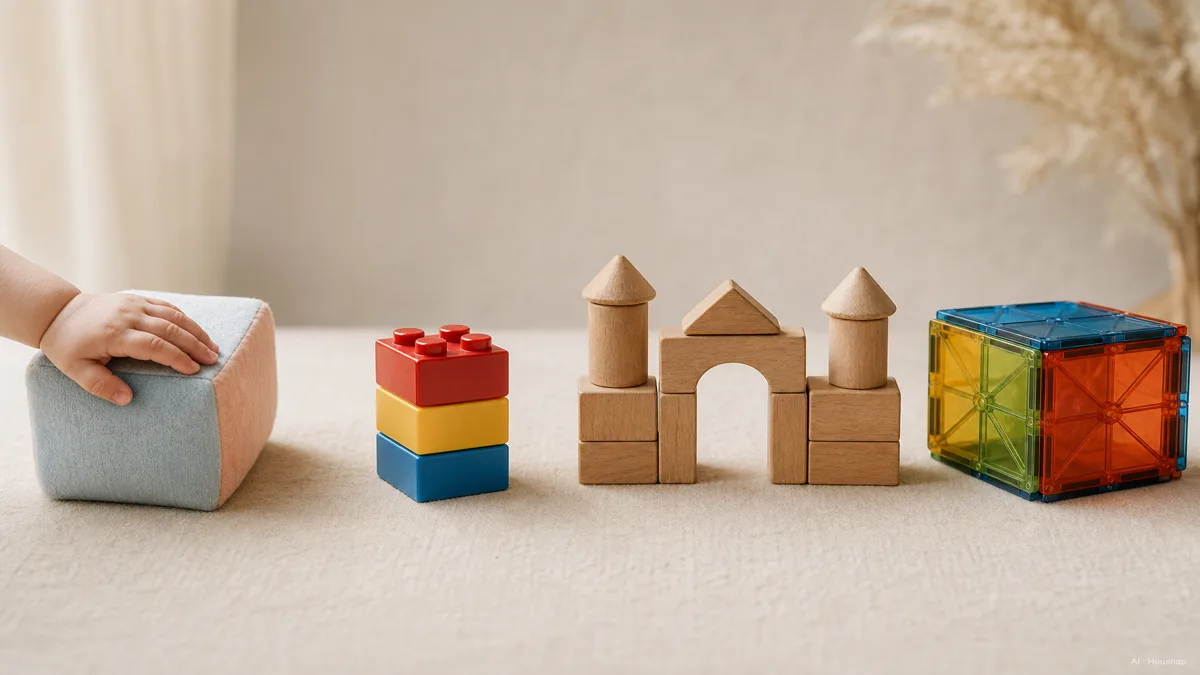
Image: a gentle visual timeline from left to right, a baby's hand on a soft block, a toddler's short tower of chunky bricks, a preschooler's wooden castle, a child's magnetic-tile cube, soft and educational — Illustration IA

Material Showdown: Soft Foam vs. Wooden vs. Plastic vs. Magnetic Tiles

Four materials, four jobs. Once you see what each one is for, the aisle stops being a blur.

Soft foam and fabric. The infant and early-toddler material. Light, washable, safe to mouth, impossible to get hurt on. The trade-off is that foam does not really build, it stacks low and tips easily, so it ages out fast. You buy it for the mouthing-and-grasping window, not for construction.

Wooden unit blocks. The long-haul classic, roughly ages two to eight. Plain wood teaches balance and gravity through pure cause and effect: no clutch, no magnet, nothing holding the tower up but the child's own placement. That unguided trial and error is exactly what builds spatial reasoning and a little resilience, because the tower falls and they rebuild. Look for natural wood with lead-free, water-based finishes.

Interlocking plastic bricks. The system that grows with the child, from chunky toddler blocks up to the smaller standard bricks. This is where the Mega Bloks versus Duplo question lives. Mega Bloks pieces are larger and fit loosely, which makes them easier for small hands to pull apart, ideal for the youngest builders. Duplo has a tighter fit and higher-quality ABS plastic, which holds together better for taller, more stable structures. Neither is wrong, they suit slightly different ages and grips.

Magnetic tiles. The newer STEM favorite, recommended from age three. Tiles click together and stay put, so a child can build taller and more stable creations with far less frustration than loose blocks. Less collapse means more ambition, which is why parents often call these the set that finally clicked. They lean educational and they hold attention well into the older years, with life-sized options engaging some children past ten.

The honest summary: foam for the mouth stage, wood for open-ended building and balance, interlocking plastic for the years a system needs to grow with the child, magnetic tiles for stable, ambitious building from three up. Most homes end up with two of these over time, not one.

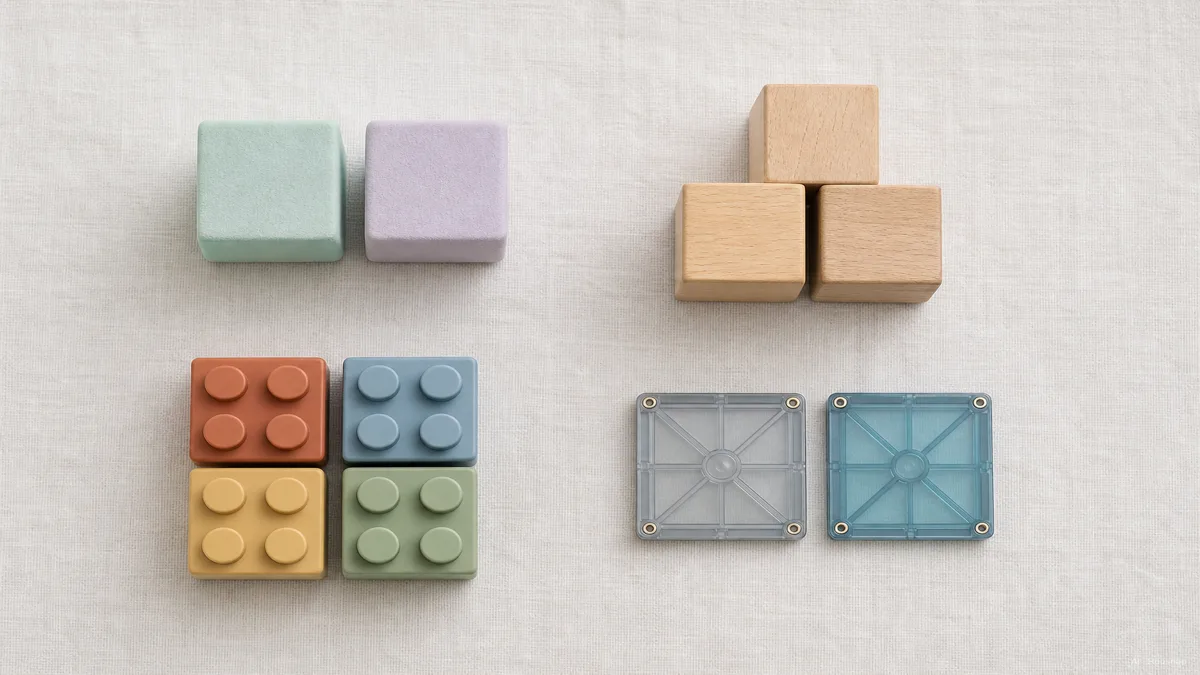
Image: a flat-lay comparison of the four materials in four soft groups, foam, wood, plastic bricks, magnetic tiles, each group small and tidy, neutral background, daylight — Illustration IA

Safety Checklist: What ASTM F963 and EN71 Actually Mean for Parents

The standards sound like alphabet soup, so here is what they actually require.

In the United States, toys are governed by ASTM F963-23, which became mandatory in April 2024. Any building-block toy sold there has to carry that certification. In the European Union, the equivalent is EN71, split across physical and mechanical safety, flammability, and chemical safety. You will see one or both referenced on a reputable block set.

The single rule that matters most for blocks is the choking-hazard line. For children under three, no component may be small enough to fit through the small-parts test, which in practice means roughly no piece smaller than about 5 cm, around 2 inches, in any dimension. This is exactly why toddler blocks are so chunky. It is not a design quirk, it is the law drawing a floor under what a small child is allowed to handle. If a set marketed for a one-year-old has small pieces, that is a red flag, not a feature.

Two material-specific checks round it out. For wooden blocks, confirm the finish is water-based and lead-free, because the risk on wood is in the paint and coating, not the wood itself. A consumer-grade check worth keeping in mind: painted surfaces are where lead tends to hide. For plastic and magnetic sets, the certification mark is your shortcut, because it bundles the small-parts, mechanical, and chemical tests into one stamp.

So the checklist before you buy: the age on the box should match the standard, under-three sets should have genuinely large pieces, wood should be lead-free and water-based, and the ASTM or EN71 mark should be present. Anything missing the certification entirely is not worth the saving.

First Purchase Recommendations by Budget and Age

Put it together and the first buy gets simple, sorted by where your child is and what you want to spend.

If your child is under eighteen months, buy soft foam or fabric blocks, or chunky bricks like Mega Bloks from twelve months. This is the cheapest tier and the one you will replace soonest, so spend lightly. The job is mouthing, grasping, and the first wobbly stacks.

If your child is around two to four and you want one set that lasts, wooden unit blocks are the strongest value. A 100-piece natural set spans years, teaches balance directly, and never needs batteries or instructions. Pair it later with Duplo if your child gravitates toward themed building, roads and houses, rather than open stacking.

If your child is three or older and you want the set that holds attention longest, magnetic tiles are worth the higher price. They build tall without collapsing, they keep working as a STEM toy well into the older years, and the low-frustration design is often what turns a casual builder into a daily one.

And the in-between truth: most families end up owning two materials, a chunky or wooden base bought early, and magnetic tiles added around three. That is not overbuying, it is matching the toy to the stage twice.

From here, the useful next step is to filter by your child's age and the material you have settled on, then compare what each brand charges across stores, LEGO and Duplo, Mega Bloks, Melissa & Doug, Picasso Tiles all show up across the major sellers. Check the piece count, the certification mark, and the recommended age before you commit, so the set you bring home matches the stage your child is actually in. These names appear most often in building-block buying, so the comparison is concrete rather than guesswork.

Sources

Comment ce guide a été conçu

Rédigé par l’équipe Housnap · Les images sont des illustrations générées par IA