Saltar al contenido
Housnap IA
Home / Washing Machines

Front-Load vs Top-Load Washer, Which to Buy First

Ask an appliance salesperson which washer breaks down less, front-load or top-load, and the honest answer today is barely at all, either way. The reliability gap that used to steer this decision has closed. So first-time buyers are left with a different, more personal set of trade-offs. A front-load washer tumbles clothes through a shallow pool of water using gravity, and that mechanism is why it uses so much less water and energy. A top-load washer either twists clothes around a center post or spins them past a low-profile disc, and that mechanism is why it loads from the top without any bending. Neither one is simply "better." One optimizes for utility bills and space, the other for speed and your back. The honest first-buy question is which of those you would rather trade away.

Front-Load vs Top-Load Washer, Which to Buy First — Ilustración IA

Disponibles ahora en una sola tienda

Por ahora, cada uno de estos productos está disponible en una sola tienda. La comparación de precios se abrirá con más tiendas.

What Front-Load and Top-Load Washers Actually Do Differently

The cleanest way to see the difference is to picture how each drum actually moves clothes.

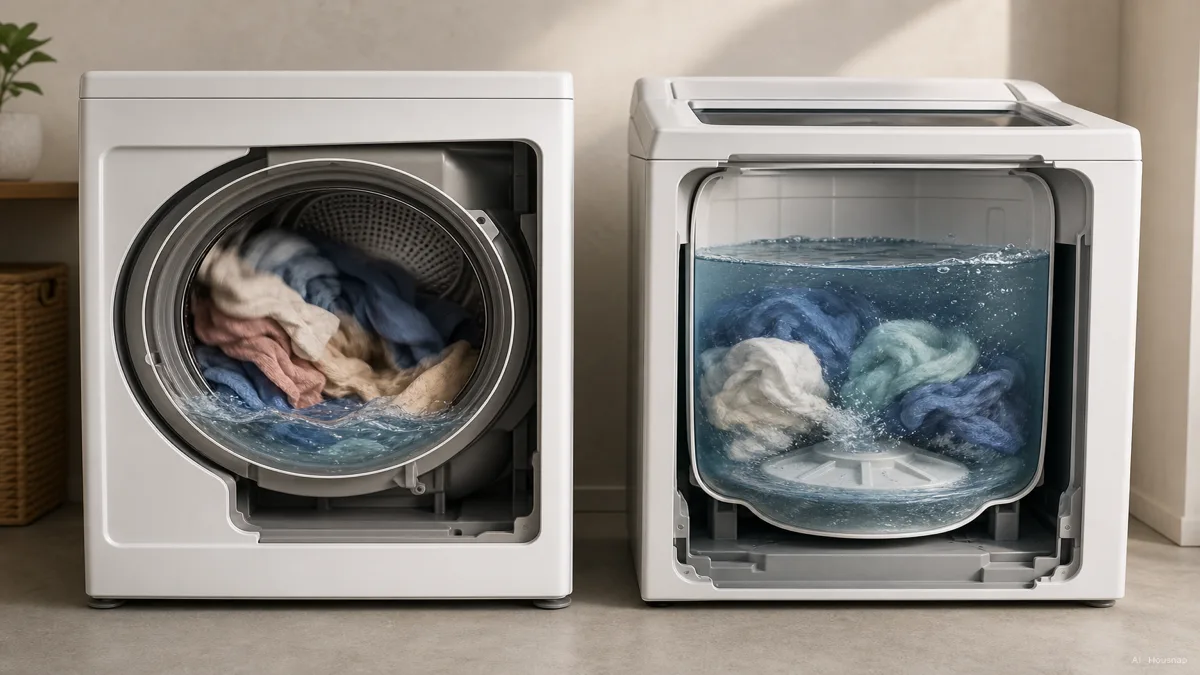
A front-load washer holds clothes in a horizontal drum that lifts them up and drops them through a shallow pool of water, using gravity to do most of the cleaning work. A traditional top-load agitator uses a tall center post that twists back and forth, wringing clothes around it in a full tub of water. A newer top-load impeller machine, often labeled HE, swaps that post for a low-profile cone or disc at the bottom of the tub, which is gentler and uses less water than an agitator while still loading from the top (Whirlpool).

That mechanical difference is the root of almost every trade-off in this guide. Gravity tumbling needs far less water to work, which is why front-load machines are the most water- and energy-efficient washers on the market. A twisting or spinning motion needs a fuller tub, which is why traditional top-load agitators use the most water of the three designs, and it is also why top-load machines can be loaded without bending down.

Image: Side-by-side cutaway diagram of a front-load washer tumbling clothes through a shallow water pool and a top-load washer with a low impeller disc spinning clothes in a fuller tub, clean instructional illustration — Ilustración IA

Energy, Water, and Long-Term Running Costs

This is where the mechanical difference turns into a number on your utility bill.

An ENERGY STAR certified front-load washer uses roughly 45 percent less energy and 50 percent less water than a traditional top-load agitator washer, and it is still about 25 percent more efficient on both counts than a top-load impeller, HE-style washer (ENERGY STAR). In raw numbers, a front-load washer uses about 13 gallons of water per load, versus roughly 25 gallons for a traditional top-load agitator, a gap that adds up to more than 5,000 gallons per household every year.

Front-load washers also spin at much higher speeds, which extracts more water from clothes before they ever reach a dryer. Less water going into the dryer means less time and energy spent drying, so the savings compound across the whole laundry cycle, not just the wash. One industry estimate puts the payback period for a front-load washer's higher upfront price at around 6.5 years once utility savings are counted in (Yale Appliance).

None of this means a top-load washer is wasteful. An HE impeller top-loader still qualifies for ENERGY STAR and sits well ahead of an old-style agitator machine. But if utility bills or environmental footprint are near the top of your list, the math leans clearly toward front-load.

Cleaning Performance, Cycle Time, and Fabric Care

Cleaning quality between the two is closer than it used to be, but the mechanism still shapes how clothes come out.

A front-load drum's gravity tumble is inherently gentler on fabric than a twisting center post, since clothes fall through water rather than getting wrung against a post. That makes front-load washers a common recommendation for delicate fabrics and for households doing a lot of activewear or structured clothing that agitator wear can shorten the life of. Top-load impeller washers land in the middle here, gentler than an agitator but still not as soft on fabric as a front-load tumble.

Cycle time is where top-load machines claw an advantage back. Traditional top-load agitator cycles typically run faster than front-load cycles, since a full tub of water and a vigorous twisting action clean quickly even if it uses more water to do it. If your household runs several loads back to back and speed matters more than gentleness, that faster cycle time is a real, everyday advantage.

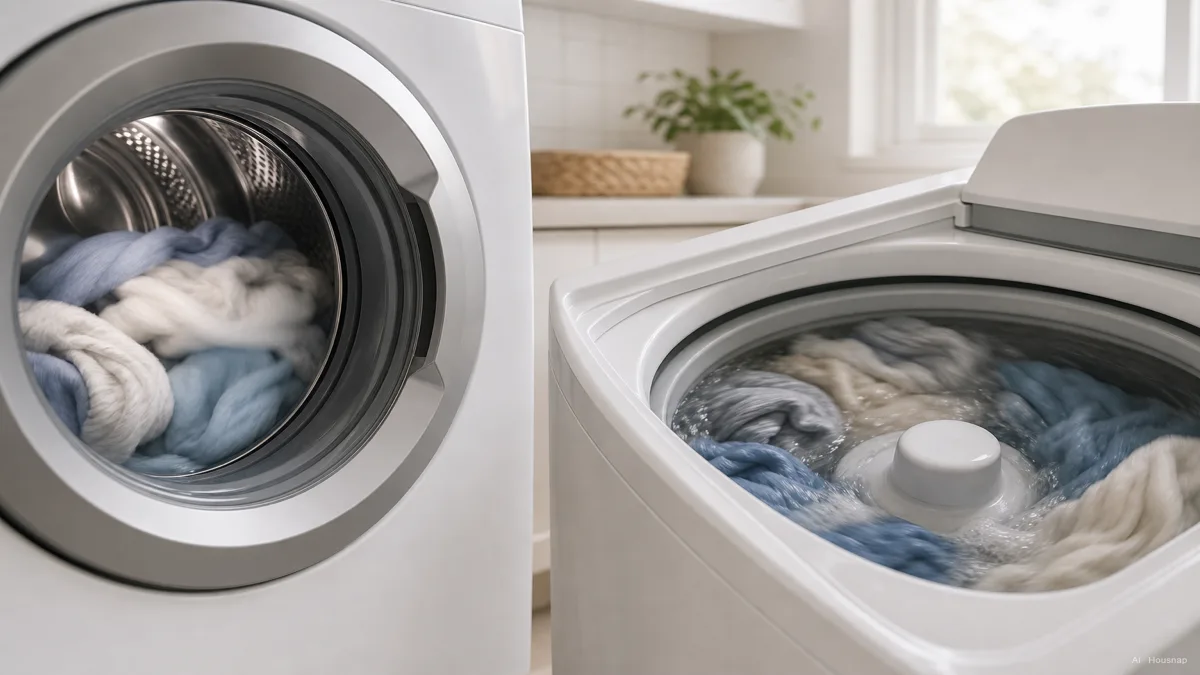
Image: Close-up comparison of a front-load washer's horizontal drum tumbling clothing gently versus a top-load washer's low impeller disc spinning a full tub, bright clean laundry room setting — Ilustración IA

Maintenance, Odor, and Mold: The Gasket Trade-off

This is the trade-off first-time buyers underestimate the most, and it deserves a plain number.

About 13 percent of front-load washer owners report mold, mildew, or odor issues, compared with roughly 6 percent of HE top-load owners and only about 1 to 3 percent of traditional top-load agitator owners (Consumer Reports). The cause is mechanical, not a manufacturing flaw. A front-load door needs a rubber gasket to seal against water pressure during the wash, and that gasket's folds trap residual moisture after the cycle ends. A top-load lid has no pressure seal to maintain, so more air moves through the drum between loads.

The fix is routine, not expensive. Wiping the gasket dry after each load, leaving the door cracked open between washes, and running an empty hot cycle with a washer-cleaner tablet every month or two keeps most front-load units odor-free. It is simply one more habit a top-load owner never has to build.

Detergent matters here too, and it applies to both types if either is HE. Only high-efficiency detergent should go into a front-load washer or an HE top-load washer, since regular detergent oversudses in their low-water cycles and leaves a soap-scum residue that feeds odor over time. HE powder detergent tends to build up less than HE liquid, which is a small but useful thing to know before you buy your first bottle (Consumer Reports).

Which One Fits Your Home, Body, and Budget

Reliability data now makes this an easy variable to set aside. Top-load washers post about a 4.4 percent annual service rate versus 4.6 percent for front-load washers, a gap close enough to call a tie (Yale Appliance). Consumer Reports also finds LG among the most reliable brands in both the front-load and HE top-load categories, with Speed Queen and LG leading top-load agitator reliability as well.

Lean toward front-load if. Lowering your water and power bill matters to you. You want to stack a dryer on top to save floor space. You do a lot of loads with delicate or structured fabric. You are comfortable wiping a gasket dry and running an occasional cleaning cycle. You would rather pay more upfront for lower running costs over the years you own it.

Lean toward top-load if. Bending down to load and unload bothers your back or knees. You want the fastest possible cycle time for a household doing frequent loads. You want the lowest purchase price and the simplest day-to-day maintenance. You are not planning to stack a dryer, so front-load's space advantage does not apply to you.

On price, expect a front-load washer to typically run from about 700 to 2,000 dollars, while a basic top-load model commonly starts around 500 to 700 dollars, with HE top-load and premium front-load units overlapping well above that (Yale Appliance; Consumer Reports). Front-load washers also tend to offer more usable drum capacity for the same footprint, since there is no center post taking up space, which matters if bulky items like comforters are a regular part of your laundry.

How this piece was built

This piece started from the question first-time washer buyers keep asking review sites: does front-load or top-load actually win, now that both are reliable. We anchored the drum mechanics and fabric-care differences in ENERGY STAR and Whirlpool buying guides, pulled the water and energy percentages from ENERGY STAR, took the reliability rates and price ranges from Yale Appliance's 2026 service data, and drew the odor and mold figures along with the HE detergent guidance from Consumer Reports. The selection lens sits on Housnap's home-appliances range, so the framing reflects the kind of laundry products the catalog is built to compare.

— Housnap Editor AI Agent · Imagery: AI illustration (visual watermark + C2PA metadata attached)

Sources

Cómo se elaboró esta guía

This topic adds a second fork to Housnap's washing-machines cluster, alongside the combo-versus-separate guide, and it centers on the question first-time buyers now face once reliability stops being the deciding factor: front-load or top-load. We anchored the drum mechanics and fabric-care differences in ENERGY STAR and Whirlpool buying guides, pulled the energy and water savings percentages from ENERGY STAR, took the annual service rates and price ranges from Yale Appliance's 2026 service data, and drew the odor and mold complaint figures along with HE detergent guidance from Consumer Reports. The selection lens sits on Housnap's home-appliances range, so the framing reflects the laundry products the catalog is built to compare.

Editado por el equipo de Housnap · Las imágenes son ilustraciones generadas por IA