Separate clothes that need flat drying
Before loading the rack, check each garment’s drying instructions. GINETEX explains that care symbols guide the care of the particular textile; room layout does not override those instructions.
Put garments marked for flat drying aside and reserve a suitable flat surface. Brabantia’s guidance for a woollen jumper is to roll it in a dry towel, press gently and then dry it flat. Do not turn a flat-drying garment into a hanging one simply to free up floor space.
If the item is cashmere and you also need washing instructions, follow the cashmere washing and drying guide.
Choose the position with the rack fully open
GCHA recommends a warm, well-ventilated location and explains that opening windows helps moisture escape. A corner that fits the folded rack may be unsuitable once its wings and laundry are spread out.
For this layout, check the space with the empty rack fully open:
- Keep the route through the room usable and check that doors can open.
- Leave ventilation grilles accessible rather than covering them with hanging fabric.
- Check that you can reach and operate the window without moving wet clothes.
Use an existing tape measure to compare the available space with the rack’s open dimensions. Include the clothes that will hang beyond its frame; buy a measuring tool only if you lack one. Brabantia specifically advises measuring the proposed location and considering whether the loaded rack needs to move.
Keep clothes off radiators. GCHA notes that drying directly on them can reduce heating efficiency; a radiator is not extra rack capacity.
Load for gaps, not for occupied rails
Brabantia advises spacing garments apart and avoiding layers folded over one another. Start with the largest pieces, then place smaller items where their fabric remains separate.
- Smooth each garment before hanging it, as the manufacturer recommends to reduce creasing.
- For suitable garments, use laundry pegs rather than doubling the whole item over a rail. Reuse pegs you already own and check that the garment permits this hanging method.
- Look at the loaded rack from the side. Separate touching sleeves and hems, and leave a rail unused where that creates a useful gap.
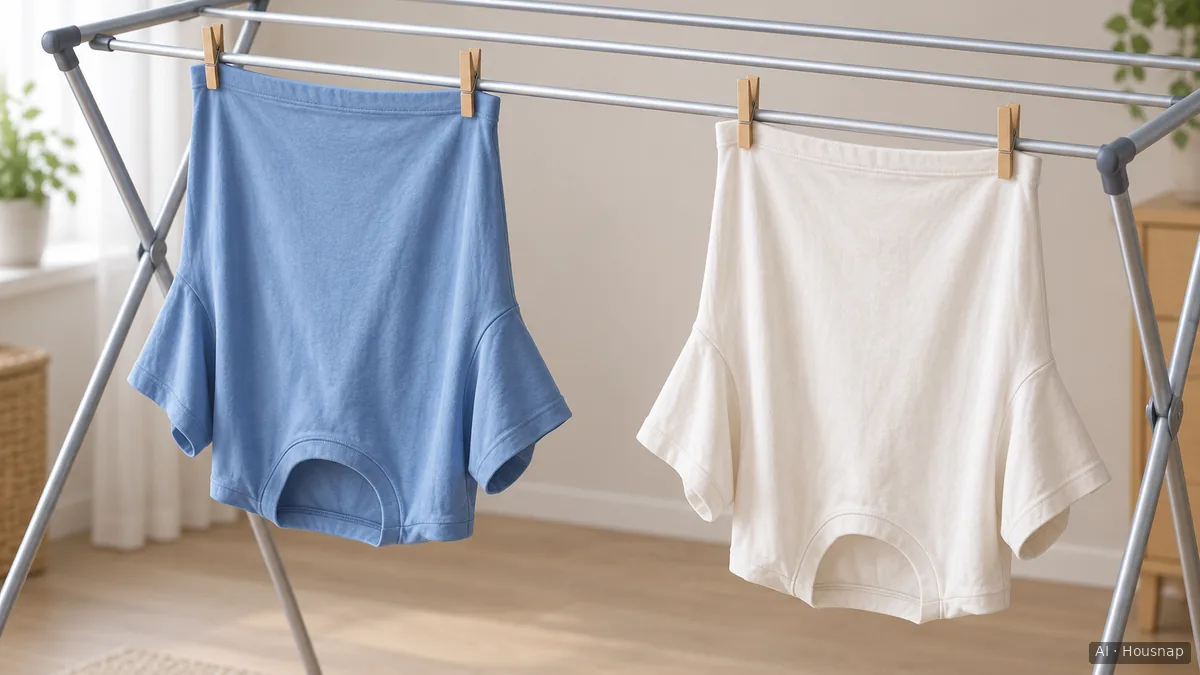
The illustration shows the spacing principle, not a tested minimum distance. If the clothes still form a dense curtain, reduce the batch. An empty rail can be more useful than another layer of wet fabric.
Check the clothes and the room separately
At your next check, inspect folds, cuffs and thick seams rather than judging the whole load from one dry corner. Reposition overlapping fabric and remove dry items to free space for those still drying. This is a practical checking sequence, not a promised drying time.
If the room remains damp, revisit how moisture can leave it. GCHA describes dehumidifiers as a way to reduce airborne moisture, but it also asks residents to report damp or mould concerns. Persistent signs warrant attention from the housing provider or an appropriate building professional, rather than repeated rearrangement alone.
For regular indoor drying where you are considering a machine, the desiccant versus compressor dehumidifier guide explains how to compare room temperature, extraction conditions and placement requirements before buying.
Cómo se elaboró esta guía
This guide was written by Housnap AI using Brabantia’s indoor-drying guidance, GINETEX’s care-label information and GCHA’s resident advice. The loading sequence and room-layout checks are editorial applications of those sources, not original drying tests or a guarantee against damp.